Adjustment of Culling Range Proportional to AI Risk
Reducing Wild Boar Population to Suppress ASF, etc.
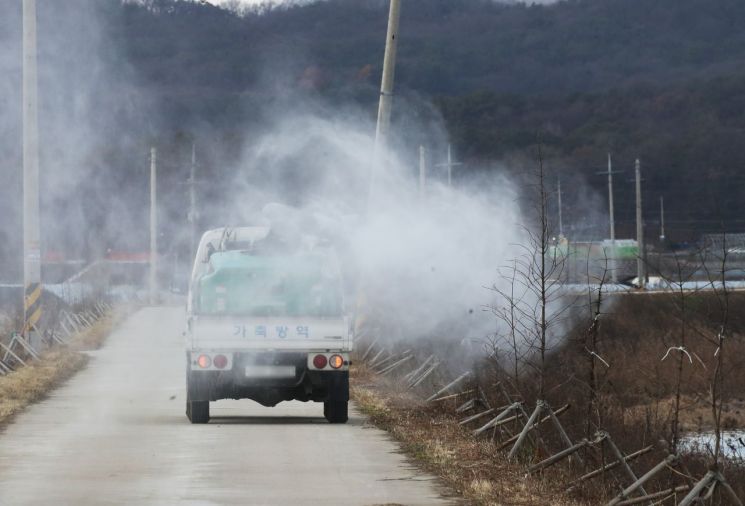 On November 23 last year, an Icheon Livestock Cooperative quarantine vehicle was conducting avian influenza (AI) prevention around Bokhacheon in Huan-ri, Hobeop-myeon, Icheon-si, Gyeonggi-do. (Image source=Yonhap News)
[Sejong=Asia Economy Reporter Moon Chaeseok] The Ministry of Agriculture, Food and Rural Affairs announced on the 19th that it plans to conduct stricter inspections of farm biosecurity measures to prevent the spread of highly pathogenic avian influenza (AI) and African swine fever (ASF).
According to the Ministry, there have been 21 cases of highly pathogenic AI in poultry since November 8 of last year. This is 69% fewer than the 68 cases during the same period the previous year, reflecting improved farm biosecurity levels and a decrease in highly pathogenic AI cases among wild birds. The scale of culling to prevent AI spread has also significantly decreased. The number of chickens culled was 1,615, a 90% reduction compared to 16,373 during the same period a year ago, and ducks culled were 267, an 85% decrease from 1,752 in the previous period.
However, as of last month, there were 1.73 million migratory birds residing domestically, 10% more than the 1.57 million in the same month last year, and since migratory birds begin moving northward from February, poultry farms need to maintain vigilance. Especially, while H5N1-type highly pathogenic AI has been mainly occurring in Europe recently, Japan has seen a high frequency of H5N8-type cases, making it possible for both types to be additionally introduced into Korea. The Ministry explained, "Based on past cases, when multiple AI types occur, it can lead to large-scale infections over a long period, so we cannot afford to loosen biosecurity measures."
The Ministry plans to continue precise biosecurity measures by assessing AI risk every two weeks and adjusting the scope of preventive culling proportionally to the risk level at each point. From 2020 to 2021, the preventive culling radius was within 3 km of the outbreak farm, but now it is operated at about 500 m (1 km for ducks). Utilizing local governments and central inspection teams, the Ministry will intensively inspect biosecurity conditions in special management areas for laying hens, manure and fertilizer companies, traditional markets, migratory bird habitats, and disinfection status on National Routes 3 and 38.
Regarding ASF, no additional cases have been reported in pig farms since the outbreak in Inje-gun, Gangwon Province, on October 5 last year. However, pig farms are densely located in eastern Gyeonggi and northern Chungbuk and Gyeongbuk, adjacent to the wild boar ASF detection areas of Danyang and Jecheon in Chungbuk, requiring preemptive measures. The Ministry plans to collaborate with the Ministry of Environment to reduce the wild boar population as much as possible by March to lower habitat density and suppress virus spread. It will also promote mandatory installation of biosecurity facilities such as quarantine rooms and internal fences at pig farms nationwide.
Kim Injoong, Deputy Minister of the Ministry of Agriculture, Food and Rural Affairs, said, "With increased movement of vehicles and people during the Lunar New Year holiday, concerns about the spread of highly pathogenic AI and ASF will grow," urging, "Farms should thoroughly disinfect facilities, and visitors should refrain from visiting farms during the holiday period."
© The Asia Business Daily(www.asiae.co.kr). All rights reserved.
![User Who Sold Erroneously Deposited Bitcoins to Repay Debt and Fund Entertainment... What Did the Supreme Court Decide in 2021? [Legal Issue Check]](https://cwcontent.asiae.co.kr/asiaresize/183/2026020910431234020_1770601391.png)















