[Asia Economy Reporter Kim Jin-ho] Ko Seung-beom, Chairman of the Financial Services Commission, stated that he is considering an additional extension of the maturity extension and interest repayment deferral measures for small business loans, which are set to expire at the end of March. Taking into account the COVID-19 quarantine situation, the aim is to establish "sufficient safeguards" so that self-employed individuals do not face a sudden lump-sum repayment burden. This is interpreted as a step back from the original principle of "ending at the end of March."
On the 19th, at the 'Small Business Debt Risk Review Meeting' held at the Bankers' Hall in Myeong-dong, Seoul, Chairman Ko said, "While the principle is to end at the end of March, we will make a final decision considering the COVID-19 quarantine situation and the monitoring results of financial sector soundness until the end date."
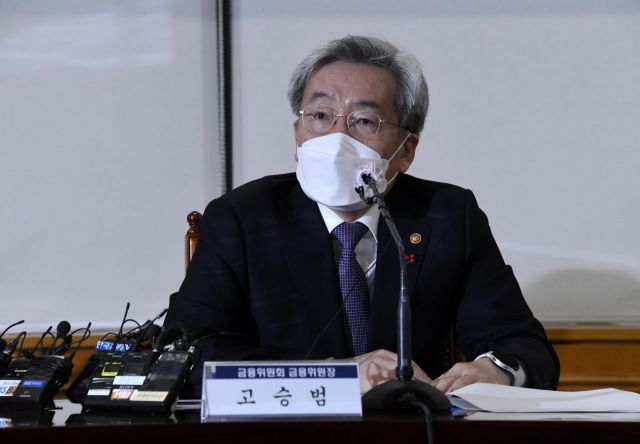 Financial Services Commission Chairman Ko Seung-beom is delivering opening remarks at a meeting to review small business debt risks held on the 19th at the Korea Institute of Finance in Jung-gu, Seoul. Photo by Hyunmin Kim kimhyun81@
Attending the meeting were Chairman Ko, Lee Chan-woo, Senior Deputy Governor of the Financial Supervisory Service, Lee Sang-hyun, Deputy Governor of the Bank of Korea, Seo Jeong-ho, Deputy Director of the Korea Institute of Finance, Nam Chang-woo, Deputy Director of the Korea Development Institute (KDI), and Hong Woon-sun, Deputy Director of the Korea Institute of Small and Medium Business (KISMB).
Chairman Ko diagnosed, "The deadline for the maturity extension and interest repayment deferral measures is approaching in two months. The progression of COVID-19 remains fluid, and economic and financial conditions are challenging due to domestic and international interest rate hikes and early tightening in the U.S."
He added, "We will consider the optimal timing and method regarding the maturity extension and interest repayment deferral measures in a situation where the capacity of self-employed individuals to respond to crises and the strengthening of risk management due to monetary policy normalization are in conflict."
Furthermore, Chairman Ko said that during the normalization process, "sufficient safeguards" will be put in place to prevent self-employed individuals from experiencing a sudden lump-sum repayment burden. He stated, "Together with the Financial Supervisory Service, we are conducting a micro-analysis of the management and financial status of self-employed individuals as if taking an MRI scan. Based on this, we will review customized measures."
He also emphasized that to minimize potential non-performing loans in the financial market and industry, if necessary, bold and preemptive debt restructuring will be implemented to ensure "soundness management." He urged financial institutions to sufficiently expand their loss absorption capacity, such as loan loss provisions, considering the possibility of negative shocks caused by non-performing loans in self-employed loans.
Most economic and financial experts attending the meeting shared Chairman Ko's views. Nam, Deputy Director of KDI, suggested, "Due to strengthened social distancing, the sales recovery of small businesses is delayed. We should consider an additional extension of the maturity extension and repayment deferral measures." He added, "If necessary, shortening the extension period from six months to three months and sequentially implementing support target restrictions and phased termination could also be a method."
Hong, Deputy Director of the Korea Institute of Small and Medium Business, also said, "Since small business owners are under significant financial cost burdens due to decreased sales and base interest rate hikes, we hope for an additional extension of the maturity extension and repayment deferral measures until the COVID-19 situation calms down."
© The Asia Business Daily(www.asiae.co.kr). All rights reserved.

















