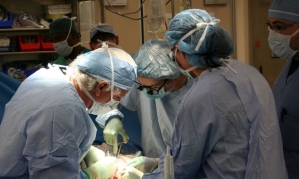
!["Thank You, Pig"…Can Bioartificial Organs Fulfill the Dream of Longevity Without Disease? [Reading Science]](https://cphoto.asiae.co.kr/listimglink/1/2022011909374114782_1642552660.jpg) In Baltimore, Maryland, USA, on the 7th (local time), medical staff at the University of Maryland showed a pig heart to David Bennett (57), a terminal patient who could not receive a human heart transplant, to be transplanted.
In Baltimore, Maryland, USA, on the 7th (local time), medical staff at the University of Maryland showed a pig heart to David Bennett (57), a terminal patient who could not receive a human heart transplant, to be transplanted.
[Asia Economy Reporter Kim Bong-su] Recently, a surgery transplanting a pig heart into a human was successfully performed in the United States. This event gave great hope to patients and families in need of organ transplants due to various diseases and accidents. Although research aiming to achieve human disease-free longevity by transplanting bioartificial organs is actively underway, many challenges still remain.
◇ What Are Bioartificial Organs?
Artificial organs refer to those produced to replace organs that have lost functionality due to disease or physical damage. Depending on the production method, they can be divided into animal-based, cell-based, and electronic device-based artificial organs. Among these, bioartificial organs encompass next-generation artificial organs created using technologies such as organoids (mini-organs) that possess actual organ-specific characteristics developed by culturing and differentiating stem cells; artificial tissues made by decellularizing tissues to obtain extracellular matrix and then injecting and culturing normal cells; and bio-printing technology that utilizes biocompatible materials and 3D printing techniques. Animal organ production methods include blastocyst complementation, which involves injecting human stem cells into blastocyst-stage embryos; humanized animal methods, where human stem cells are transplanted into adult animals with suppressed immune functions; and xenotransplantation, which controls early immune rejection responses to enable cross-species organ transplantation.
◇ Why Is It Needed?
Recently, due to population aging and the increase of various diseases, the number of people whose organs are damaged and who require transplants to sustain life is rapidly increasing. As of the end of 2019, the number of patients waiting for organ transplants such as kidney, liver, pancreas, and heart reached 41,755. However, only about 10% succeed in receiving transplants. This is because the total number of organ donations, including brain death, post-mortem, and living donors, was only 5,770. In Korea, post-mortem body donations are fewer than 500 per year, with most transplants occurring between family members. Consequently, more than 2,000 people lose their lives each year while desperately waiting for organ donations. The number of deaths while waiting for organ transplants over the past five years (2016?2020) has been increasing annually: 1,492 in 2016, 1,762 in 2017, 1,894 in 2018, 2,142 in 2019, and 2,194 in 2020.
!["Thank You, Pig"…Can Bioartificial Organs Fulfill the Dream of Longevity Without Disease? [Reading Science]](https://cphoto.asiae.co.kr/listimglink/1/2022011907235214452_1642544632.jpg)
◇ Korea Is Catching Up
The United States, Europe, and Japan are leading global artificial organ research by investing heavily in research and development (R&D). In the case of organoids, organoids for most human organs have already been developed. Korea is also catching up. According to the Korea Institute of S&T Planning and Evaluation (KISTEP), Korea’s stem cell utilization technology related to bioartificial organs is at about 85% of the top-tier group, with a gap of roughly two years. Dr. Son Mi-young of the Korea Research Institute of Bioscience and Biotechnology explained, "Korea is in the follower group, with active artificial organ research centered on research institutes, universities, and hospitals. Studies on creating or utilizing bioartificial organs through convergence research combining various technologies, as well as research on functional enhancement or utilization of stem cell-derived organoids, are steadily reported." In fact, in May 2019, research injecting human induced pluripotent stem cells (iPSCs) into pig blastocysts was approved, marking the start of basic research. This means research similar to the U.S. 'pig heart' transplant is underway. Additionally, last year, a joint research team from Konkuk University College of Medicine and the National Institute of Animal Science transplanted a kidney produced from a minipig into a monkey, which survived for more than 64 days, breaking domestic records and challenging the U.S. record of 499 days. The production of experimental artificial organs for xenotransplantation is also active. However, no institutions currently use humanized pigs or blastocyst complementation methods for artificial organ production.
◇ Long Road Ahead for Fundamental Technology Development
Since the barrier of ‘immunity’ between humans and animals must be overcome, various technology developments must precede. In particular, research to improve efficiency by developing fundamental technology that induces immunodeficiency by genetically modifying minipigs, which serve as source animals, is essential. Another obstacle is that research is being conducted on species genetically distant from humans, such as rodents, dogs, and primates.
In the United States, many studies are underway to identify differences between primates and humans for application in artificial organ production. Kim Hyun-il, CEO of Optipharm, pointed out in a Korea Research Foundation report, "In Korea as well, research to clarify differences in immune systems between primates and humans is necessary to predict and overcome immune responses in xenotransplantation and to secure strategic approaches." The need for institutional improvements has also been raised, including elucidation of immune mechanisms between different animal species, improvement and development of immunosuppressants, establishment of experimental and clinical facility standards and guidelines, and standardization of production facilities.
© The Asia Business Daily(www.asiae.co.kr). All rights reserved.