The Bank of Korea Analyzes 'The Impact of Climate Change on Productivity'
[Asia Economy Reporter Jang Sehee] An analysis has emerged suggesting that productivity may decline due to abnormal high temperatures, disaster occurrences, and ecosystem changes caused by climate change.
According to the 'Impact of Climate Change on Productivity' released on the 19th through the BOK Issue Note by the Bank of Korea, abnormal climate conditions affect workers' health and working environments, leading to a decrease in labor quality and thus a reduction in labor productivity.
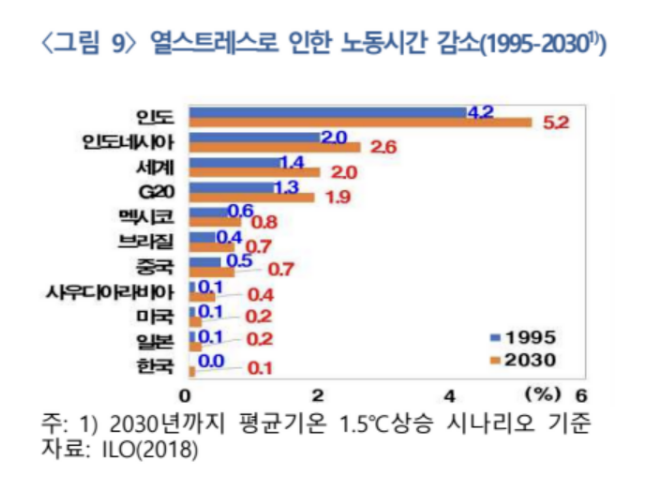
The International Labour Organization (ILO) projected that even under the optimistic scenario of a 1.5-degree Celsius increase, the global total working hours lost due to heat stress will rise from 1.4% in 1995 to 2.0% in 2030. This corresponds to a reduction in labor equivalent to 35 million and 72 million full-time workers, respectively.
It was also stated that rising temperatures, reduced sunlight hours, and increased frequency of abnormal weather events can cause decreases in output and quality, potentially leading to contraction in ecosystem service-based industries such as tourism.
Furthermore, it was mentioned that if global warming intensifies ocean acidification and hypoxia, it could lead to reductions in resource quantities and species diversity. According to the ILO, workers in ecosystem service-based industries such as agriculture, fisheries, energy, and tourism accounted for 39.5% of global total employment as of 2014, and these sectors are expected to be the most directly impacted by physical risks.
Lastly, it was emphasized that sea level rise and increased frequency of natural disasters due to climate change could negatively affect capital productivity, as they impact physical assets such as corporate infrastructure and factory facilities. If supply routes or human capital mobility are restricted, the risk of damage to corporate supply chains increases. Additionally, it is expected to affect companies' capital procurement costs.
The Bank of Korea stated, "Continuous assessment and management of climate change risks, along with consistent policy design and operation, are necessary to reduce uncertainty," and added, "It is essential to enhance resilience against various risks arising from climate change."
It further noted, "Due to high uncertainty and large initial investment costs, the private sector's risk-taking capacity is insufficient, so the government's role as a catalyst in fostering an innovation ecosystem and promoting research and development investment is important."
© The Asia Business Daily(www.asiae.co.kr). All rights reserved.