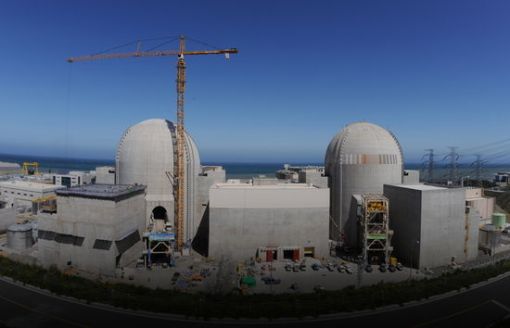
 Wolseong Nuclear Power Plant. Photo by Asia Economy DB
[Asia Economy Reporter Jeong Dong-hoon] In the trial of three Ministry of Trade, Industry and Energy officials indicted on charges including ordering the deletion or erasure of data related to the economic feasibility of the Wolseong Nuclear Power Plant, the prosecution disclosed 530 deleted documents.
The Daejeon District Prosecutors' Office presented the digitally forensically recovered materials as evidence at the second hearing of the case involving Ministry officials A (53), B (50), and C (45) on charges of damaging public electronic records, violating the Board of Audit and Inspection Act, and trespassing, held on the afternoon of the 18th at the Daejeon District Court Criminal Division 11 (Presiding Judge Park Heon-haeng).
The investigating prosecutor stated, "In addition to the 444 documents confirmed through forensic analysis by the Board of Audit and Inspection, we identified 102 more during the investigation, totaling 546 deleted documents. However, 16 of these could not be recovered, so we ultimately secured 530 documents as evidence." Among these materials was a Blue House report document indicating the plan to decide on the early shutdown of Wolseong Unit 1 following the government's energy transition roadmap measures.
The prosecution explained that there was also a document requesting the Korea Hydro & Nuclear Power Co., Ltd. (KHNP) president, stating, "It needs to be concluded that continuing operation of Wolseong Unit 1 is not economically viable, and since this has already been reported to the Blue House, a board resolution by KHNP is necessary."
The prosecution confirmed that documents titled "Requests from Chae Hee-bong (Blue House Industrial Policy Secretary)," "Prime Minister's Instructions," and "Establishing Counterarguments Against Anti-Nuclear Activities" were also deleted. The prosecution revealed only the titles of 135 documents among the 530 deleted ones, stating, "It appears clear that the defendants deleted these, but we could not print them." Many of the 530 deleted documents included drafts or versions such as "revised" or "version 2," which cannot be considered final versions.
There was a mixture of materials unrelated to Wolseong Nuclear Power Plant, including "pro-nuclear" documents related to nuclear power export industrialization and reference materials for dinners with ministers and press corps. Due to this, intense disputes are expected in future trials over whether all 530 documents can be regarded as public electronic records as defined by law.
Previously, the defendants' lawyers argued, "Only 44 of the deleted documents can be considered final versions," and "Since even these documents remain on the Ministry of Trade, Industry and Energy's server, this does not constitute destruction of originals."
© The Asia Business Daily(www.asiae.co.kr). All rights reserved.