Announcement of Pilot Project Target Area Selection Contest Starting from the 19th
[Asia Economy Reporter Kim Daehyun] Sick workers will receive partial income compensation through sickness benefits starting in 2025 to ensure their rest.
On the 18th, the Ministry of Health and Welfare announced, "From July, a three-stage pilot project will be conducted over three years," and "Starting from the 19th, a public contest will begin to select pilot project regions."
Sickness benefits refer to a system that compensates income to allow workers to focus on treatment when they are unable to work due to illness or injury unrelated to their job. Among OECD countries, all except South Korea and the United States (where only some states have introduced it) operate sickness benefit systems.
According to a survey by the Korea Institute for Health and Social Affairs last year, 35% of domestic workers experienced illnesses or injuries severe enough to make working difficult within a year, and 30% of sick workers did not receive timely and adequate treatment due to concerns about workplace atmosphere and income loss.
Choi Jonggyun, Director of the Health Insurance Policy Bureau, said, "South Korea has faced many difficulties due to COVID-19," and added, "On the other hand, it has raised the important issue that the 'right to rest when sick' must be guaranteed," and "We plan to prepare a system suitable for South Korea’s conditions through a three-year pilot project."
The government plans to apply three models in six cities, counties, and districts during the first stage of the pilot project to examine policy effects. Each model will operate in urban and mixed urban-rural areas, with a total budget of 10.99 billion KRW allocated this year. Office workers, self-employed individuals, freelancers, and platform workers will also be eligible for support.
Looking at each model, the first and second models are "unable to work models." Sickness benefits are paid for the period during which the worker cannot work, regardless of hospitalization. However, the waiting period for the first model is 7 days, and benefits are paid for up to 90 days within a year. In contrast, the second model has a waiting period of 14 days and pays benefits for up to 120 days within a year.
The third model is the "medical utilization days model," which recognizes beneficiaries if hospitalized, with a waiting period of 3 days and a coverage period of up to 90 days within a year.
A Ministry of Health and Welfare official explained, "Countries overseas set waiting periods to prevent abuse of sickness benefits and to pay benefits only to workers who are genuinely unable to work temporarily due to illness or injury." The waiting period is the time between the onset of sickness and the start of benefit payments; for example, if the waiting period is 7 days, sickness benefits can be received starting from the 8th day of absence from work.
The daily sickness benefit is 43,960 KRW, which is 60% of this year’s minimum wage. In the first stage of the pilot project, a fixed amount will be paid to analyze policy effects according to the scope of disease coverage, but from the second stage, the payment method will change to a fixed-rate benefit.
In the future, the government plans to review the results of the first stage pilot project, analyze policy effects according to coverage levels and methods in the second stage, and apply the same model in the third stage to finalize the system.
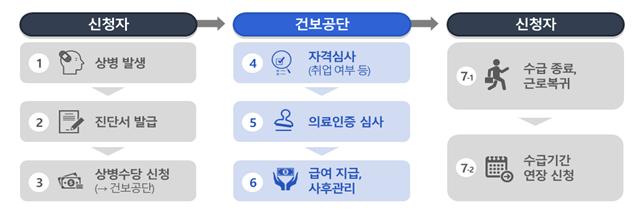
The National Health Insurance Service (NHIS) will handle tasks such as eligibility screening for sickness benefits, medical certification review, and benefit payments. Workers who experience sickness must visit a medical institution to obtain a sickness benefit diagnosis certificate and then submit it along with the sickness benefit application form to the NHIS website or the local branch office.
The NHIS will verify eligibility requirements such as employment status, review whether the period of inability to work or medical utilization days are appropriate, and then determine and notify the number of benefit payment days. If fraudulent claims are detected, measures such as suspension of benefit payments, recovery of funds, and future benefit restrictions will be enforced.
© The Asia Business Daily(www.asiae.co.kr). All rights reserved.
![User Who Sold Erroneously Deposited Bitcoins to Repay Debt and Fund Entertainment... What Did the Supreme Court Decide in 2021? [Legal Issue Check]](https://cwcontent.asiae.co.kr/asiaresize/183/2026020910431234020_1770601391.png)















