Import Substitution of 'Low-Emission Refractory' Playing a Key Role in High-Quality Molten Iron Production
Solving Issues Like Quality Degradation and Erosion, Reducing Costs to One-Third Level
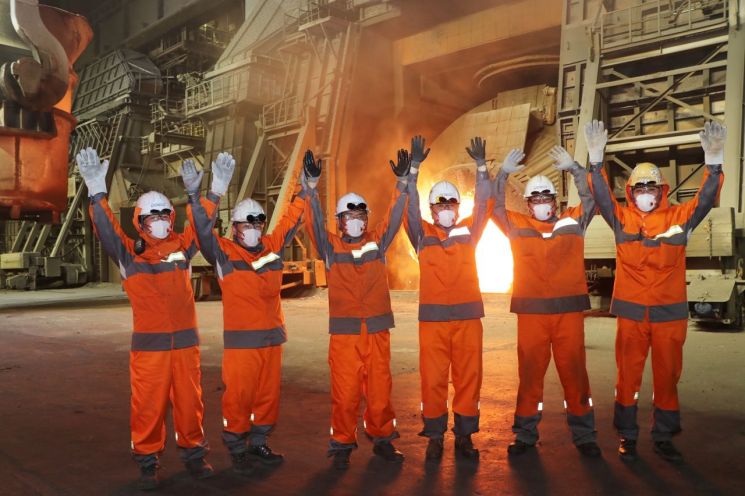
[Asia Economy Honam Reporting Headquarters, Reporter Heo Seonsik] POSCO Gwangyang Steelworks (Director Lee Jinsu) has succeeded in 100% domestic production of ‘deoxidizing refractory’.
To produce high-quality molten iron, the composition of the molten iron in the converter must be uniformly adjusted. For this, oxygen is blown from the top of the converter, and inert gases such as argon are blown from the bottom; the latter is called ‘deoxidizing’.
At this time, refractory materials that can withstand the high temperature inside the converter are constructed on the bottom. This is called ‘deoxidizing refractory,’ and if the tuyere that injects inert gas into the deoxidizing refractory is blocked or the amount is inaccurate, the molten iron will not mix uniformly, making it a key factor in determining quality.
Gwangyang Steelworks had been importing all of these ‘deoxidizing refractories’ from Japan. Therefore, if quality deteriorated or technical problems such as erosion occurred, it inevitably took a lot of time and cost to resolve, making domestic production of the material necessary.
Accordingly, the Nojae Group, Steelmaking Department, Steelmaking Research Group of Gwangyang Steelworks, and POSCO Chemical began full-scale collaboration to promote the domestic production of ‘deoxidizing refractory’ while aiming to improve performance such as reducing erosion degree and speed compared to existing imported products.
Gwangyang Steelworks first analyzed operational data targeting the 1st Steelmaking Plant to derive improvements, and POSCO Chemical developed a method to prevent bending of the tuyere inside the refractory based on this.
Additionally, the Steelmaking Research Group of the Technical Research Institute derived measures to suppress blockage and erosion of the ‘deoxidizing refractory’ and newly designed the structure considering the number of tuyeres and flow rate.
Through this process, Gwangyang Steelworks completed a pilot application of the newly developed deoxidizing refractory ‘Pos-MHP’ to one converter in the 1st Steelmaking Plant and expanded it to the entire plant. As a result, the 1st Steelmaking Plant of Gwangyang Steelworks has transformed into the first plant where ‘domestically produced deoxidizing refractory’ is applied 100%.
‘Pos-MHP’ is significant not only because it succeeded in domestic production of deoxidizing refractory that was previously fully imported but also because it differentiates the number of tuyeres compared to existing products and reduces costs to about one-third.
A Gwangyang Steelworks official said, “We are very pleased to have succeeded in domestic production of deoxidizing refractory,” and added, “Starting from this, we will do our best to apply the new deoxidizing refractory to all converters at Gwangyang Steelworks and Pohang Steelworks in the future.”
Asia Economy Honam Reporting Headquarters, Reporter Heo Seonsik hss79@asiae.co.kr
© The Asia Business Daily(www.asiae.co.kr). All rights reserved.
![User Who Sold Erroneously Deposited Bitcoins to Repay Debt and Fund Entertainment... What Did the Supreme Court Decide in 2021? [Legal Issue Check]](https://cwcontent.asiae.co.kr/asiaresize/183/2026020910431234020_1770601391.png)