EU Plastic Use Restriction Policy Doubles Prices in One Year... 25% Quota Mandatory by 2025
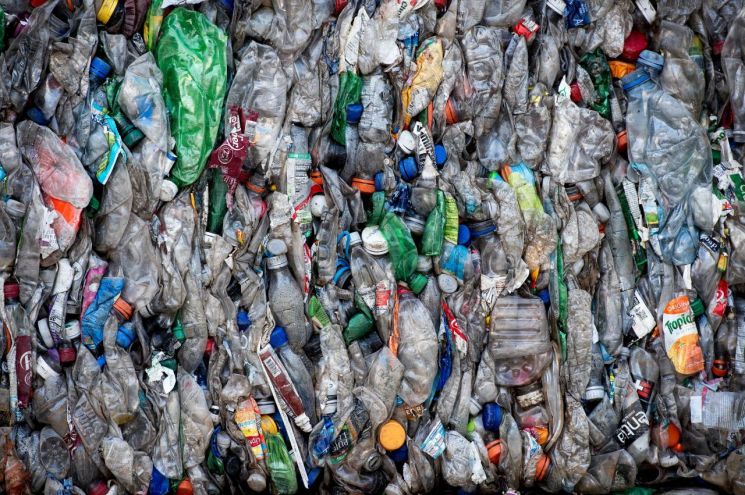
[Asia Economy Reporter Park Byung-hee] Major foreign media reported on the 17th (local time) that the price of recycled plastic in Europe has doubled in one year due to the European Union (EU)'s policy to restrict plastic use.
According to data analysis firm ICIS, the price of plastic flakes made by crushing used PET (polyethylene terephthalate) recently reached 1,609 euros per ton, a 103% increase compared to one year ago.
The EU has mandated a 25% recycling rate for packaging containers by 2025 to reduce plastic usage. As a result, demand for recycled plastic is increasing, especially among food and beverage companies such as Coca-Cola, PepsiCo, and Nestl?.
Coca-Cola plans to increase the recycling rate of its packaging materials to 50% by 2030. As of 2020, Coca-Cola's recycling rate was 22%, with the PET recycling rate being only 11.5%. Coca-Cola produces 112 billion plastic PET bottles annually. The world's largest food company, Nestl?, has committed to reducing its use of non-renewable plastics by one-third by 2025 compared to current levels.
With the rise in demand for recycled plastic, last week the price of recycled PET even surpassed that of unused PET. Expectations of rising plastic production costs due to surging fossil fuel prices such as crude oil and natural gas have spread, leading to a significant increase in demand for recycled plastic, which is usually cheaper, causing a price inversion phenomenon.
Due to various constraints such as difficulties in collection, it is difficult to significantly increase the supply of recycled plastic.
According to the U.S. Environmental Protection Agency (EPA), the plastic recycling rate in the United States is less than 10%. Although the situation is somewhat better in Europe, the recycling rate there is only 33%. Some European countries have introduced deposit systems that pay a certain amount when used plastic containers are returned, establishing institutional measures to collect recycled plastic. However, it is expected to be difficult to cope with the rapidly increasing demand.
Helen McGoff, Senior Analyst at ICIS, predicted that the sharp rise in recycled plastic prices and limited supply could hinder companies from achieving their recycling rate targets. She said, "I have recently heard from suppliers that the soaring prices of recycled plastic are causing a decrease in corporate demand for recycled plastic."
Recently, there has been an increase in cases where clothing companies produce products by recycling used PET bottles. Consequently, the beverage industry argues that beverage companies should be granted priority to use recycled plastic over other industries such as clothing.
The Union of European Soft Drinks Associations (UNESDA) stated, "If appropriate measures are not taken, it will be very difficult for beverage companies to achieve their recycling rate targets," and demanded that the EU Commission prepare countermeasures.
Nestl? also stated, "To achieve perfect circulation of PET bottles, the collection volume of PET bottles must be increased, and definite measures must be established to ensure that collected PET bottles can be made into new PET bottles," adding, "Priority for collected PET should be given to beverage companies."
© The Asia Business Daily(www.asiae.co.kr). All rights reserved.
![User Who Sold Erroneously Deposited Bitcoins to Repay Debt and Fund Entertainment... What Did the Supreme Court Decide in 2021? [Legal Issue Check]](https://cwcontent.asiae.co.kr/asiaresize/183/2026020910431234020_1770601391.png)