CEO Oh to Run for Next Savings Bank Association President
"Will Cut Salary by 50% to Serve as Advisor"
Focus on Resolving Polarization Between Medium and Small Savings Banks
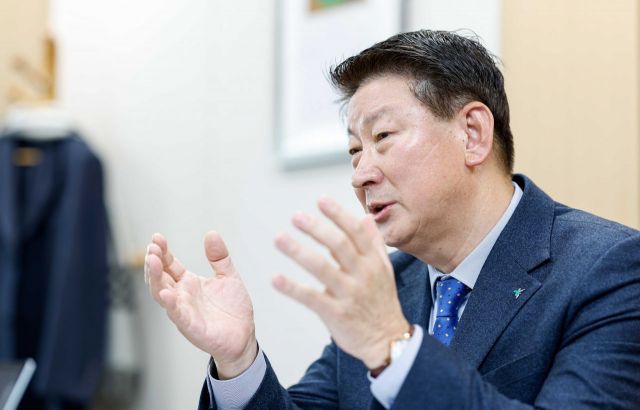 Oh Hwa-kyung, CEO of Hana Savings Bank, is being interviewed at the Hana Financial Group Gangnam Building in Gangnam-gu, Seoul. Photo by Kang Jin-hyung aymsdream@
"Until now, the savings bank industry has not been able to properly raise its voice against unreasonable regulations. We must unite our voices to improve these regulations."
Oh Hwa-kyung, CEO of Hana Savings Bank, has announced her candidacy for the chairman election of the Korea Federation of Savings Banks. Her challenge is driven by the need to resolve unfair savings bank regulations and the increasingly severe polarization within the industry. Attention is focused on whether a private savings bank CEO can take the chairman position, which has traditionally been held by former bureaucrats.
On the 18th, Oh emphasized in an interview with Asia Economy at her office in Gangnam-gu, Seoul, that "the savings bank industry has not achieved proper consensus." She stated, "Savings banks have very diverse opinions depending on region and size, and have failed to unite properly," adding, "I intend to coordinate the many outstanding disagreements and unify opinions to transform the industry at the federation level."
Oh has served as CEO of Hana Savings Bank since March 2018. She is currently in her third term after two reappointments. She has also held positions as Executive Director at HSBC Bank, CEO of Aju Savings Bank, and President of Aju Capital.
She identified the resolution of regulations such as deposit insurance premiums as the most critical issue. Savings banks pay deposit insurance premiums that are 4 to 5 times higher than those of commercial banks or other financial sectors. There are many criticisms that this reduces the lending capacity and profitability of savings banks. The easing of regulations on loan loss provisions, real estate loans, and loan-to-deposit ratios is also considered a long-standing demand.
"I will cut my salary by 50% and use it for advisory roles"
Oh explained, "Not all regulations will be resolved immediately, but the intention is to make demands that we have not been able to make before, based on reasonable discussions and evidence." To this end, she pledged to cut her salary by 50% and use the funds to employ professional advisors within the federation. If necessary, she said she would also engage in government relations work to build logic and justification for key issues.
Regarding concerns that communication with financial authorities might be more difficult for a private-sector figure than for a former bureaucrat, she dismissed this by saying, "(Regulation) is not something that can be solved by individual capability, nor is it an era where personal networks can be used to get things done."
In the past 20 years, the only private-sector individual to have been elected chairman of the Korea Federation of Savings Banks was Lee Soon-woo, former chairman of Woori Financial Group, the 17th chairman. Other candidates rumored alongside Oh are all former bureaucrats, including Lee Hae-seon, former chairman of the Korea Exchange Market Surveillance Committee; Jung Wan-gyu, former president of Korea Securities Finance Corporation; and Hong Young-man, former president of Korea Asset Management Corporation (KAMCO).
On the polarization among savings banks, she analyzed, "Small and medium-sized savings banks in the provinces are really struggling," adding, "If Seoul and Gyeonggi regions are rated 9 to 10, the provinces are only at 1." She advised that "Mergers and acquisitions (M&A) are quite restricted, but they should be activated for industrial development." She also mentioned, "It is desirable for capital that can support savings banks to flow in actively."
Regarding digital strategy, she stressed urgency. With non-face-to-face financial transactions already becoming the norm, savings banks cannot afford to fall behind. "If customers who prefer mobile banking experience inconvenience even once when using a savings bank platform, the savings bank industry will fall behind," she said, adding, "We will promote digitalization and computerization efforts at the federation level."
© The Asia Business Daily(www.asiae.co.kr). All rights reserved.

















