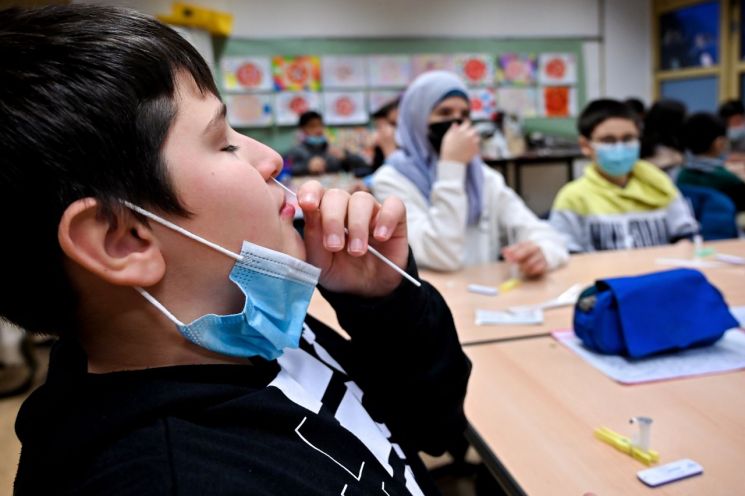
 A student at a middle school located in Bonn, a city in western Germany, is conducting a COVID-19 self-test kit diagnosis before the start of class.
 [Image source=EPA Yonhap News]
[Asia Economy Reporter Seulgina Cho] "There will be no complete end."
As the COVID-19 pandemic enters its third year of sweeping across the globe, many global leaders continue to express pessimistic outlooks about the future. This is due to a series of challenges including the emergence of successive variants, an unpredictable end to the pandemic, vaccine inequality, and the resulting impact on the global economy.
Anthony Fauci, the United States' top infectious disease expert and Chief Medical Advisor to the President, who is also the director of the National Institute of Allergy and Infectious Diseases (NIAID), stated on the 17th (local time) during a virtual session at the World Economic Forum’s annual meeting (WEF, Davos Forum) ‘Davos Agenda 2022’ that "Even if Omicron is the last variant, it does not mean the end of COVID-19." He drew a clear line against recent speculations that the pandemic might end sooner due to the relatively mild symptoms of the spreading Omicron variant, saying, "There will be no complete eradication of the virus."
The event, held as a pre-meeting to the Davos Forum, covered major topics such as COVID-19, vaccine inequality, the Fourth Industrial Revolution, the climate crisis, and global economic outlook. Participants emphasized the need for global cooperation by discussing what the next phase of the pandemic might be in a separate session.
Ant?nio Guterres, Secretary-General of the United Nations (UN), expressed concern over vaccine inequality, noting that the event was held "in the shadows during very difficult times for the economy, people, and the planet." He explained that vaccine inequality creates disparities in economic recovery speeds between developed and developing countries, which could lead to future social divisions and geopolitical risks. This aligns with the WEF’s ‘Global Risks Report,’ where over 80% of respondents presented pessimistic forecasts, citing the pandemic and vaccine inequality as key reasons.
Secretary-General Guterres stated, "The past two years have shown a simple but harsh truth: if anyone is left behind, we all fall behind," and insisted, "To end the pandemic, everyone worldwide must be vaccinated." Earlier, the UN projected that global economic growth would slow from 5.5% last year to 4% this year and to the 3% range next year.
Chinese President Xi Jinping, who participated as a special speaker, also emphasized that the international community must "strengthen solidarity and cooperation" in the face of the COVID-19 crisis. Sunil Bharti Mittal, Chairman of India’s Bharti Enterprises, highlighted the importance of technology, stating, "The Fourth Industrial Revolution will be the key to solving the biggest challenges the world currently faces."
Meanwhile, according to the global risks report released by the WEF, 84.2% of respondents expressed concern about the global outlook. The largest group, 61.2%, said they were ‘concerned,’ followed by a more pessimistic 23.0% who said they were ‘very concerned.’ In contrast, only 12.1% responded ‘positive,’ and a mere 3.7% were ‘optimistic’ about the future.
Regarding the global outlook over the next three years, only 10.7% of respondents answered that ‘global recovery will accelerate.’ All other responses reflected negative expectations. The highest response, at 41.8%, was that ‘anxiety will persist amid various unexpected events,’ followed by ‘the gap between winners and losers will widen amid divisions caused by the COVID-19 crisis’ (37.4%), and ‘a decisive tipping point will steadily progress as catastrophic outcomes increase’ (10.1%).
© The Asia Business Daily(www.asiae.co.kr). All rights reserved.