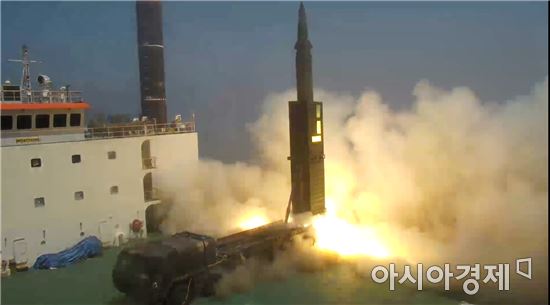
[Asia Economy Yang Nak-gyu, Military Specialist Reporter] The missile North Korea launched on the 17th has been identified as the 'North Korean version of ATACMS' (KN-24). It is evaluated that the continuous launch time has been reduced and precision strike capability has been added, meaning that the deployment of actual combat power is essentially complete.
On the 18th, the Korean Central News Agency stated, "According to the plans of the National Defense Science Institute and the Second Economic Commission, among other relevant organizations, a tactical guided missile inspection firing test was conducted."
The inspection firing test announced by North Korea means that quality inspection was conducted through live firing by randomly selecting products from the production batch. It is interpreted as having deployed the KN-24 in actual combat and intending to increase production quantity in the future.
The continuous launch time of the KN-24 is gradually decreasing. North Korean State Affairs Commission Chairman Kim Jong-un praised it highly during the first KN-24 test launch on August 10, 2019, saying, "It is a new weapon developed to suit our country's terrain conditions and the requirements of the Juche warfare method." At that time, the launch interval was 16 minutes. However, it was reduced to 15 minutes (August 16) → 5 minutes (March 21, 2020), and this time, continuous launches were made within 4 minutes.
The KN-24 is launched from a tracked or vehicle-type TEL equipped with two launch tubes. It can hide in tunnels and forests, then emerge into open areas to launch two missiles consecutively and quickly conceal itself again. When launched from Pyongyang, it has a range (around 400 km) capable of directly striking the Army, Navy, and Air Force Headquarters in Gyeryongdae, Chungnam Province. Its peak altitude is lower than the minimum interception altitude (50 km) of the high-altitude missile defense system THAAD, making it difficult to counter.
Military experts predict that North Korea will additionally launch cruise missiles or submarine-launched ballistic missiles (SLBMs). This is related to the 'five major tasks' mentioned at the 8th Party Congress in January last year: hypersonic missiles, super-large nuclear warheads, improving the 15,000 km strike accuracy rate, developing underwater and ground solid-fueled intercontinental ballistic missiles (ICBMs), and possessing nuclear submarines and underwater-launched nuclear strategic weapons. However, it is expected that North Korea will refrain from launching ICBMs, which even China finds difficult to support.
Military provocations are expected to continue until this month. Since China, which acts as North Korea's 'backer,' is preparing for the Beijing Winter Olympics, it is believed that North Korea will refrain from actions that would spoil the event.
Professor Kim Dong-yeop of the Graduate School of North Korean Studies said, "With only a week left until the 25th of this month, when Olympic athletes enter the village, there is a high possibility of additional provocations during this period. After the March presidential election, when the South Korea-U.S. joint military exercises resume, provocations could become even more intense."
© The Asia Business Daily(www.asiae.co.kr). All rights reserved.
















