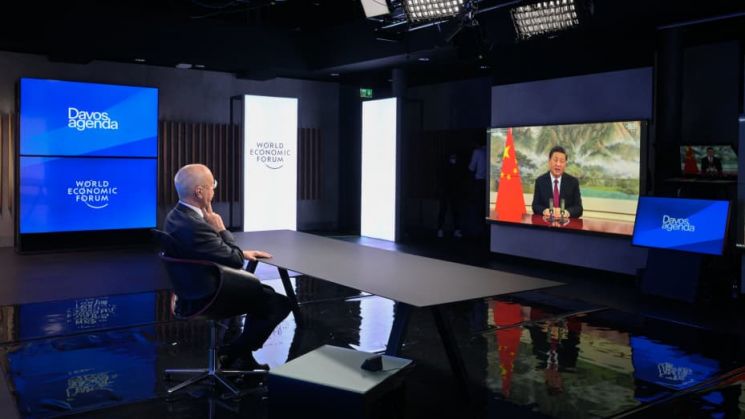
 Klaus Schwab, Chairman of the World Economic Forum (WEF), is watching Chinese President Xi Jinping deliver a special 'Davos Agenda' speech via video on the 17th (local time). (Photo by AFP)
[Asia Economy Reporter Yujin Cho] The 'Davos Agenda 2022,' where heads of major countries and leaders of international organizations participate via non-face-to-face video conferencing to discuss responses to key global issues, opened on the 17th (local time). This was held as a preliminary meeting after the World Economic Forum (WEF)'s annual meeting, the 'Davos Forum,' was postponed due to the spread of the Omicron variant.
Under the theme of 'State of the World,' this online meeting covers topics such as the COVID-19 pandemic, China, the climate crisis, sustainable development, and global economic outlook.
The most notable figure at this meeting was Chinese President Xi Jinping, who attended as a special speaker. Amid rising concerns over US-China tensions surrounding Taiwan and the possibility of Russia's invasion of Ukraine, President Xi emphasized the need to "abandon Cold War thinking."
In his speech delivered via video, he said, "History has repeatedly shown that confrontation between major powers only leads to disastrous outcomes," and added, "Countries around the world must strengthen economic policy cooperation and prevent the global economy from falling into recession again."
President Xi also highlighted the achievements of his country's lockdown measures and expressed confidence that the Beijing Winter Olympics would be held safely under a 'zero COVID' policy.
US economic media CNBC pointed out that the US-China tensions over the Taiwan issue will be the biggest threat in the Asian region this year. Referring to past warnings by economist Steven Roach that "US-China tensions are reaching their worst since the early 1970s," it noted that regulatory crackdowns by Chinese authorities on Chinese companies listed on US stock exchanges will further escalate conflicts between the two countries.
Stefan Bancel, CEO of US pharmaceutical company Moderna, announced in the afternoon session titled 'COVID-19: What Next?' that clinical trials for a vaccine targeting the Omicron variant will begin within weeks. CEO Bancel also expressed expectations to share data on the vaccine with pharmaceutical regulatory authorities around March.
Anthony Fauci, director of the US National Institute of Allergy and Infectious Diseases (NIAID), who participated in the same session, stated that there is no evidence that repeated booster shots will overwhelm the immune system.
The event, running until the 21st, includes participants such as Bill Gates, founder of Microsoft (MS), John Kerry, US presidential climate envoy, Ursula von der Leyen, President of the European Union (EU) Commission, Tedros Adhanom Ghebreyesus, Director-General of the World Health Organization (WHO), and Janet Yellen, US Treasury Secretary.
Tedros Adhanom Ghebreyesus, Director-General of the WHO, is expected to advocate for increasing vaccine equity among countries worldwide.
Janet Yellen, who will speak on the final day, is expected to focus on promoting the Biden administration's efforts to prevent the global catastrophe of climate change.
Foreign media predict that the event may reiterate support for the $1 trillion infrastructure law, a response to economic recovery amid the COVID-19 pandemic and soaring inflation, as well as the global minimum corporate tax agreed upon by more than 130 countries.
© The Asia Business Daily(www.asiae.co.kr). All rights reserved.