Promotion of 30 Execution Tasks for 3 Major Strategies Related to the Serious Accident Punishment Act... Establishment of a Field-Centered Safety System
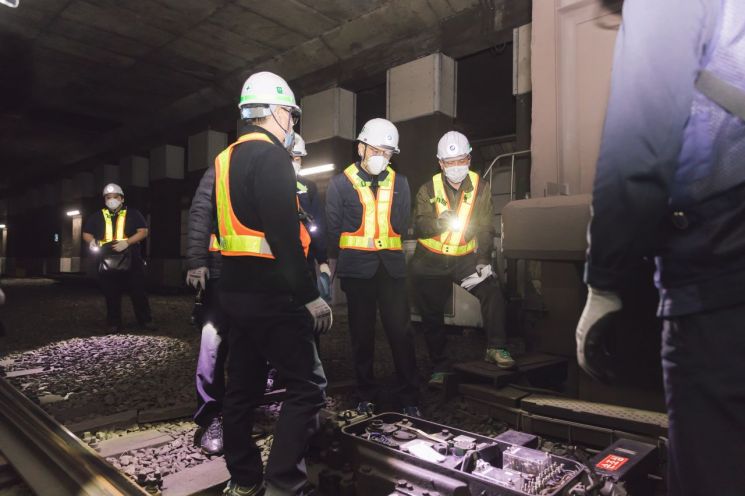
[Asia Economy Reporter Lim Cheol-young] Seoul Metro announced on the 18th that it has established a strategy for major industrial accidents and major citizen accidents in accordance with the Serious Accident Punishment Act, which will be enforced on the 27th, and will make multifaceted efforts to achieve zero major accidents in the subway.
The strategy for major industrial accidents and major citizen accidents established by the corporation is being promoted through three main areas: elimination of risk factors (blind spots), reinforcement of the safety system (institution), innovation of on-site safety culture, and 30 priority projects.
The corporation was the first urban railway operator nationwide to establish a dedicated organization last May and has expanded and deployed 12 dedicated personnel for on-site safety management. It classifies high-risk accidents during subway on-site work into five types (asphyxiation, falls, entrapment, contact, electric shock) and strengthens inspection and prevention activities tailored to each type.
Furthermore, it will accelerate the replacement of aging trains and facility improvements, which have been promoted annually. This year, it will invest 491.4 billion KRW to prevent subway safety accidents that may occur due to aging infrastructure. The replacement of Line 4 trains (260 cars) will also begin. The train replacement has been sequentially promoted since 2014 based on the previously established aging train replacement plan. So far, the corporation has invested 1.255 trillion KRW to complete the replacement of 420 cars on Line 2 and is currently replacing 526 cars on Lines 2, 3, 5, and 7.
Although not directly visible to citizens, improvements to facilities essential for safe subway operation are also underway. These include electrical (power facilities, overhead lines), tracks (aging rails, switches), and old signal wires and relays, aiming to minimize failures and malfunctions that frequently occurred due to aging.
In addition, emphasis has been placed on raising safety awareness among the corporation’s employees and citizens. To enhance employees’ understanding of the Serious Accident Punishment Act, the corporation produced and distributed 560 copies of a guide and commentary on the Act and 17,300 promotional leaflets in early January. Safety training for field managers is conducted weekly, and major accident prevention education for all employees is held monthly.
For citizens, the corporation is expanding promotion of safe subway usage methods, such as correct E/S usage guidance, to raise awareness of the risks of major accidents and prevent incidents. In connection with the Seoul Metropolitan Government’s metaverse platform construction project, the corporation is also promoting the online conversion of the “Subway Safety Experience Promotion Center” currently installed at Banpo Station on Line 7. Joint disaster response drills with fire stations and police, as well as a citizen safety monitoring system involving direct citizen participation, are also being implemented.
To strengthen the capacity to respond to major accidents by reflecting a broader perspective, a comprehensive consulting research project on major accident response will begin this month. With the help of external specialized institutions, the corporation will analyze application methods according to various laws and prepare systematic and scientific management plans.
Kim Sang-beom, President of Seoul Metro, said, “As the largest public transportation operator in the country, protecting the safety of citizens using the subway is the corporation’s top management priority,” adding, “Labor and management will join forces to do their best to prevent major industrial and citizen accidents.”
© The Asia Business Daily(www.asiae.co.kr). All rights reserved.