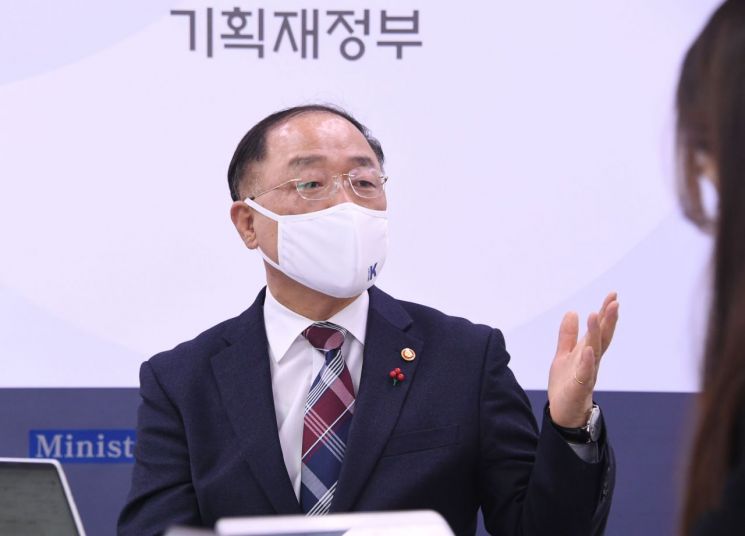
 Hong Nam-ki, Deputy Prime Minister and Minister of Economy and Finance, is answering reporters' questions at a press briefing held at the Government Complex Sejong on the afternoon of the 17th.
[Sejong=Asia Economy Reporter Son Sun-hee] Hong Nam-ki, Deputy Prime Minister and Minister of Economy and Finance, said on the 17th regarding the supplementary budget (supplementary budget) bill, "The scale submitted by the government (14 trillion won) needs to be maintained, and I hope the National Assembly will respect this government position." This is interpreted as a preemptive move to block political demands for an increase that have already been raised even before the government submitted the supplementary budget bill.
Deputy Prime Minister Hong said in the afternoon at the Government Complex Sejong, "From the government's perspective, various economic and fiscal conditions and the fact that this is a one-point supplementary budget at the beginning of the year were taken into account," regarding the scale of the supplementary budget. He added, "It is scheduled to be submitted to the National Assembly next Monday after being approved at the Cabinet meeting this week." The National Assembly's review of the supplementary budget bill is expected to begin immediately after the Lunar New Year holiday.
Hong explained, "One of the reasons for the supplementary budget is excess tax revenue, but since it can only be used after the settlement procedure in April, most of the supplementary budget funds will be covered by issuing deficit bonds," and added, "Due to the urgency and seriousness of supporting small business owners, this supplementary budget is being made even if deficit bonds are issued."
However, regarding the use of the global surplus generated from excess tax revenue after the settlement in April, he said, "There are several choices such as using it to repay debt or for a new supplementary budget, so it is a matter to be judged at that time." Although the supplementary budget bill was prepared considering the scale of excess tax revenue, it means that the surplus generated from excess tax revenue may not necessarily be used for debt repayment later.
On the 14th, the government announced plans to prepare the supplementary budget bill, and on the same day, the Bank of Korea raised the base interest rate by 0.25%. While one side is injecting funds through fiscal spending, the other side is tightening monetary policy through interest rate hikes, leading to criticism from some quarters that this is a 'policy mismatch.'
In response, Deputy Prime Minister Hong reiterated the existing position that "This fiscal policy targeting support for small business owners and quarantine measures is complementary to monetary policy aimed at responding to risks such as asset markets and price stability," describing it as a 'policy mix.'
Meanwhile, the International Monetary Fund (IMF) is expected to soon announce revised global economic outlooks including for Korea. Recently, major international organizations such as the Organisation for Economic Co-operation and Development (OECD) have been lowering growth forecasts due to global supply bottlenecks and the Omicron variant of the virus.
Regarding this, Hong said, "Overall, there are various global risks, but a gradual economic recovery trend is expected to continue," and added, "The Korean economy's growth rate last year is cautiously expected to achieve the government's target of 4.0%, and the growth target for this year remains valid at 3.1%."
© The Asia Business Daily(www.asiae.co.kr). All rights reserved.
![User Who Sold Erroneously Deposited Bitcoins to Repay Debt and Fund Entertainment... What Did the Supreme Court Decide in 2021? [Legal Issue Check]](https://cwcontent.asiae.co.kr/asiaresize/183/2026020910431234020_1770601391.png)