US and China Retail Sales Data Shock
Concerns Grow Over Domestic Export Decline
Ahead of LG Energy Solution IPO This Week
Increased Supply-Demand Volatility
Won-Dollar Exchange Rate at 1190 Won
Impact of Tightening Concerns and Sharp Interest Rate Rise
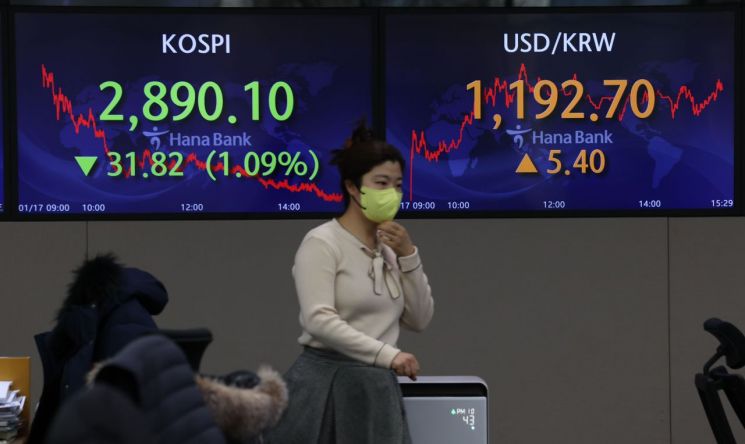
[Asia Economy Reporter Minji Lee] The KOSPI closed the session around the 2890 level, experiencing a sharp decline of over 1%. The drop in the index is analyzed to be influenced by concerns over rising interest rates, weak economic indicators from the U.S. and China, and supply-demand pressure following the LG Energy Solution IPO.
On the 17th, the KOSPI closed at 2890.10, down 1.09% (31.82 points) from the previous trading day. During the session, the index fell to as low as 2875.97, marking the lowest level of the year. This was the first time in over a month since January 1, when the closing price was 2899.72, that the KOSPI closed below the 2900 mark.
The KOSPI opened at 2918.55, down 0.12% (3.37 points) from the previous day, but continued its downward trend amid selling pressure from foreign and institutional investors. Foreigners and institutions sold stocks worth 252 billion KRW and 259.3 billion KRW respectively, while individual investors were the sole buyers, purchasing stocks worth 482.6 billion KRW.
The domestic stock market's decline was greater than that of the U.S. market last week. Given Korea's high dependence on exports, weak retail sales data from the U.S. and China heightened concerns over domestic companies' earnings. Additionally, worries about the U.S. Federal Reserve potentially tightening monetary policy further, along with recent remarks from the Bank of Korea about additional rate hikes, increased pressure on interest rates, negatively impacting the stock market. Consequently, the won-dollar exchange rate closed at 1192.7 KRW, up 5.4 KRW from the previous day's 1187.3 KRW, returning to the 1190 KRW range.
Supply-demand pressure is also increasing due to large-scale IPOs such as LG Energy Solution. Lee Kyung-min, a researcher at Daishin Securities, said, “In January, a negative supply-demand environment is forming for the KOSPI and large-cap stocks, and concerns are growing that the LG Energy Solution IPO could become a supply-demand black hole for large-cap stocks. The KOSPI is facing a triple challenge of global consumption anxiety, interest rate pressure, and increased supply-demand burdens.”
All sectors showed weakness in the stock market on this day. The pharmaceutical sector (-3.18%) experienced the largest decline, mainly due to the accounting fraud controversy surrounding Celltrion (-6.3%). This was followed by declines in banks (-2.22%), construction (-2.14%), and textiles/apparel (-2.05%).
Among the top market capitalization stocks, Samsung Electronics (0.26%) and NAVER (0.44%) closed higher. However, most other major stocks continued to fall, including SK Hynix (-1.17%), LG Chem (-1.26%), Samsung SDI (-0.93%), Samsung Biologics (-2.82%), Hyundai Motor (-1.91%), Kakao (-1.06%), and Kia (-1.31%).
The KOSDAQ index closed at 957.90, down 1.39% (13.49 points) from the previous day. It opened at 971.81, up 0.04% (0.42 points), but the decline accelerated during the session due to foreign selling. Regarding investor trends, institutions and individuals bought stocks worth 92.7 billion KRW and 18.7 billion KRW respectively, while foreigners were net sellers, offloading stocks worth 117 billion KRW.
Among the top market capitalization stocks on KOSDAQ, Celltrion Healthcare fell 7.50% to 65,400 KRW. EcoPro BM (0.48%), L&F (1.19%), Cheonbo (1.72%), and Lino Industrial (2.46%) rose, while Pearl Abyss (-1.67%), Kakao Games (-1.41%), and HLB (-0.72%) declined.
© The Asia Business Daily(www.asiae.co.kr). All rights reserved.
![User Who Sold Erroneously Deposited Bitcoins to Repay Debt and Fund Entertainment... What Did the Supreme Court Decide in 2021? [Legal Issue Check]](https://cwcontent.asiae.co.kr/asiaresize/183/2026020910431234020_1770601391.png)















