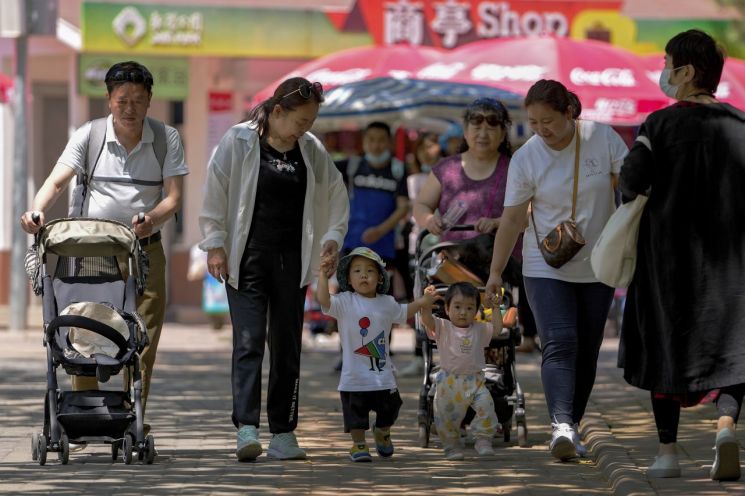
[Asia Economy Reporter Park Byung-hee] China's birth population last year was the lowest since 1961, and the birth rate (the ratio of births per 1,000 people) recorded the lowest since the founding of the country.
China's National Bureau of Statistics announced on the 17th that last year's birth population was 10.62 million and the death population was 10.14 million. This means the population increased by about 480,000 last year.
As of the end of last year, China's population was estimated at 1.4126 billion. This does not include the populations of Hong Kong, Macau, Taiwan, or foreigners within the mainland.
Although the total population increased, the birth population fell by 11.5% from 12 million in 2020, the lowest since the Great Famine period in 1961 (9.49 million births), marking a decline for five consecutive years.
Last year, China's birth rate was 0.752%, the death rate was 0.718%, and the natural population growth rate was 0.034%.
AFP reported that last year's birth rate of 0.752% is the lowest since the birth rate was first recorded in the Chinese government's yearbook in 1978, and also the lowest since the founding of the People's Republic of China in 1949.
The natural population growth rate of 0.034% is far below the average annual growth rate of 0.53% announced in May last year during China's once-in-a-decade population census (the 2020 population census).
Japan's Nihon Keizai Shimbun (Nikkei) reported that the natural population growth rate of 0.034% is the lowest since 1960, when the Great Leap Forward under Mao Zedong, which caused the Great Famine, was in full swing.
As a result, China cannot shake off concerns about rapid aging and population decline.
At the end of last year, the urban resident population was 914.25 million, an increase of 12.05 million from the previous year, while the rural resident population was 498.35 million, a decrease of 11.57 million. The proportion of the urban population in the total population (urbanization rate) rose by 0.83 percentage points to 64.72%, accelerating urban concentration.
Among the total population, there were 723.11 million males and 689.49 million females, with a ratio of 104.88 males per 100 females.
To respond to low birth rates, China introduced a three-child policy in May last year, effectively abolishing the birth control policy. The current statistics are considered not to reflect the results of this policy.
© The Asia Business Daily(www.asiae.co.kr). All rights reserved.
![User Who Sold Erroneously Deposited Bitcoins to Repay Debt and Fund Entertainment... What Did the Supreme Court Decide in 2021? [Legal Issue Check]](https://cwcontent.asiae.co.kr/asiaresize/183/2026020910431234020_1770601391.png)















