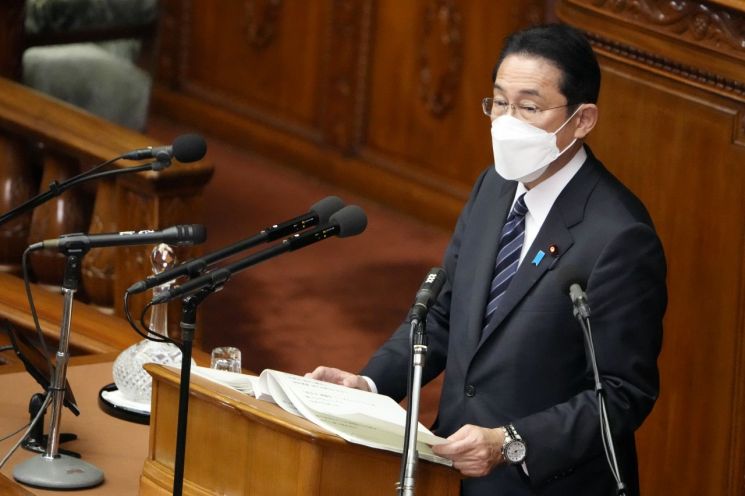
[Asia Economy Reporter Park Byung-hee] Japanese Prime Minister Fumio Kishida reiterated the existing stance that problem-solving led by the South Korean government is necessary regarding the ongoing Japan-South Korea conflicts during his policy speech at the opening ceremony of the regular Diet session on the 17th.
Prime Minister Kishida defined South Korea as an important neighboring country and stated, regarding major Japan-South Korea conflict issues such as the South Korean court rulings on compensation for forced labor victims, "We will strongly demand appropriate responses from South Korea based on Japan’s consistent position."
The "appropriate response" from South Korea mentioned by Prime Minister Kishida refers to the argument that the issues of forced labor victims during Japan’s colonial rule and the comfort women, which are the biggest issues between the two countries, were completely resolved by the 1965 Japan-South Korea Claims Agreement and the 2015 Japan-South Korea Foreign Ministers’ 'Comfort Women Agreement.' Therefore, the South Korean court rulings that do not recognize this are considered violations of international law, and the Japanese government demands that the South Korean government present measures to correct judicial decisions.
Prime Minister Kishida made similar remarks in his policy speech at the extraordinary Diet session on October 8 last year, shortly after taking office.
Regarding North Korea’s abduction of Japanese citizens, Kishida described it as "the most important issue" and reaffirmed his intention to meet directly with North Korean State Affairs Commission Chairman Kim Jong-un unconditionally to realize the early return of all abductees as soon as possible.
He also repeatedly stated the existing position aiming to comprehensively resolve all North Korea-related issues such as abductions, nuclear weapons, and missiles, and to normalize diplomatic relations between the two countries by overcoming the unfortunate past, based on the Japan-North Korea Pyongyang Declaration issued after the September 2002 Pyongyang summit between North Korean National Defense Commission Chairman Kim Jong-il and Japanese Prime Minister Junichiro Koizumi.
Regarding North Korea’s repeated ballistic missile launches, Kishida said, "We absolutely cannot allow it," and mentioned that the significant advancement of North Korean missile technology cannot be overlooked.
He said that in response to these missile issues and the rapid changes in military balance, he plans to revise the three major strategic documents?National Security Strategy, National Defense Program Guidelines, and Mid-Term Defense Program?within this year.
In this process, he revealed plans to realistically review all options, including the so-called "enemy base strike capability," without excluding any choices, and expressed the intention to fundamentally strengthen defense capabilities with a sense of urgency.
Prime Minister Kishida said he will pursue a "new era realism diplomacy" that faces reality, and plans to hold an early summit with U.S. President Joe Biden to further strengthen the deterrence and response capabilities of the Japan-U.S. alliance, which is the cornerstone of Japan’s diplomacy and security.
The two leaders are scheduled to hold a virtual summit on the 21st.
He also stated that to realize a free and open Indo-Pacific vision, Japan will strengthen cooperation not only with Australia and India but also with the Association of Southeast Asian Nations (ASEAN) and European countries.
Regarding relations with China, which will mark the 50th anniversary of diplomatic ties this September, he said, "We will strongly demand responsible behavior while asserting what needs to be asserted," and aims to build constructive and stable relations through repeated dialogue.
Prime Minister Kishida, who is from the atomic bombed city of Hiroshima, expressed his pursuit of a world without nuclear weapons and revealed plans to launch an "International Wise Persons’ Conference" for a nuclear-free world involving current and former political leaders from various countries, aiming to hold the first meeting in Hiroshima within this year.
Regarding constitutional revision, he limited his remarks to saying, "The form of the constitution is something the people decide together," and expressed hope that active discussions on revision will first take place at the parliamentary level.
© The Asia Business Daily(www.asiae.co.kr). All rights reserved.
![User Who Sold Erroneously Deposited Bitcoins to Repay Debt and Fund Entertainment... What Did the Supreme Court Decide in 2021? [Legal Issue Check]](https://cwcontent.asiae.co.kr/asiaresize/183/2026020910431234020_1770601391.png)