Bupyeong 11th Street Urban Regeneration 'Innovation Center' Complex Building Groundbreaking in March
Jemulpo Station-J to Develop 'Young Square' Building and More by 2026
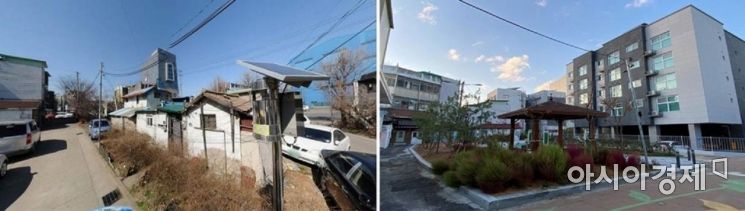 Hwaseu Jeongwon Village in Dong-gu, Incheon has been newly transformed through the Urban Regeneration New Deal project. The photo shows the appearance before (left) and after the construction of the Happy Housing.
 [Photo by Incheon City]
[Asia Economy Reporter Park Hyesook] Among the 26 urban regeneration New Deal projects underway in Incheon, Dong-gu Hwasujeongwon Village was the first to be completed.
According to Incheon City on the 17th, starting with the 'Open Port Creative City Regeneration Project' in 2016, a total of 26 urban regeneration New Deal projects are currently being promoted. Among them, the regeneration project in Hwasu-dong, Dong-gu, titled 'Again, Blooming Hwasujeongwon Village,' has achieved results first.
Hwasujeongwon Village is a newly named area for urban regeneration, derived from the name Hwasu-dong (花水洞). Hwasu-dong was once one of Korea's three major fishing ports, but with the development of the new port, the Hwasu-dong pier declined, and as residential areas aged and the number of vacant and abandoned houses increased, it became a representative declining area.
Incheon City invested a total project cost of 16.1 billion KRW through the 2017 Urban Regeneration New Deal project contest, supplying public rental housing and promoting home repairs along with improvements to the surrounding environment. Eleven vacant houses were demolished, and 48 units of Happy Housing were newly built and provided to vulnerable residential groups such as youth, university students, and newlyweds.
Additionally, a public parking lot with 30 spaces was created to provide parking for residents of nearby multi-family houses. A cooperative was established to operate a village caf? and manage villas, leading to job creation.
Furthermore, Incheon’s representative urban regeneration New Deal project, 'The Path of People Returning After 50 Years,' underway around the old Gyeongin Expressway (now Incheon-daero), is accelerating toward completion in 2023.
On a 213,000㎡ site around Seoknam Station in Seo-gu, a youth startup incubation facility with three underground floors and nine above-ground floors, including a startup incubation center and startup support housing (60 units), will be built, along with a complex cultural facility with two underground floors and seven above-ground floors, housing a cultural center and Happy Housing (109 units).
Also, the 'Sustainable Bupyeong 11th Street' urban regeneration project, being promoted on a 226,795㎡ site at 65-17 Bupyeong-dong, Bupyeong-gu, with a total project cost of 164.3 billion KRW, will be completed this year.
The core innovation center construction of this project is scheduled to begin in March. The innovation center will be a complex building with three underground floors and 20 above-ground floors, featuring residential, commercial, and public functions such as a food platform, public support center, Happy Housing, public rental stores, and a public parking lot.
Additionally, 'Jemulpo Station-J' was selected in the 3rd Urban Regeneration New Deal project contest in 2021, with a total project cost of 70.4 billion KRW to be invested by 2026. Plans include constructing the 'Young Square' building with three underground floors and ten above-ground floors at the north plaza of Jemulpo Station, along with a public parking lot (223 spaces), shared kitchen, and rooftop garden.
Upon completion, it is expected that the area around Jemulpo Station in Michuhol-gu, which lost vitality after Incheon University moved to the new city of Songdo, will see an increase in the floating population such as youth, creating jobs and revitalizing the community, thereby regaining its former vibrancy.
Unlike urban maintenance projects such as reconstruction and redevelopment that completely demolish neighborhoods, the Urban Regeneration New Deal project maintains the existing appearance while revitalizing aging residential areas and declining old downtowns through local initiatives to enhance urban competitiveness.
© The Asia Business Daily(www.asiae.co.kr). All rights reserved.
![User Who Sold Erroneously Deposited Bitcoins to Repay Debt and Fund Entertainment... What Did the Supreme Court Decide in 2021? [Legal Issue Check]](https://cwcontent.asiae.co.kr/asiaresize/183/2026020910431234020_1770601391.png)