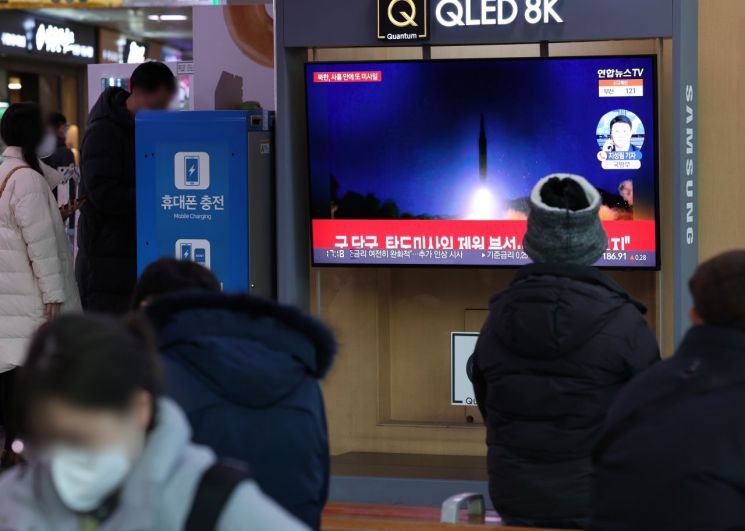
[Asia Economy Reporter Lee Ji-eun] North Korea has already launched missiles four times this year. Experts interpret North Korea's missile launches as a way to express dissatisfaction with U.S. sanctions against North Korea and to pressure for the resolution of the 'double standards.' However, there is also a possibility that tensions caused by North Korea's missile launches may ease starting next month when the Beijing Winter Olympics take place.
The Joint Chiefs of Staff announced on the morning of the 17th that North Korea fired an unidentified projectile into the East Sea.
Although the specifications such as range, altitude, and speed are still under analysis, considering that the Joint Chiefs promptly notify the media upon detecting ballistic missiles, it is estimated to be at the ballistic missile level.
This launch marks North Korea's fourth show of force since the beginning of the new year. North Korea launched ballistic missiles claimed to be hypersonic missiles on the 5th and 11th, and on the 14th, it fired two short-range ballistic missiles presumed to be the 'North Korean version of Iskander (KN-23).'
The interval between the first missile (on the 5th) and the second missile (on the 11th) was six days, but the intervals between the second and third (14th) and the fourth (17th) launches were shortened to three days each, indicating a shorter launch interval between each missile.
North Korea's barrage of missile launches since the new year appears to be a response to U.S. sanctions following North Korea's missile launches.
The U.S. Department of the Treasury's Office of Foreign Assets Control (OFAC) sanctioned six North Korean nationals involved in North Korea's missile development on the 12th (local time). In response, North Korea's Foreign Ministry spokesperson stated on the 14th, "If the U.S. continues to take such confrontational attitudes, we cannot help but respond more strongly and clearly," and carried out an additional launch just eight hours later.
This launch is also interpreted as an extension of the 'strong and clear response' mentioned in the statement. Hong Min, a research fellow at the Korea Institute for National Unification, analyzed, "It is a show of force disguised as training to check or warn the U.S.," adding, "It is a way to 'drive a wedge' to the U.S. to stop further arguments about strategic weapons."
This indicates a move to respond to the U.S. sanctions with a 'strong-for-strong' principle. This stance contrasts with the opening of the border with China the day before, with whom North Korea is fostering friendly relations. Previously, Kim Jong-un, General Secretary of the Workers' Party of Korea, declared the 'strong-for-strong, preemptive-for-preemptive' principle toward the U.S. at the 8th Party Congress last year.
However, there is also an analysis that North Korea may refrain from missile launches and move toward dialogue during the Beijing Winter Olympics starting next month. Professor Yang Moo-jin of the University of North Korean Studies said, "Since the Beijing Winter Olympics will be held from February 4, missile launches will be restrained during this period," adding, "While missile launches will be intensified in January, the possibility of shifting to a peaceful offensive phase in February cannot be ruled out."
© The Asia Business Daily(www.asiae.co.kr). All rights reserved.
![User Who Sold Erroneously Deposited Bitcoins to Repay Debt and Fund Entertainment... What Did the Supreme Court Decide in 2021? [Legal Issue Check]](https://cwcontent.asiae.co.kr/asiaresize/183/2026020910431234020_1770601391.png)