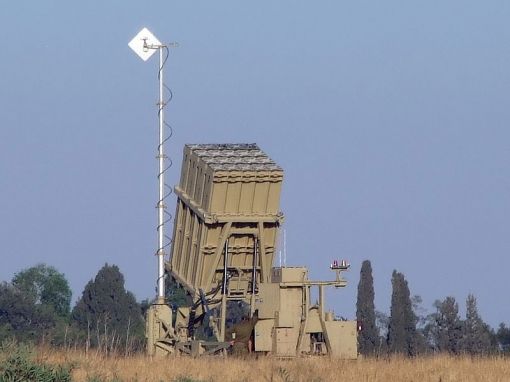
 Iron Dome missile launcher
[Asia Economy Yang Nak-gyu, Military Specialist Reporter] Last May, the world was astonished by a video released by Israel. It showed hundreds of rockets fired by the Palestinian armed faction Hamas at southern Israeli cities such as Ashkelon, being intercepted in the air before hitting their targets. This scene clearly demonstrated the performance of the Iron Dome interceptor missile developed by the Israeli defense company Rafael.
Israel invested about 230 billion won in 2007 and developed the Iron Dome in 2011. The system deploys interceptor missile launch vehicles at multiple locations, creating a dome-shaped air defense network that intercepts incoming rockets and artillery shells. One Iron Dome battery consists of three launch vehicles capable of firing 20 interceptor missiles, Tamir interceptor missiles, radar with a detection range of 150 km, tracking systems, and a fire control center. The cost of one battery is about 60 billion won, and each Tamir interceptor missile costs over 50 million won.
The Iron Dome intercepts enemy short-range rockets and mortar shells within approximately 70 km. The time from initial detection to interception is known to be about 15 to 25 seconds. The manufacturer claims an interception rate of over 90%. According to the Israeli Ministry of Defense, since the conflict began, more than 1,000 rockets have been fired from the Gaza Strip, and 90% of the rockets reaching Israeli airspace were destroyed by the Iron Dome.
Our military is also starting to develop a ‘Korean Iron Dome’ to prepare for potential North Korean long-range artillery attacks. This is intended to protect critical national facilities from North Korean long-range artillery threats, with a project budget of 2.89 trillion won planned from this year until 2035. Currently, about 1,000 various long-range artillery pieces are deployed in the northern areas near the Military Demarcation Line (MDL). Among these, approximately 330 units of 170mm self-propelled guns with a range of 54 km and 240mm multiple rocket launchers with a range of 60 km are known to directly target Seoul and the metropolitan area.
Some argue that the domestic development cost of the long-range artillery interception system is about 4 to 5 times higher than Israel’s Iron Dome. In response, our military explained, "The Iron Dome sporadically counters rockets from armed groups like Hamas and irregular forces. In contrast, the system we are pursuing to counter North Korean long-range artillery has similarities to the Iron Dome in terms of system and interception capabilities, but considering the security situation, it requires higher technical difficulty."
© The Asia Business Daily(www.asiae.co.kr). All rights reserved.
![User Who Sold Erroneously Deposited Bitcoins to Repay Debt and Fund Entertainment... What Did the Supreme Court Decide in 2021? [Legal Issue Check]](https://cwcontent.asiae.co.kr/asiaresize/183/2026020910431234020_1770601391.png)