[Asia Economy Yang Nak-gyu, Military Specialist Reporter] Our military began developing surface-to-air guided missiles for the first time in the 1980s. On October 9, 1983, North Korea carried out the Aung San terrorist attack in Yangon, Myanmar, attempting to assassinate then-President Chun Doo-hwan. Although President Chun narrowly escaped harm due to a delayed schedule that caused him to arrive late at the scene, the attempt to assassinate government officials abroad was shocking. This incident triggered the start of the domestic short-range surface-to-air guided missile (KSAM) project, leading to the development of the Korean short-range surface-to-air guided missile 'Cheongung.' The recently exported Korean-made interceptor missile Cheongung II, first sold to the Middle East's United Arab Emirates (UAE), is based on this technology. On the 10th, I visited Hanwha Systems' Yongin Research Center to observe the radar technology, a core component of Cheongung II.
The radar research center staff were filled with pride over the Middle East export of Cheongung II. It was the first overseas export and symbolized the largest scale in domestic defense exports. Cheongung II was developed through collaboration among LIG Nex1 (launcher), Hanwha Systems (radar), and Hanwha Defense (launcher platform). Hanwha Systems expects export revenues to reach between 1.2 trillion and 1.6 trillion KRW from this deal.
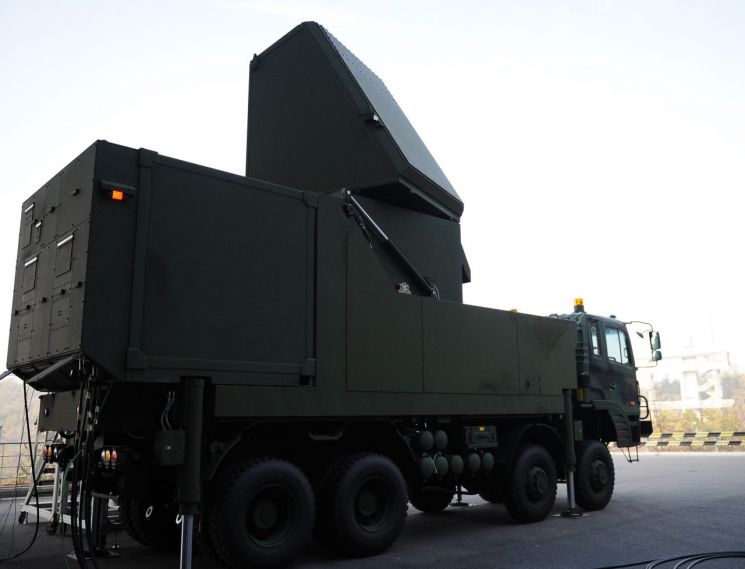
After climbing about 1 km up the hill at the Yongin Research Center, a radar vehicle stood at the summit. It was the fifth Cheongung II radar unit soon to be delivered to our military. The vehicle carrying the radar was a 14-ton truck, measuring 10 meters in length, 7 meters in height, with wheels over 1 meter in diameter.
The Cheongung II radar distinguishes North Korean fighter jets or ballistic missiles flying from 100 km away by distance, altitude, and speed. When a research center staff member simulated radar signals from three North Korean ballistic missiles aimed at Cheongung II, three white dots appeared on the screen starting from the 150 km mark. The missiles began approaching Seoul at a speed of 1,200 km/h, crossing the Military Demarcation Line. As they approached within 80 km, the white dots transformed into triangles, and precise analysis began.
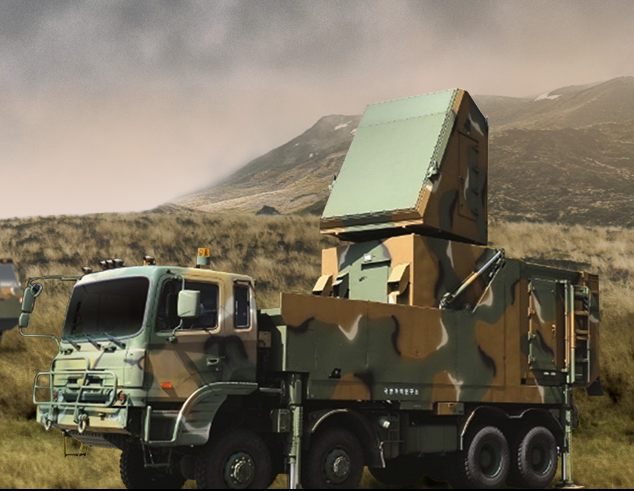
The adjacent monitor displayed the altitude of the incoming missiles. When the altitude reached 50 km, the radar transmitted the ballistic missile's location to the Cheongung II operation control center, which ordered the launcher to intercept. The entire sequence of responses was completed within 5 seconds. Two interceptor missiles were launched from the launcher, and the ballistic missiles soon disappeared. The Cheongung II missile recorded a 100% hit rate during a test launch in 2017. It is launched from a vertical launcher using a 'cold launch' method, soaring upward before sharply turning toward the target to intercept. Developed through technological cooperation with Russia, it is similar to the Russian S-350 interceptor missile.
The Cheongung II radar, capable of simultaneously detecting about 100 aircraft and 20 ballistic missiles, was fixed and operated facing Incheon Airport. The monitor captured all aircraft flying in the forward area. Unidentified objects at the 100 km mark were displayed as white dots. As they approached 80 km, the dots changed to yellow (accurately detected targets), then to blue (identification of friend or foe).
Park Hyuk, head of the Radar System Center, explained, "If a fighter jet radar had 500 to 1,000 human eyes, the Cheongung II radar has 7,000. This is why it can simultaneously track aircraft and missiles without missing them."
© The Asia Business Daily(www.asiae.co.kr). All rights reserved.