[Seoul District News] Yangcheon-gu Launches Sharing Campaign from Jan 17 to Feb 7 for Food and Daily Necessities Donations Including Rice, Ramen, Canned Goods, Soap, and Tissue... Jongno-gu Conducts 'Seol Holiday Donation Sharing Event' Accepting Food and Daily Necessities Donations Until the 21st for Low-Income Residents... Seongdong-gu Refunds 98 Million KRW in Local Taxes via KakaoTalk Application Service... Dobong-gu Supports Replacement of 4,337 Eco-Friendly Home Boilers to Reduce Greenhouse Gas Emissions... 'Gangseo Customized Smart City Basic Plan'
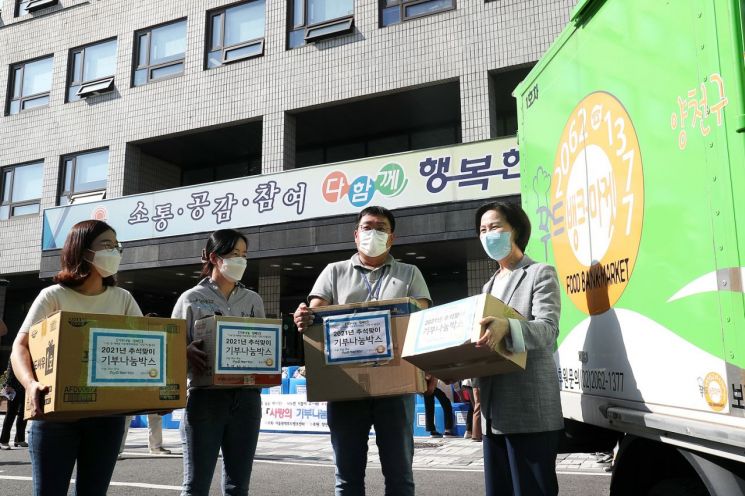 Kim Soo-young, Yangcheon District Mayor, with employees at the donation sharing box delivery ceremony for last year's Chuseok holiday (far right)
[Asia Economy Reporter Park Jong-il] Yangcheon-gu (Mayor Kim Soo-young) will conduct the ‘2022 Lunar New Year Donation Sharing Campaign’ from January 17 to February 7 ahead of the traditional Lunar New Year holiday.
The ‘Donation Sharing Campaign’ is an event to collect food and daily necessities stored in each household and deliver them to neighbors in need in the community so that they can have a warm holiday.
Residents who wish to participate can donate food items such as ▲rice ▲ramen ▲canned food ▲processed food ▲beverages and daily necessities such as ▲soap ▲detergent ▲toothpaste ▲toothbrush ▲tissue paper to sharing boxes set up at the community service centers and designated base institutions in each neighborhood. However, frozen/refrigerated foods, side dishes, and instant foods that can spoil at room temperature are excluded.
The donated items collected with warm hands will be delivered to neighbors in need through the ‘Yangcheon-gu Food Bank & Market Center.’
The district operates a year-round donation campaign that anyone can participate in without burden to widely spread a culture of sharing centered on individuals rather than companies. Individuals or groups wishing to participate can inquire at the Welfare Policy Division or the Yangcheon-gu Food Bank & Market Center.
Kim Soo-young, Mayor of Yangcheon-gu, said, “Through the Lunar New Year donation sharing campaign, we ask for active participation from those interested so that our neighbors in the welfare blind spots can have a plentiful and abundant holiday.”
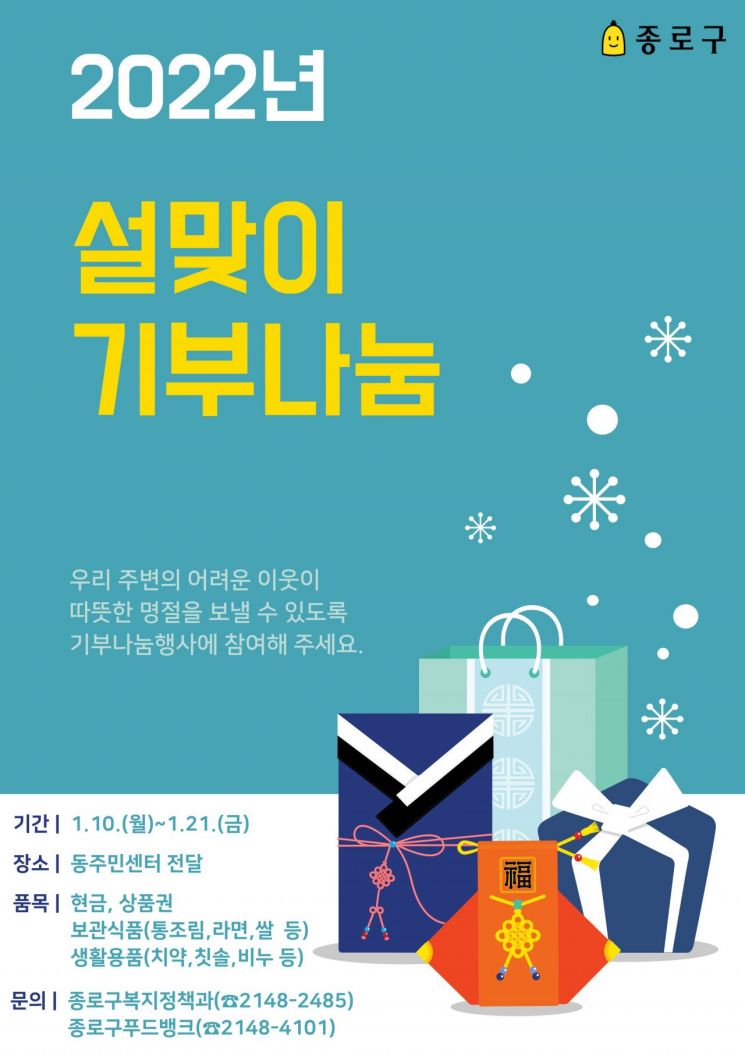
Jongno-gu has prepared a sharing event to exchange warm hearts among neighbors ahead of the Lunar New Year holiday.
The ‘Lunar New Year Donation Sharing’ event, held from the 10th to the 21st of this month, is an occasion to collect food and daily necessities and deliver them to low-income residents. It aims to spread a resident-led sharing culture in connection with the neighborhood community security council and create a warm welfare city.
Since 2012, based on voluntary participation of one item per employee at the district office, the event has continued for over 10 years, and last Lunar New Year, about 20 million won worth of daily necessities and cash were collected and delivered to neighbors in need.
This year, it plans to provide various daily necessities that can offer mental and material comfort to marginalized residents who are having a hard time due to ongoing social distancing measures.
Donation items include long-lasting canned food, canned beverages, rice, and daily necessities such as soap, shampoo, toothpaste, toothbrush, detergent, and tissue paper.
Additionally, unused items, recyclables, and quarantine supplies such as masks or hand sanitizers considering the COVID-19 situation are also acceptable. However, fresh foods that can spoil at room temperature, medicines, and functional foods are excluded.
Any resident wishing to share warm hearts with neighbors can place prepared items in the sharing boxes installed at the district office’s Welfare Policy Division or nearby community service centers.
The collected items will be delivered to the Jongno-gu Food Bank & Market Center on the 24th and provided to low-income residents in the area under a thorough quarantine system.
A district official said, “The donation sharing event has been steadily held for over 10 years every holiday since 2012, thanks to the active participation of district office employees and residents. As it is a meaningful occasion to directly deliver mental and material comfort to neighbors who are less fortunate than ourselves, we ask for the interest and participation of many residents.”
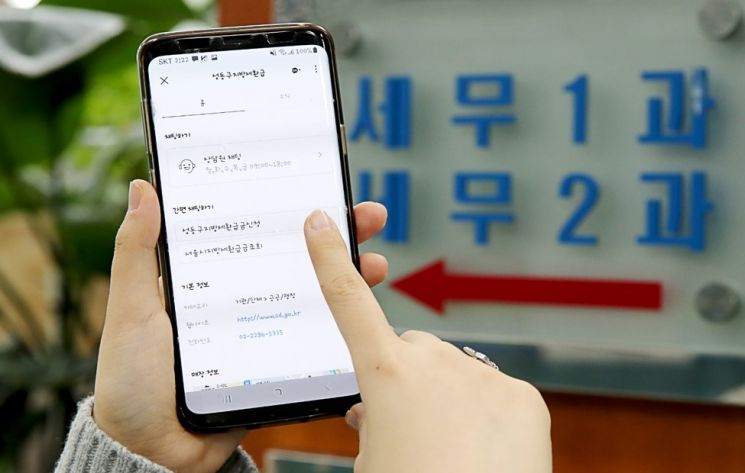
Seongdong-gu (Mayor Jung Won-oh) has reportedly returned 98 million won to residents through the ‘KakaoTalk Application Service’ used for local tax refund applications.
The ‘KakaoTalk Refund Application Service’ is a service that allows local tax refunds via KakaoTalk, enabling easy application without the traditional procedures of filling out and sending forms.
This convenient and easy non-face-to-face refund application method has received much praise and positive feedback from residents. Taxpayers can conveniently receive refunds at their preferred time or consult on inquiries other than local tax refunds via 1:1 chat, which has been highly appreciated by residents. Notably, over 70% of users applied after business hours or on holidays, showing high satisfaction with the 24/7 year-round refund application availability.
Local tax refunds mainly arise from reasons such as vehicle tax prepayment followed by scrapping or ownership transfer, and if not claimed within five years from the refund decision date, they expire. To resolve inconveniences such as low interest in small refunds and complicated procedures, the district introduced the KakaoTalk refund application service last year, established a safe business channel approved by KakaoTalk with business registration certificates, and created QR codes for easy channel access.
The ‘Seongdong-gu KakaoTalk Refund Application Service,’ introduced nationwide as a user-centered refund service best practice by the Ministry of the Interior and Safety in 2021, processed 998 out of 4,756 refund applications last year, exceeding a 20% processing rate and accelerating a 99.8% refund amount processing rate over the past five years. This year, the district plans to further enhance convenience by operating ‘Local Tax of the Month’ to provide local tax news.
To check and apply for local tax refunds, search ‘Seongdong-gu Local Tax Refund’ on KakaoTalk or use the QR code to access the channel, check Seoul local tax refunds, and enter the refund number, name, and bank account number in the chat window to submit the application. The refund will be deposited within 1-2 business days.
Jung Won-oh, Mayor of Seongdong-gu, stated, “The KakaoTalk refund application system is a tax administration service that protects taxpayers’ rights and convenience in line with the times. We will continue to strive to provide various services suitable for a smart inclusive city to taxpayers.”
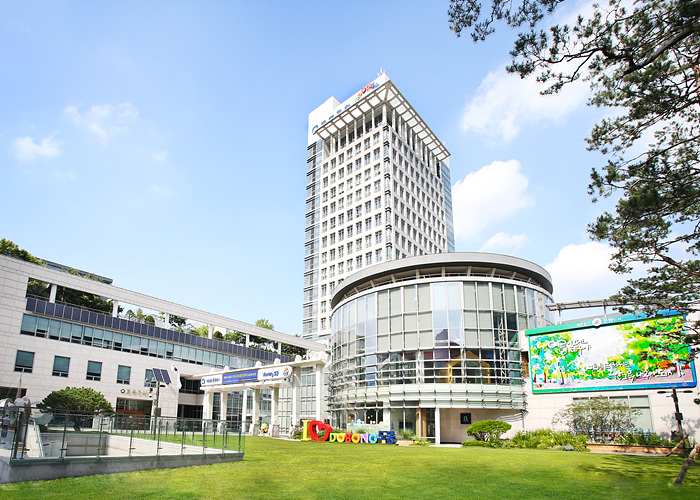
Dobong-gu (Mayor Lee Dong-jin) will support the replacement of 4,337 household eco-friendly boilers from January 2022 to reduce greenhouse gas emissions and fine dust.
Household eco-friendly boilers are boilers certified with the ‘Environmental Label’ by the Korea Environmental Industry & Technology Institute, emitting nitrogen oxides (NOx) at one-eighth the level of general boilers and having 12% higher thermal efficiency, thus reducing greenhouse gases and fine dust. Specific product specifications of eco-friendly boilers can be checked on the Korea Environmental Industry & Technology Institute website.
The support target is Dobong-gu residents who replace boilers manufactured over 10 years ago (before December 31, 2012) with eco-friendly boilers. For each boiler, general households receive 100,000 won, and low-income households receive 600,000 won. Support is prioritized in the order of ▲vulnerable groups (recipients of livelihood benefits, near-poverty groups, etc.) ▲private childcare centers, private senior centers, and other privately operated social welfare facilities ▲those who replaced household boilers (priority given to older boilers), with applications accepted until the end of each month and support provided according to priority.
The support procedure includes two methods: the buyer contracts with the supplier (boiler agency, etc.) for the amount after deducting the subsidy, and the supplier installs the boiler after the district confirms the subsidy payment; or the buyer installs the boiler first and then applies for the subsidy.
Applications can be submitted by visiting or mailing the ‘Dobong-gu Environmental Policy Division’ with the subsidy application form and required documents before the budget is exhausted. For details, refer to the ‘2022 Household Eco-friendly Boiler Installation Support Implementation Guide’ on the district website’s notice board.
Meanwhile, the eco-friendly boiler distribution project is a core task of Dobong-gu’s ‘2050 Greenhouse Gas Reduction Strategy’ established in September 2020. The district plans to replace 100% of boilers in the area with eco-friendly boilers by 2050. Last year, Dobong-gu distributed a total of 4,899 eco-friendly boilers, reducing about 2,700 tons of carbon dioxide (CO2).
Lee Dong-jin, Mayor of Dobong-gu, said, “Replacing with eco-friendly boilers has been mandatory since 2020. If you have an old boiler at home, we recommend using this support to replace it with an eco-friendly boiler. We ask for active interest and participation from residents for Dobong-gu’s carbon neutrality by 2050.”
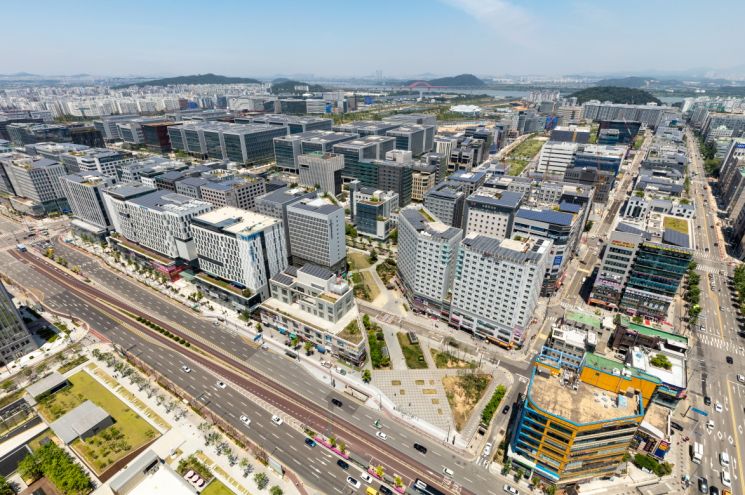
Gangseo-gu, Seoul (Mayor Noh Hyun-song) is starting efforts to create a smart city that all residents can conveniently enjoy.
The district announced that it has established a three-year basic plan to actively promote the ‘Gangseo Customized Smart City Project’ reflecting local characteristics.
Under the vision of ‘Gangseo-gu, a smart city that adds value to future urban life,’ the district aims to complete the ‘Lim Smart Project’ centered on the old downtown and the ‘Plus Smart Project’ centered on the new downtown, promoting a total of 41 projects under 9 strategic goals with a budget of 16.8 billion won over three years.
The district plans to lead the Fourth Industrial Revolution era by focusing on balanced development between the new and old downtown areas and promoting smart city projects across various fields such as safety, environment, urban agriculture, and transportation.
The Magok district, which has rapidly grown into a high-tech industrial city, will be further developed into a smart city, and the residential-centered old downtown will enhance resident convenience through smart technologies, promoting balanced development between the old and new downtown areas through smart city projects tailored to local characteristics.
To this end, the district will implement the ‘Lim Smart Project’ in existing residential areas such as Hwagok, Yeomchang, Gayang, and Deungchon to minimize urban problems and create a safe and pleasant residential environment.
▲ Introduction of smart women’s safety services ▲ Installation of disaster safety management systems for facilities ▲ Installation of streetlight smart poles for electric vehicle and electric kickboard charging ▲ Distribution of IoT devices to elderly living alone and middle-aged single-person households, focusing on safety, housing, welfare, and environment to improve residents’ quality of life.
In new downtown areas such as Magok, the ‘Plus Smart Project’ will be promoted in urban agriculture, tourism, and transportation to create a city that coexists and develops by adding smart technologies.
▲ Establishment of intelligent video surveillance systems ▲ Review and introduction of sandbox test fields ▲ Expansion of smart gardens inside buildings ▲ Construction of barrier-free, slope-free PM-only roads, utilizing advanced technologies throughout the region to independently solve urban problems and lead smart technology.
Notably, this smart city basic plan is significant as it is the first in the autonomous district to be developed through collaboration among project managers and departments rather than external research services.
This achievement was made by collecting data on local issues across all fields for two years, analyzing urban problems in detail, and matching solutions through expert advisory meetings with the Korea Research Institute for Human Settlements, Seoul Digital Foundation, and others.
Through this three-year master plan, the district plans to lay the foundation to become a genuine smart city Gangseo by 2024 and discover and expand related projects.
Mayor Noh Hyun-song said, “The most important thing for Gangseo-gu to lead the Fourth Industrial Revolution and move toward a future smart city is balanced development between the old and new downtown areas. We will create a people-centered smart city so that no one is left behind and all residents can enjoy cutting-edge public services.”
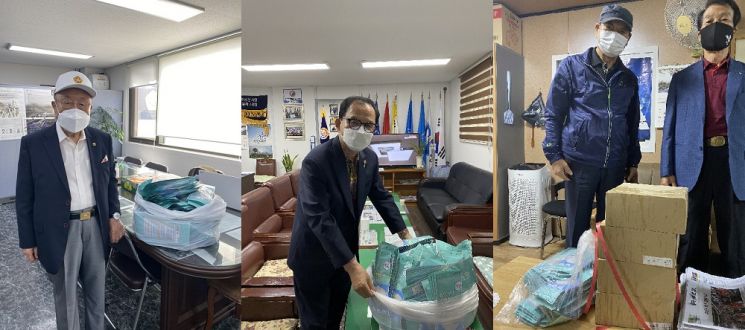
Dongjak-gu (Mayor Lee Chang-woo) will significantly expand respect and support for national veterans, including those who sacrificed and devoted themselves to the country this year, as well as veterans’ halls and veterans’ organizations.
In particular, the monthly veterans’ honor allowance paid to national veterans and their families will be increased to 30,000 won, and for the first time, funeral services (worth 200,000 won) will be provided upon death to ensure respect until the end of life.
Last year, the district partially revised and promulgated the ‘Seoul Dongjak-gu Ordinance on Respect and Support for National Veterans’ Enforcement Rules’ to expand support for national veterans, which will be implemented from this year.
Accordingly, the veterans’ honor allowance will be increased from the existing 20,000 won per month to 30,000 won, and consolation money of 20,000 won will be paid during Lunar New Year, Chuseok holidays, and the June Veterans Month.
The district plans to increase the veterans’ honor allowance annually until 2025 to improve the welfare of national veterans.
To receive the veterans’ honor allowance, applicants must visit their local community service center to apply, and from this month, payments will be made non-face-to-face via bank transfer.
Also, the requirement to have lived in the district for more than one year to receive the death consolation money (200,000 won) and apply has been abolished, allowing bereaved families (priority order) of eligible persons registered in the district at the time of death to benefit.
Furthermore, to revitalize veterans’ organizations and improve the welfare of their members, subsidies previously provided only for war zone pilgrimage projects will be expanded and supported to allow customized projects according to each organization’s characteristics.
Along with this, the district plans to support the operation of veterans’ halls and veterans’ organizations and reinforce facility functions to expand stable support and respect for veterans.
Park Mi-young, Director of the Welfare Policy Division, said, “We will do our best to provide stable and appropriate support and respect to ensure a dignified life for those who sacrificed for the country and their families, never forgetting and remembering them.”
© The Asia Business Daily(www.asiae.co.kr). All rights reserved.
![User Who Sold Erroneously Deposited Bitcoins to Repay Debt and Fund Entertainment... What Did the Supreme Court Decide in 2021? [Legal Issue Check]](https://cwcontent.asiae.co.kr/asiaresize/183/2026020910431234020_1770601391.png)

















