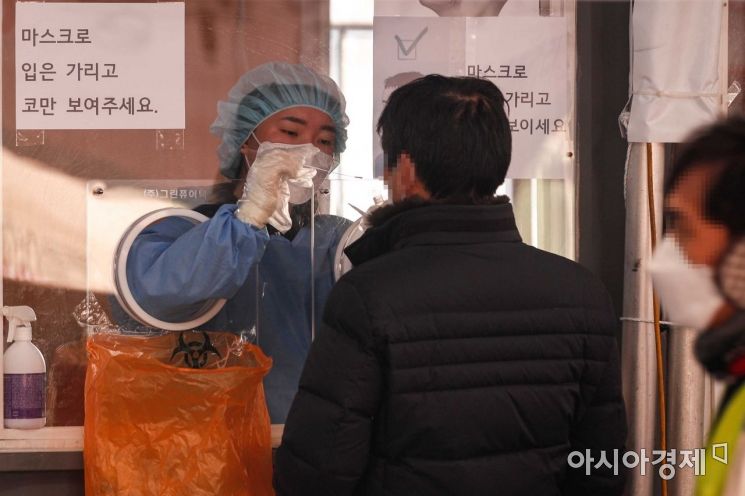
 On the 16th, when 4,194 new COVID-19 cases were reported, citizens visiting the temporary screening clinic set up at Seoul Station Plaza are getting tested. Photo by Jinhyung Kang aymsdream@
[Asia Economy Reporter Seo So-jeong] As the Omicron variant spreads and daily COVID-19 cases in South Korea exceed 10,000, the government plans to fully implement rapid antigen testing (diagnostic kits) at local clinics. This is because the surge in cases caused by the highly transmissible Omicron variant will push the capacity of the currently free polymerase chain reaction (PCR) tests to their limits, making it impossible to meet testing demand.
According to the Central Disaster and Safety Countermeasures Headquarters on the 16th, the government is currently discussing the scope of health insurance coverage and the costs individuals will bear regarding rapid antigen testing at medical institutions. Park Hyang, head of the Central Accident Response Headquarters’ quarantine team, stated, "The scale of the outbreak that exceeds PCR testing capacity is about 10,000 confirmed cases per day. Rapid antigen tests, in addition to PCR tests, can be used for vaccination proof and negative confirmation systems (quarantine passes), but self-tests are not recognized."
Earlier, on the 14th, the government announced the 'Omicron Spread Response Strategy,' stating that when the Omicron variant becomes dominant, rapid antigen testing using diagnostic kits will be conducted at hospital and clinic-level medical institutions. Although rapid antigen tests are less accurate than PCR tests, results can be obtained within 30 minutes.
Initially, during the Omicron preparation phase (up to 5,000 daily confirmed cases), the government will strengthen response efforts by increasing PCR testing capacity by 100,000 tests to a total of 850,000 tests per day. However, from the Omicron response phase (starting at 7,000 daily confirmed cases), due to the surge in cases, PCR testing will be prioritized. Priority for PCR testing will be given to the elderly at high risk of severe illness from COVID-19, infection-vulnerable facilities with significant cluster infections, and individuals with epidemiological links.
However, even if the Omicron variant becomes dominant, if the number of tests does not exceed 850,000 per day, PCR tests will continue to be available for free at screening clinics as before. If daily testing exceeds 850,000 and reaches capacity limits, rapid antigen testing will be actively implemented at local clinics. If respiratory symptoms or other suspected COVID-19 symptoms are present, individuals can receive rapid antigen tests at local medical institutions, and if the result is positive, they can then receive a PCR test. Even with a doctor's note, PCR testing can be done without taking a rapid antigen test.
Local clinic services will begin at otolaryngology, internal medicine, and pediatric clinics and will be gradually expanded. Currently, infectious disease-dedicated hospitals mainly handle treatment, but in the future, respiratory clinics will also be allowed to provide care. There are 649 respiratory clinics nationwide, including 70 in Seoul.
© The Asia Business Daily(www.asiae.co.kr). All rights reserved.
![User Who Sold Erroneously Deposited Bitcoins to Repay Debt and Fund Entertainment... What Did the Supreme Court Decide in 2021? [Legal Issue Check]](https://cwcontent.asiae.co.kr/asiaresize/183/2026020910431234020_1770601391.png)















