Seoul Apartment Actual Transaction Prices Fall for the First Time in 19 Months
Both Mortgage and Credit Loan Interest Rates Rise
[Asia Economy Reporter Jang Sehee] Following loan regulations by financial authorities and subsequent interest rate hikes, stock prices and housing prices are declining. With additional interest rate hikes expected in the future, there are forecasts that prices could fall sharply compared to their peak levels.
Over the past year, loan interest rates have already risen by more than 1 percentage point, and it is estimated that the average borrower's interest burden has increased by more than 640,000 KRW per person.
Moreover, if the base interest rate rises to 1.75% as expected by the end of this year, interest payments could increase by nearly 500,000 KRW again.
The Bank of Korea estimated that during the normalization of the base interest rate (0.50% → 1.25%) since last year, the annual interest burden on households would increase by 9.6 trillion KRW. The interest burden per person is expected to rise from 2,896,000 KRW annually to 3,380,000 KRW, an increase of 484,000 KRW.
As interest burdens increase, borrowers may reduce consumption, and if the asset prices obtained through leveraged investments fall below the acquisition price, a domino effect of asset sales could begin.
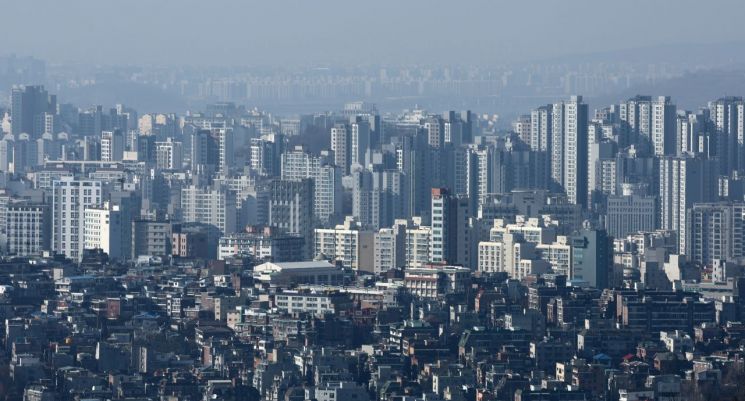
◆ Seoul Apartment Actual Transaction Prices Fall for the First Time in 19 Months... Stocks Also 'Plummet' = According to the Korea Real Estate Board, as of November last year, the Seoul apartment actual transaction price index (179.9) fell by 0.79% in one month. This is the first decline in 19 months. The Gyeonggi Province actual transaction price index (-0.11%) also turned downward for the first time in 2 years and 6 months.
The KOSPI index as of the 14th stands at 2,921.92, which is 11.6% lower than the all-time high of 3,305.21 recorded on July 6 last year.
The price of Bitcoin (as of the 15th, in the 52 million KRW range) has plunged by about 37% in just about two months compared to November last year (in the 82 million KRW range).
In the 'Financial Stability Report' released last month, the Bank of Korea mentioned the potential impact on consumption due to household debt, rapid deleveraging (repayment and reduction of borrowing), and the possibility of housing price adjustments.
In the report, the Bank of Korea stated, "Considering the high proportion of real assets held by households in our country and the increase in high-risk households, if households' real income decreases significantly, households may secure liquidity by selling real assets, which could lead to housing price adjustments."
◆ Both Upper Limits of Mortgage Loans and Credit Loans Rise = According to the financial sector on the 16th, the variable interest rates for mortgage loans (new COFIX-linked) at KB Kookmin, Shinhan, Hana, and Woori Banks as of the 14th are at an annual rate of 3.570% to 5.070%. Compared to December 31, 2020 (2.520% to 4.054%), the lower and upper limits have each increased by about 1.050 percentage points and 1.016 percentage points over roughly one year.
During the same period, the mixed (fixed) interest rates for mortgage loans also rose from 2.690% to 4.200% annually to 3.750% to 5.510%. The lowest interest rate increased by 1.060 percentage points, and the highest interest rate rose by as much as 1.310 percentage points.
For credit loans, the current interest rates applied (grade 1, 1 year) are 3.440% to 4.730%. Compared to the end of December 2020 (2.650% to 3.760%), the lower limit rose by 0.790 percentage points, and the upper limit increased by 0.970 percentage points.
© The Asia Business Daily(www.asiae.co.kr). All rights reserved.