On the 16th, the 47th Small but Certain Happiness Pledge Announced
"Ignoring the Risk of Fukushima Nuclear Plant Radioactive Water with a Diplomatic Low Profile Is Turning a Blind Eye to Citizens' Lives and Safety"
[Asia Economy Reporter Oh Ju-yeon] Lee Jae-myung, the presidential candidate of the Democratic Party of Korea, stated on the 16th, "We will strengthen radiation inspections on domestically produced imported goods and introduce the 'Positive List System,' an international standard safety management system, to completely block the import of radioactive contaminated seafood from Japan, thereby taking responsibility for the safety of seafood food products."
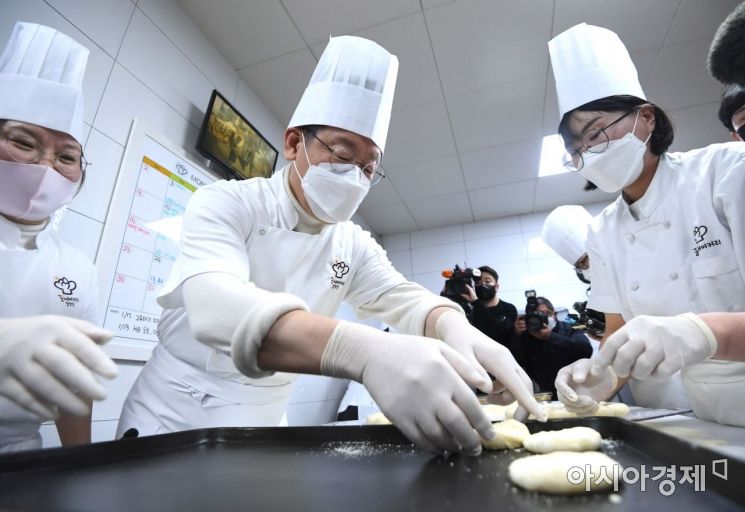 Lee Jae-myung, the Democratic Party presidential candidate, is experiencing bread making at Kkum Bakery in Jung-gu, Incheon, on the afternoon of the 14th. Photo by the National Assembly Press Photographers Group
On the same day, through Facebook, Candidate Lee announced his 47th small but certain happiness pledge, saying, "We will protect seafood safety and the lives of the people from Fukushima contaminated water."
He expressed concern, saying, "Despite various concerns and opposition, Japan is pushing forward with plans to discharge contaminated water from the Fukushima nuclear power plant. If a massive amount of radioactive contaminated water is discharged, it will have a significant impact on our marine ecosystem, causing serious threats such as damage to fishing activities and seafood safety."
Candidate Lee emphasized that along with a strong diplomatic response to Japan's unilateral discharge of Fukushima nuclear power plant contaminated water, he will actively prepare for the expected economic damage and seafood safety.
As the first measure to ensure seafood safety, he pledged to strengthen radiation inspections on domestically produced seafood and introduce the Positive List System, an international standard safety management system. This aims to completely block the import of radioactive contaminated seafood and take responsibility for the safety of the people's seafood food products. He added that for substances without separately established maximum residue limits, imports will be strictly allowed only if the level is below 0.01 mg/kg.
He also promised a significant expansion of safety management infrastructure, including radiation inspection equipment and related personnel. He plans to increase investments necessary for equipping radiation inspection devices and establishing laboratories in line with the modernization of aging fish markets.
The pledge also mentioned past remarks by Yoon Seok-youl, the presidential candidate of the People Power Party. Candidate Yoon previously said, "Although the Fukushima nuclear power plant suffered great damage due to earthquakes and tsunamis, the nuclear plant itself did not collapse, so there was no radioactive leakage."
In response, Candidate Lee pointed out, "In March 2011, an earthquake and tsunami struck the Fukushima nuclear power plant, damaging the buildings and disabling the plant's functions, resulting in a large-scale release of radioactive materials," and added, "The International Atomic Energy Agency assigned the highest level 7 on the International Nuclear and Radiological Event Scale (INES) for this incident," emphasizing, "This is the fact."
Candidate Lee stated, "In protecting the safety of the people, I will respond so strongly that it may be considered an overreaction."
© The Asia Business Daily(www.asiae.co.kr). All rights reserved.
![User Who Sold Erroneously Deposited Bitcoins to Repay Debt and Fund Entertainment... What Did the Supreme Court Decide in 2021? [Legal Issue Check]](https://cwcontent.asiae.co.kr/asiaresize/183/2026020910431234020_1770601391.png)















