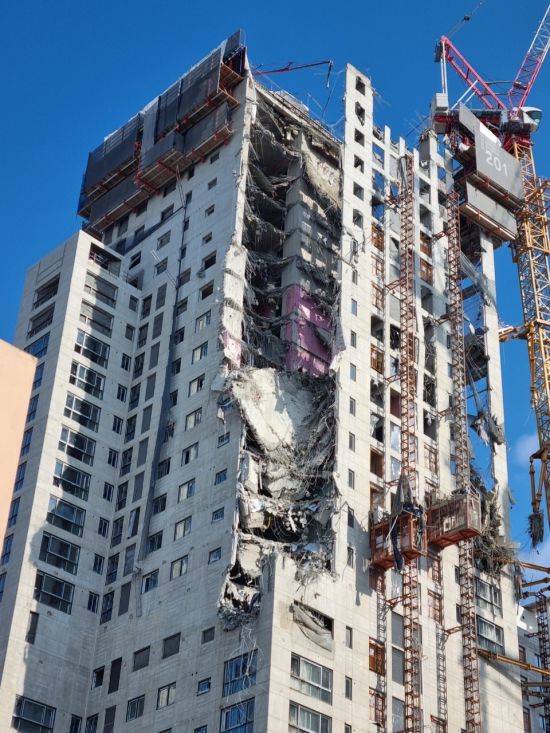
[Asia Economy Honam Reporting Headquarters Reporter Park Jin-hyung] The 'insufficient concrete curing period,' considered one of the causes of the Hwajeong I-Park accident in Seo-gu, Gwangju Metropolitan City, is gaining weight.
According to the concrete pouring log for Building 201 of the collapsed structure secured by the Construction Labor Union Gwangju-Jeonnam Headquarters on the 15th, after pouring the concrete for the 35th-floor slab on November 23 last year, the next floor, the 36th-floor slab, was poured 10 days later.
Subsequently, the 37th and 38th-floor slabs were poured after 7 and 6 days, respectively, and the 38th-floor ceiling (PIT floor slab) was also poured after 8 days.
A week later, the PIT floor (the floor where equipment and piping pass) walls were poured, and 11 days later, the collapse accident occurred while pouring the 39th-floor slab.
From the 35th floor to the PIT floor, five floors were poured within 6 to 10 days each, undermining HDC Hyundai Development Company's explanation that "a sufficient curing period of 12 to 18 days was observed."
In winter, concrete does not dry well, so curing work must be done by allowing enough time and using hot air to harden it strongly. The analysis that poor curing caused the lower floors to fail to support the weight of the gang form (formwork), leading to the collapse of the lower floors as well, is gaining traction.
Professor Choi Myung-gi of the Korea Industrial Site Professors Group explained, "In winter, concrete does not dry well and requires about two weeks of curing. Raising one floor every week means that curing was poorly conducted."
Professor Song Chang-young of the Department of Architecture at Gwangju University also analyzed, "The weight of the concrete poured on the day of the collapse influenced the collapse, and combined with poor concrete curing, it appears that the supporting layer could not withstand the load."
© The Asia Business Daily(www.asiae.co.kr). All rights reserved.
![User Who Sold Erroneously Deposited Bitcoins to Repay Debt and Fund Entertainment... What Did the Supreme Court Decide in 2021? [Legal Issue Check]](https://cwcontent.asiae.co.kr/asiaresize/183/2026020910431234020_1770601391.png)
















