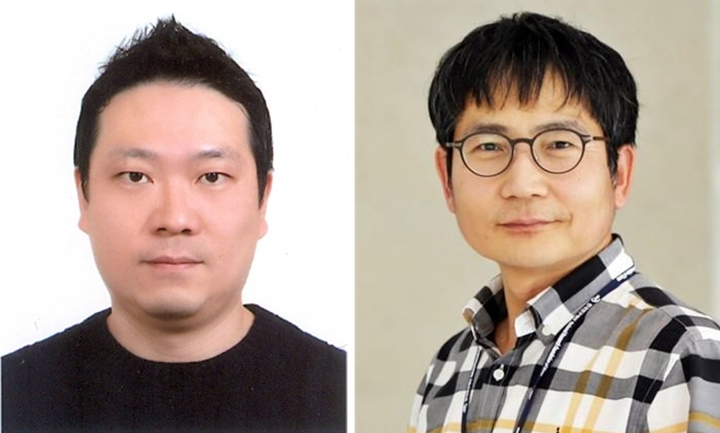
 Professors Kwon Moon-hyuk and Kim Seon-won of Gyeongsang National University. [Image source=Gyeongsang National University]
[Asia Economy Yeongnam Reporting Headquarters Reporter Choi Soon-kyung] On the 14th, the ABC-RLRC research team at the Anti-Aging Biomaterial Cell Factory Regional Innovation Research Center of Gyeongsang National University announced that they have identified the enzyme that synthesizes diterpenoids and secured genetic resources for mass production in cell factories.
This study, conducted as an international joint collaboration between the Regional Innovation Research Center and the University of Calgary in Canada, was led by ABC-RLRC with support from the Ministry of Science and ICT's Leading Research Center project. As a result, it was published in the January issue of the world-class journal in the enzyme and catalyst field, ACS Catalysis (IF=13.084).
Salvia divinorum, native to Europe and West Asia, is a plant belonging to the Lamiaceae family that produces salvinorin and salvinicin, diterpenoid natural substances with strong antipsychotic effects. For this reason, since ancient times, the Aztec Indians have used it in religious ceremonies and as a medicinal treatment, calling it "Magic Mint."
In particular, salvinorin and salvinicin have a unique structure that selectively binds only to specific opioid receptors that regulate human emotions and pain, making them natural substances spotlighted as next-generation antipsychotic drug materials. Opioids are substances that act on opioid receptors to produce morphine-like effects and are mainly used for pain relief, including anesthesia.
Research Professor Kwon Moon-hyuk, who led this study, said, "Taking this research as an opportunity, we will continue to identify all enzymes involved in the synthesis of salvinorin and salvinicin from Magic Mint and discover genetic resources that can be used as components in cell factories."
Center Director Kim Seon-won stated, "We will continue research to secure essential genetic resources for constructing cell factories and produce high value-added biomaterials through this."
© The Asia Business Daily(www.asiae.co.kr). All rights reserved.
![User Who Sold Erroneously Deposited Bitcoins to Repay Debt and Fund Entertainment... What Did the Supreme Court Decide in 2021? [Legal Issue Check]](https://cwcontent.asiae.co.kr/asiaresize/183/2026020910431234020_1770601391.png)