Amid numerous 2030-related pledges, most are populist promises
Lee Jae-myung and Yoon Seok-youl say "National and bipartisan consensus needed on pension reform" but only start talking
Ahn Cheol-soo calls for pension reform but focuses more on integrating civil servant pensions than fundamental solutions
[Asia Economy Reporter Naju-seok] While each presidential candidate is expressing concern about the future of the 2030 generation and unveiling related pledges, there are many criticisms that these are mostly about ‘handing out money’ or limited to areas that have immediate impact. In particular, no blueprint for pension reform?a field that will come as a kind of ‘disaster’ to the youth generation?is emerging in this presidential election. It seems that candidates are avoiding tackling areas with significant social ripple effects due to fears of backlash such as a drop in approval ratings, but some argue this also reflects the candidates’ lack of capability.
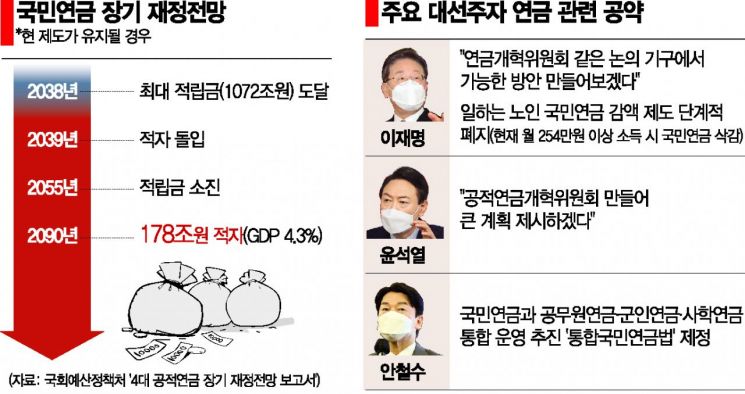
◆Presidential candidates lack the ‘courage to touch the National Pension’= The National Assembly Budget Office revealed in a report titled ‘Long-term Financial Outlook of the Four Major Public Pensions’ that the National Pension Fund will be depleted by 2055. According to this scenario, which assumes no pension reform is undertaken, the National Pension deficit will reach 178 trillion won by 2090. Some have expressed concerns that generations born after 1990 may not receive any National Pension benefits at all. The situation with special occupational pensions is also worsening. Public officials’ pensions and military pensions are already running deficits, with the government injecting tax money as compensation. According to last year’s settlement details, the government injected 2.5644 trillion won into the public officials’ pension and 1.5779 trillion won into the military pension as compensation funds. The relatively better-off private school teachers’ pension is expected to turn into a deficit around 2033 and be completely depleted by about 2048.
◆Knowing but ‘silent or ignoring’= Major presidential candidates are either completely ignoring the pension issue or trying to avoid controversy by sidestepping the core problem when they mention it. Lee Jae-myung, the Democratic Party presidential candidate, and Yoon Seok-youl, the People Power Party presidential candidate, only mention ‘national consensus’ and ‘bipartisanship’ as a way to initiate discussions. On the 3rd, Lee said on a broadcast, "To draw out national consensus, I can only say that we will create a discussion body like a Pension Reform Committee to come up with possible measures." This statement reflects extreme caution. Yoon said at the Kwanhun Club invitation debate on the 14th of last month, "We will create a Public Pension Reform Committee and present a major bipartisan plan on this issue," which is all he said.
Among them, Ahn Cheol-soo, the People’s Party presidential candidate, is relatively proactive. Ahn mentioned the National Pension crisis and said, "We will correct discriminatory elements between the National Pension and occupational pensions. We will reform the public pension system into a single National Pension system." However, one expert assessed this by saying, "Integrating the National Pension, which has 918 trillion won, with the already deficit-running public officials’ pension does not have much significance in solving the National Pension’s financial problems."
◆The solution to pension finances and aging is ‘major surgery’ only= The ways to solve the National Pension problem are limited to either increasing the burden on citizens (raising National Pension insurance premiums), reducing the payment period (starting payments at a later age), or injecting tax funds. However, any of these options would inevitably provoke public backlash as soon as they are mentioned. This is why presidential candidates only talk about justifications like national or bipartisan consensus or stick to secondary issues like public officials’ pensions.
Domestic pension experts who led past public officials’ pension reforms have argued that the focus should be on strengthening the sustainability of the National Pension or solving elderly poverty issues. Professor Kim Yong-ha of Soonchunhyang University’s IT Finance Department said, "The National Pension can no longer lower the income replacement rate (the ratio of pension benefits to average income during employment), so eventually, the insurance premium rate or the pension benefit starting age must be adjusted." Professor Kim Yeon-myeong of Chung-Ang University’s Department of Social Welfare said, "Since the pension should be at least the minimum living cost for a single-person household (1.16 million won), we need to find ways to raise the income replacement rate to 50%."
© The Asia Business Daily(www.asiae.co.kr). All rights reserved.
![User Who Sold Erroneously Deposited Bitcoins to Repay Debt and Fund Entertainment... What Did the Supreme Court Decide in 2021? [Legal Issue Check]](https://cwcontent.asiae.co.kr/asiaresize/183/2026020910431234020_1770601391.png)















