[Asia Economy Reporter Lee Seon-ae] In the Year of the Black Tiger, many bio companies are expected to challenge initial public offerings (IPOs). However, from the very beginning of the new year, the embezzlement scandal at Osstem Implant has brought the poor accounting management systems of bio companies listed on the KOSDAQ under scrutiny, drawing attention to whether IPOs will proceed smoothly and attract strong interest.
According to the Korea Exchange on the 14th, there are currently about 20 bio companies either pursuing or planning IPOs. Companies with various technologies such as new drugs, anticancer agents, and vaccines are preparing to enter the domestic stock market.
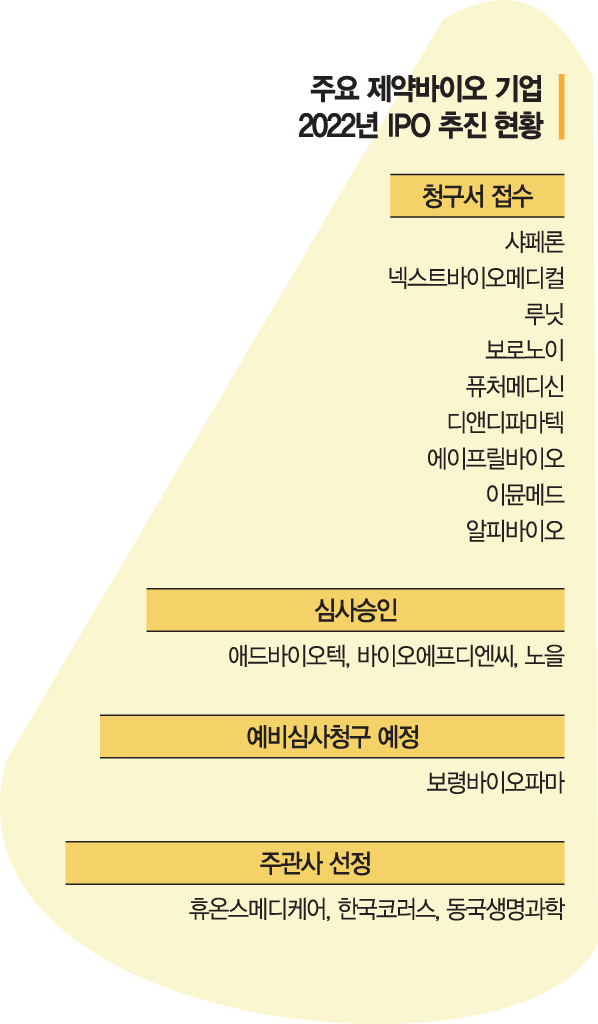
On the 6th, Shaperon, a bio company developing new drugs for immune diseases, filed for preliminary review for listing. Shaperon is developing the COVID-19 treatment candidate 'NuSepin', the atopic dermatitis treatment candidate 'NuGel', and the Alzheimer's dementia treatment candidate 'NuCerin'. NuGel has completed patient registration for Phase 2 clinical trials in Korea.
In addition, companies such as AlphiBio, ImmunMed, AprilBio, DnD Pharmatech, Future Medicine, Voronoi, Lunit, and Next BioMedical have submitted preliminary review applications and are undergoing the review process. Companies that have received review approval from the Korea Exchange include Adbiotech, BioFDNC, and Noeul. Boryung Biopharma plans to submit a preliminary review application, while Huons Medicare, Korea Chorus, and Dongkuk Life Science have selected their lead managers.
However, their IPO paths are not expected to be smooth. The embezzlement scandal at Osstem Implant has brought the chronic accounting issues in the bio industry to the forefront. The Financial Supervisory Service and the Korea Exchange are considering strengthening accounting guidelines for the bio industry, using this incident as a pretext.
Most domestic bio companies, except for a few large ones, have weak accounting systems. A bio company official said, "Osstem Implant was perceived as a listed company with a somewhat established accounting system, yet this incident occurred," adding, "Due to the nature of the bio industry, although the corporate value is in the trillions of won, sales are not significant, so accounting aspects are largely neglected."
The Osstem Implant scandal has also intensified calls for accountability from financial authorities. As the situation unfolds, the Korea Exchange has taken a tough stance, stating it will conduct more thorough verification of internal accounting systems during the listing review process for bio companies. Given concerns about bio companies' accounting among the industry and individual investors, even if companies pass the growth and technology criteria, their internal accounting systems, including fund execution and flow, will be scrutinized more closely, and those failing to meet requirements will be barred from listing.
Moreover, as trust issues regarding KOSDAQ-listed companies have surfaced, clouds have gathered over IPO success. There is a widespread perception that these companies are hotbeds of embezzlement and breach of trust. According to the Financial Supervisory Service, there were a total of 23 cases of embezzlement and breach of trust disclosed in the KOSDAQ market alone over the past year. On average, disclosures of embezzlement and breach of trust in the KOSDAQ are nearly 1.5 times higher than those in the KOSPI over several years.
Kim Hyung-soo, a researcher at Hanwha Investment & Securities, said, "The Osstem Implant scandal has lowered overall trust in healthcare and all listed companies," adding, "Since the first week of the new year, the pharmaceutical and bio sectors have experienced greater volatility than the market index."
© The Asia Business Daily(www.asiae.co.kr). All rights reserved.