Pharmaceutical Bio Association's 'Biohealth Industry Promotion New Year Dialogue'
Calls for Strengthening Regulatory Authorities' Capabilities Including Establishing Control Towers for Industry, Academia, and Investment
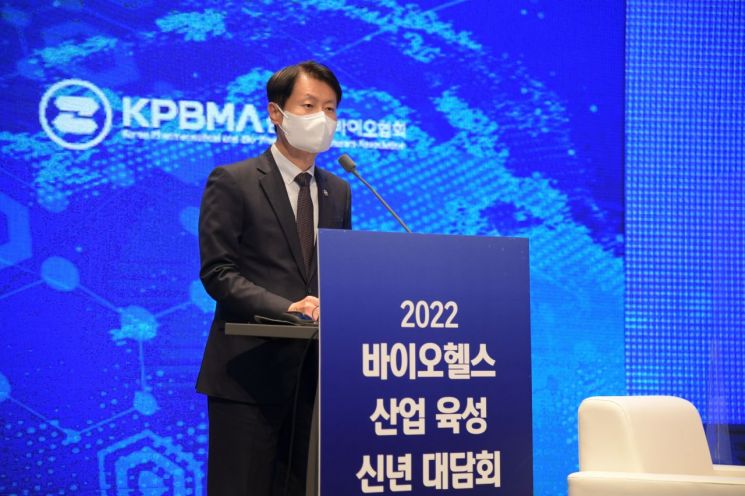 Kim Gang-rip, Commissioner of the Ministry of Food and Drug Safety, is speaking at the '2022 Biohealth Industry Promotion New Year Dialogue' hosted by the Korea Pharmaceutical and Bio-Pharma Manufacturers Association in Yongsan-gu, Seoul, on the afternoon of the 13th. (Photo by Ministry of Food and Drug Safety)
[Asia Economy Reporter Lee Chun-hee] It has been diagnosed that the manpower shortage and budget constraints of the Ministry of Food and Drug Safety (MFDS), the pharmaceutical regulatory agency, are acting as obstacles to the growth of the domestic pharmaceutical bio industry. CEOs of the pharmaceutical bio industry unanimously pointed out that the capacity of the MFDS, the responsible regulatory agency, should be strengthened to serve as a 'control tower' for the entire cycle of pharmaceutical research and development (R&D).
At the '2022 Biohealth Industry Promotion New Year Dialogue to Create an Environment for Global Innovative Drug Creation through Strengthening Expertise in Drug Approval Review and Quality Evaluation' held by the Korea Pharmaceutical and Bio-Pharma Manufacturers Association on the 13th, such criticisms poured out indiscriminately from academia, industry, and investment sectors.
Professor Oh Il-hwan of the Catholic University College of Medicine, who serves as the chairman of the Central Pharmaceutical Affairs Deliberation Committee, the statutory advisory body of the MFDS on drug safety and efficacy, evaluated the current manpower level of the MFDS as "unbelievable" in his opening presentation. As of last year, the number of public officials responsible for medical product review at the MFDS was only 228.
Professor Oh said, "Compared to us, the U.S. Food and Drug Administration (FDA) has 35.3 times (8,051 people), and the European Medicines Agency (EMA) has 17.5 times (4,000 people) the manpower," adding, "Considering that the global biopharmaceutical market share is 40.5% for the U.S. and 13.2% for Europe, it can be seen that the market share corresponds to the manpower ratio." He pointed out that we need to consider whether the small regulatory workforce is acting as a 'bottleneck effect' in the growth of our pharmaceutical bio industry.
Hwang Man-soon, CEO of Korea Investment Partners, who gave the next presentation, also said, "If regulatory science is to become a partner in the growth of pharmaceutical bio, it requires manpower and budget." He added, "Recently, problems related to pharmaceutical companies' product development have emerged one after another, but if the regulatory agency had increased manpower and secured expertise beyond the capabilities of the companies, these could have been prevented in advance."
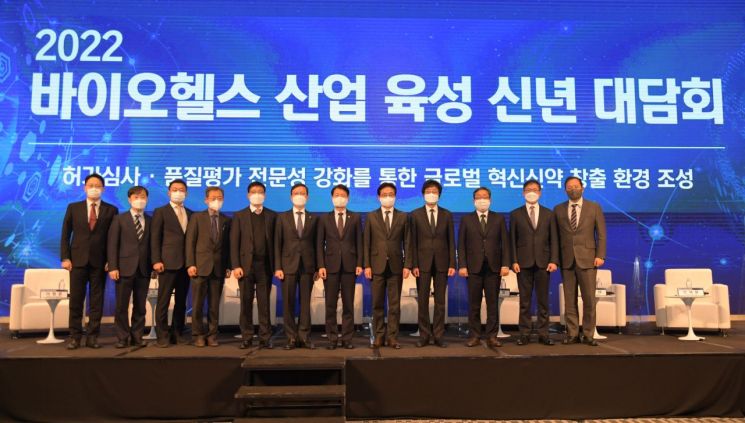
In the subsequent dialogue, under the moderation of Won Hee-mok, chairman of the Korea Pharmaceutical and Bio-Pharma Manufacturers Association, industry CEOs including Jang Shin-jae, president of Celltrion; Ahn Jae-yong, president of SK Bioscience; Kwon Se-chang, president of Hanmi Pharmaceutical; Eom Dae-sik, chairman of Dong-A ST; and Yoon Sung-tae, vice chairman of Huons Global, did not hold back affectionate criticism toward the MFDS. They called for strengthening the agency's capacity through active manpower expansion and emphasized the need for an 'integrated control tower' covering the entire drug development process.
Jang Shin-jae, president of Celltrion, said, "In the case of Regkirona, the MFDS provided intensive support for new drug development, enabling rapid product development," but expressed concern that "if there is no manpower surplus, it will be difficult to respond effectively when multiple companies make concentrated inquiries." He proposed that, just as companies assign project managers (PMs) when conducting business, the MFDS should also assign PMs for each product under review to serve as a control tower. However, Jang emphasized that this also requires the recruitment of expert personnel.
Ahn Jae-yong, president of SK Bioscience, stressed active efforts such as increasing compensation for specialized personnel to resolve the manpower shortage. He said, "In the past, we relied heavily on individual sacrifice and patriotism," adding, "To attract and nurture global talent, appropriate compensation must be provided." Ahn also called for active collaboration with global regulatory agencies. He suggested, "From a company's perspective, it is necessary to contact the MFDS, FDA, EMA, World Health Organization (WHO), and others one by one. It would be good if the MFDS had close partnerships with these agencies."
Eom Dae-sik, chairman of Dong-A ST, requested active government support for smooth new drug development. He said, "Because the prices of domestic new drugs are too low, at each development stage, we have to consider whether to stop or continue based on cost recovery rates," adding, "Although there are difficult issues such as health insurance financial soundness, please consider incentives related to drug pricing for domestic new drugs for the industry's vision."
Kwon Se-chang, president of Hanmi Pharmaceutical, also said, "Clinical trials require the most development costs," and added, "If support is provided up to global phase 3, it could be an opportunity to challenge the global market without technology export," urging increased government support for clinical trials.
© The Asia Business Daily(www.asiae.co.kr). All rights reserved.
![User Who Sold Erroneously Deposited Bitcoins to Repay Debt and Fund Entertainment... What Did the Supreme Court Decide in 2021? [Legal Issue Check]](https://cwcontent.asiae.co.kr/asiaresize/183/2026020910431234020_1770601391.png)