Year of the Golden Pig: Graduating Class of 2007
Decrease in All 16 Cities and Provinces Except Sejong
Highest in Daejeon, Seoul, Jeonbuk, and Gangwon in Order
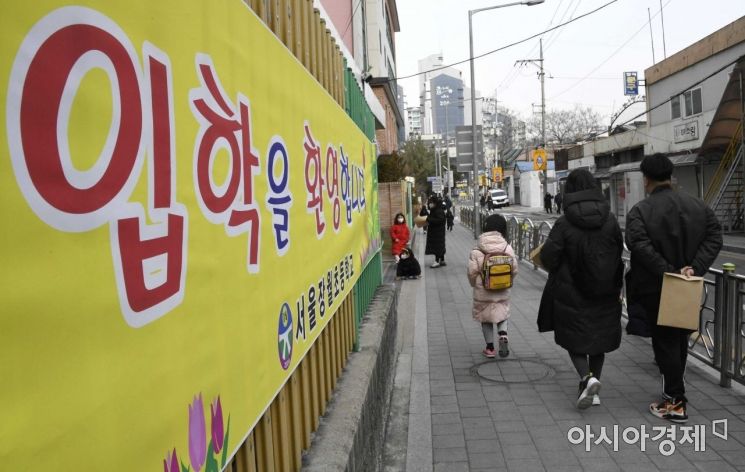 On the 5th, the day of the 2022 academic year new student orientation, prospective elementary students and their parents visited Jangwol Elementary School in Seongbuk-gu, Seoul, moving to the school to complete enrollment documents. Photo by Jang Jin-hyung aymsdream@
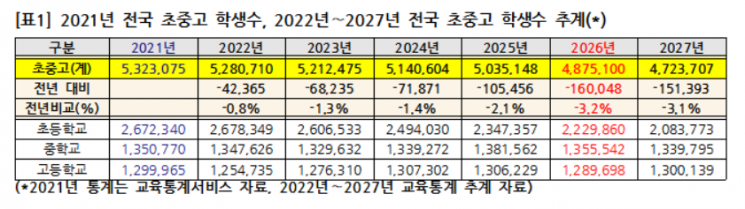
[Asia Economy Reporter Han Jinju] In 2026, the number of students in elementary, middle, and high schools nationwide is expected to fall below 5 million for the first time.
According to the Ministry of Education's 2022-2027 forecast for the number of elementary, middle, and high school students, the student population is expected to decrease to 4,875,100 starting in 2026.
The year 2026 marks the graduation year of the 2007-born cohort, known as the "Year of the Golden Pig," which had a high birth rate. Compared to 2021, this represents a decrease of 447,975 students. The number is projected to decline further to 4,724,000 in 2027.
According to a comparison by Jongno Academy between the number of students by city and province at the end of last year and the 2026 forecast, student numbers are expected to decrease in all 16 cities and provinces except Sejong City, which is expected to see a 55% increase. Particularly, regions such as Daejeon (16.1%), Seoul (15.9%), Jeonbuk (14.0%), Gangwon (12.7%), Gwangju (12.5%), Jeonnam (12.2%), and Busan (10.2%) are expected to experience double-digit decline rates.
Regions with smaller decreases include Gyeonggi (3.5%), Jeju (3.6%), and Chungnam (4.5%). The decrease in Gyeonggi Province is due to concentrated new town development, while Jeju's increase is influenced by an influx of population from the Seoul metropolitan area.
Separately, according to the future population projections announced earlier by Statistics Korea based on 2017 data, the school-age population for elementary, middle, and high schools is expected to fall below 4 million by 2033. This indicates that the rate of decline in the future school-age population will be steeper than it is now.
The nationwide number of elementary, middle, and high school students fell below 9 million in 1993 (8,816,336), below 8 million in 2000 (7,951,998), below 7 million in 2011 (6,986,847), and below 6 million in 2016 (5,882,790).
© The Asia Business Daily(www.asiae.co.kr). All rights reserved.
![User Who Sold Erroneously Deposited Bitcoins to Repay Debt and Fund Entertainment... What Did the Supreme Court Decide in 2021? [Legal Issue Check]](https://cwcontent.asiae.co.kr/asiaresize/183/2026020910431234020_1770601391.png)
















