KAIST-EGIE Joint Research Team
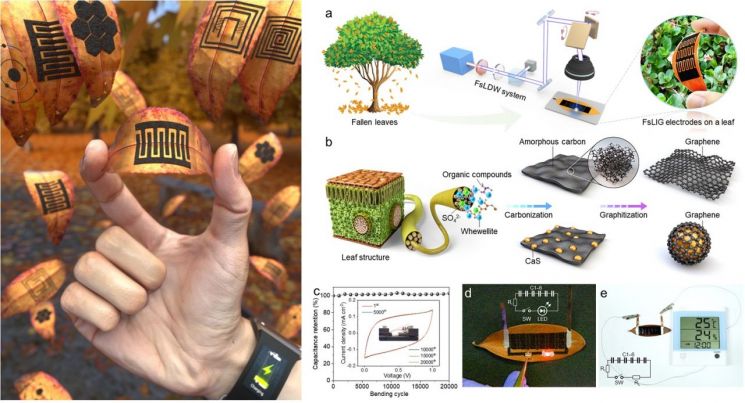 (a) Process of creating graphene electrodes on fallen leaves in the air using an ultrashort femtosecond UV laser direct writing method (b) Delamination process through carbonization and graphenization of leaf material in the laser-irradiated area (c) Capacitance retention test of leaf-based supercapacitor under bending (d, e) Examples of supercapacitor applications: LED lighting, liquid crystal display, electronic clock with temperature, humidity, timer/counter functions power supply
[Asia Economy Reporter Kim Bong-su] Domestic researchers have developed the world's first next-generation energy storage device (supercapacitor) using fallen leaves.
KAIST announced on the 13th that Professor Kim Young-jin's research team from the Department of Mechanical Engineering, together with Dr. Yoon Hana's research team from the Energy Storage Laboratory at the Korea Institute of Energy Research, succeeded for the first time in the world in fabricating a graphene-inorganic hybrid micro supercapacitor on fallen leaves based on ultrashort femtosecond laser direct writing technology.
A supercapacitor is an electrochemical energy storage device with a porous electrode and ions dissolved in an organic electrolyte, structurally similar to a conventional battery (accumulator). The difference is that no chemical reaction occurs during charging or discharging. It can be made thin and flexible, making it actively applied in electronic watches, sensors, and wearable devices. However, it is still difficult to achieve high-capacity storage, so it is not used in electric vehicles yet.
In particular, the development of wearable electronic devices is directly influenced by innovations in flexible energy storage devices. Among various energy storage devices, micro supercapacitors have attracted great attention due to their high power density, long lifespan, and short charging time. However, with the increasing consumption and use of electronic and electrical products and the advancement of IT mobile devices leading to shorter replacement cycles, the amount of waste batteries is increasing. This causes many difficulties in the collection, recycling, and disposal processes of waste batteries, including safety and environmental issues.
Forests cover about 30% of the world's land area and produce a tremendous amount of fallen leaves. This biomass is naturally abundant, biodegradable, and a renewable attractive eco-friendly material. However, if not effectively utilized and left unattended, it can cause forest disasters such as fire risks and contamination of water sources.
The research team developed a technology that simultaneously solves these two problems by irradiating femtosecond laser pulses on fallen leaves, an eco-friendly biodegradable biomass, without additional materials, generating 3D porous graphene microelectrodes with high electrical conductivity in a single step under atmospheric conditions without special treatment. They proposed a method to fabricate flexible micro supercapacitors using this technology.
The team succeeded in easily, inexpensively, and rapidly producing porous graphene-inorganic crystal hybrid electrodes from fallen leaves. They also verified the performance by testing the graphene micro supercapacitor fabricated through this method as a power supply for LED lighting and as a power source for electronic watches with temperature, humidity, timer, and counter functions. This implies the possibility of mass production of low-cost green graphene-based flexible electronic products.
Professor Kim Young-jin of KAIST said, "By reusing fallen leaves, a forest biomass that is currently difficult to manage, as next-generation energy storage devices, it enables the reuse of waste resources and the establishment of a virtuous energy cycle system." He added, "This will not only create new markets as a technology innovation in eco-friendly industries and high value-added renewable energy and secondary battery businesses but also significantly reduce the country's social and economic costs. Furthermore, it is expected to be applied to wearable electronic products, smart homes, and the Internet of Things."
Professor Kim also stated, "In addition to fallen leaves, we are conducting research to develop energy storage device components using forest byproducts such as wood powder as secondary battery anode materials," and added, "I believe there is some potential for commercialization."
The results of this research were published on December 5 last year in the international journal Advanced Functional Materials.
© The Asia Business Daily(www.asiae.co.kr). All rights reserved.