'Muryangpan Structure' Applied to Hwajeong I-Park
Same Structure as the 1995 Collapsed Sampoong Department Store
Strong Against Interfloor Noise but Concerns Over Accident Expansion
Defective Construction Pointed Out Before Concrete Fully Dries
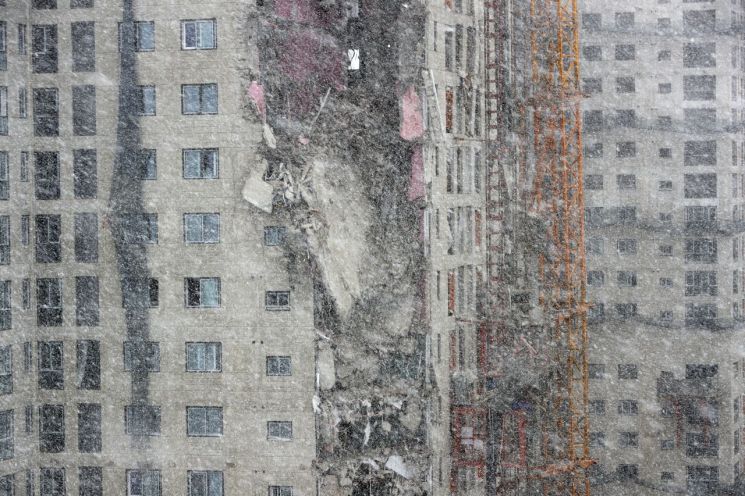
As the government has officially launched an investigation into the cause of the Gwangju Seo-gu Hwajeong I-Park collapse accident, industry experts analyze that the 'flat slab structure' applied to the complex may have increased the likelihood of the accident. The flat slab method, which constructs buildings using only columns and slabs, has the advantage of being more resistant to inter-floor noise compared to conventional wall-type structures. However, it is pointed out that because it bears a heavy load, poor construction quality can exacerbate damage.
According to the government and the construction industry on the 13th, many analyses suggest that the Hwajeong I-Park collapse was the result of a combination of poor construction by the contractor HDC Hyundai Development Company and a structure vulnerable to accidents. Examining the collapsed building, the exterior walls and structures between the 23rd and 38th floors fell like dominoes, which is explained as the result of both poor concrete curing and structural design weaknesses acting together.
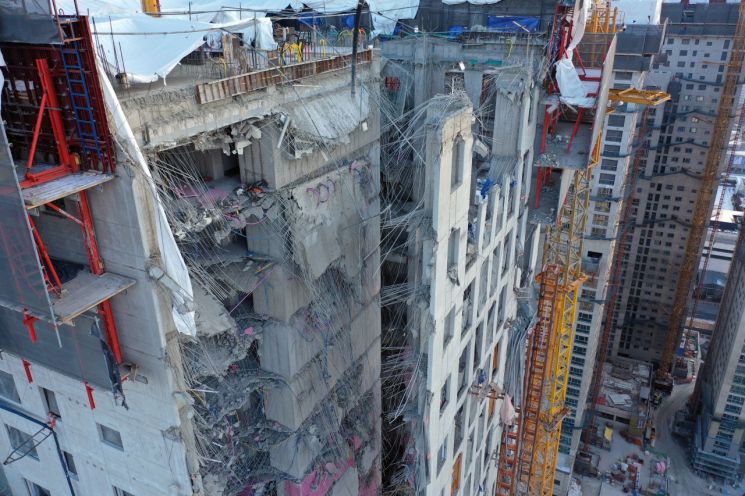 Structure of Hwajeong Hyundai I-Park Residential-Commercial Complex Apartment in Seo-gu, Gwangju
 [Image source=Yonhap News]
In fact, Hwajeong I-Park was being constructed using a flat slab structure, where columns support the slabs without horizontal beams, rather than the wall-type structure commonly used in apartment construction. The wall-type structure has the advantage of excellent overall structural rigidity and economical finishing work because walls act as columns, but it has the disadvantage of severe inter-floor noise as impact noise from upper floors is directly transmitted through the walls.
On the other hand, the flat slab structure allows noise to dissipate through the columns, resulting in less inter-floor noise than wall-type structures, and walls other than load-bearing walls can be removed, making structural changes easier during future remodeling. In the past, it was mainly applied to department stores or high-rise commercial buildings due to high costs, but recently it has been recognized for its inter-floor noise reduction and durability, expanding its application to mixed-use residential complexes as well as general apartment construction.
However, it is also pointed out that the flat slab structure bears a heavier load than the wall-type structure, so if risk factors such as poor construction occur, it can be vulnerable to accidents. The Ministry of Land, Infrastructure and Transport previously estimated that the direct cause of the Hwajeong I-Park accident was the collapse of the 'gang form (external wall formwork)' installed during apartment construction, which led to the collapse of the exterior walls.
The construction used the 'Rail-Integrated System (RCS)' method, which hydraulically lifts the gang form for concrete pouring, and this structure requires the two lower floors to support the heavy load of the system form. However, the lower two floors were not sturdy, and while forcibly stacking the upper floors, the gang form collapsed, causing the lower floors to collapse sequentially due to the impact.
In this process, it is suggested that the design structure minimizing columns and walls may have increased the scale of the accident. The Sampoong Department Store in Gangnam, Seoul, which collapsed on June 29, 1995, was also known to have a flat slab structure. For flat slab structures to be safe, columns need to be numerous and thick, but analyses suggest that cost-cutting at the time reduced the number and width of columns, which was a cause of the accident.
However, even with the same structure, construction methods may differ, and some analyses argue that factors such as the skill level of on-site workers or work speed without considering safety, rather than structural defects, were the causes of the accident.
Experts also point out that during winter, concrete does not dry well and requires about two weeks of curing to be safe, but rushing the work without properly completing this process likely caused problems. Examining the exposed rebar at the collapsed section of the structure shows it is relatively clean, which is evidence suggesting that additional work proceeded before the rebar and concrete properly bonded, leading to the collapse.
The exact cause of the Hwajeong I-Park accident is expected to be revealed at least two months later. The Ministry of Land, Infrastructure and Transport formed a Construction Accident Investigation Committee composed of 10 experts in construction, structural engineering, and legal fields the day before and has begun a full-scale investigation. Since on-site investigations, document reviews, appropriateness assessments, and simulations are required, the process is expected to take about two months.
A Ministry official emphasized, "Currently, rescuing missing workers and securing safety at the site are the top priorities, so the cause investigation is somewhat delayed. Because there is a possibility of additional accidents, the Ministry and the Korea Infrastructure Safety & Technology Corporation will focus on search and safety operations first."
© The Asia Business Daily(www.asiae.co.kr). All rights reserved.
![User Who Sold Erroneously Deposited Bitcoins to Repay Debt and Fund Entertainment... What Did the Supreme Court Decide in 2021? [Legal Issue Check]](https://cwcontent.asiae.co.kr/asiaresize/183/2026020910431234020_1770601391.png)
















