Breaking Global Corporate Monopolies and Achieving Korea's First Commercialization
Diversifying the Wire Material Business Portfolio
[Asia Economy Reporter Hwang Yoon-joo] Hanwha Solutions is set to commercialize the semi-conductive material for ultra-high voltage cables, which had previously been entirely dependent on imports, for the first time in Korea. The company succeeded in domestic production using proprietary technology developed through years of research and development (R&D) in a market for ultra-high voltage cable materials that had been monopolized by global companies such as Dow and Exxon.
Hanwha Solutions' Chemical Division announced on the 13th that it has completed pilot production of EBA (Ethylene Butylacrylate Copolymer), a core material for ultra-high voltage cables, and will begin commercial production at its Ulsan plant starting from the second quarter of this year.
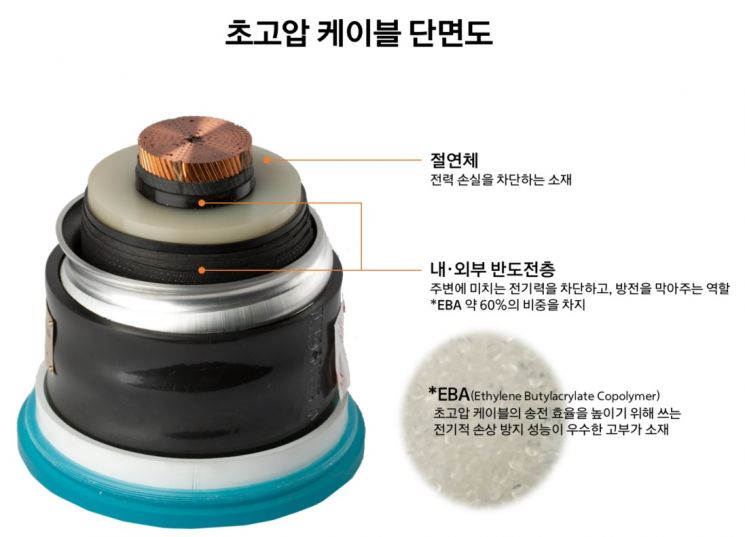
EBA, based on ethylene, is highly resistant to heat and moisture and has excellent electrical damage prevention performance, making it suitable for ultra-high voltage cables transmitting 110 kilovolts (kV) or more. It is a high-value-added material mainly used in power cables requiring high quality, such as submarine cables connecting offshore wind farms and onshore substations, or cables used for energy transmission and distribution in large power plants.
Hanwha Solutions developed EBA production technology through five years of R&D starting in 2017 and established commercial production facilities with an annual capacity of 40,000 tons. Once EBA production is fully underway this year, the company plans to package it together with XLPE (Cross Linked-Polyethylene), another key material for ultra-high voltage cables used as an insulator to prevent power loss, and expand exports to major overseas markets such as China and the Middle East. Hanwha Solutions currently has an annual production capacity of up to 110,000 tons of 275kV-grade XLPE following an expansion last year.
The global EBA market was approximately 70,000 tons annually as of 2021. It is rapidly growing due to increased demand for ultra-high voltage cables driven by infrastructure investments in renewable energy power plants such as wind and solar, as well as the replacement of aging power grids. In Korea, more than 6,000 tons of EBA are used annually, and it is expected to generate an import substitution effect worth up to 15 billion KRW each year.
Meanwhile, Hanwha Solutions has been continuously promoting the localization of high-value-added materials, following its successful commercial production of the high-performance optical lens material XDI in 2020 and its development of high-efficiency carbon molecular sieves for carbon capture.
© The Asia Business Daily(www.asiae.co.kr). All rights reserved.
![User Who Sold Erroneously Deposited Bitcoins to Repay Debt and Fund Entertainment... What Did the Supreme Court Decide in 2021? [Legal Issue Check]](https://cwcontent.asiae.co.kr/asiaresize/183/2026020910431234020_1770601391.png)















