In-Memory Computing for Data Storage and Processing Based on MRAM
Expanding Horizons of Low-Power Artificial Intelligence (AI) and Neuromorphic Chip Technologies
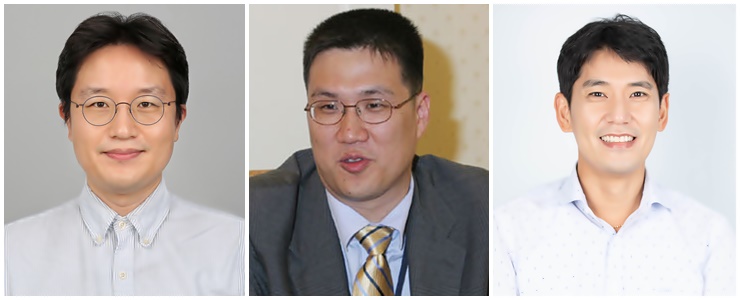 Seungchul Jeong, Senior Researcher at Samsung Advanced Institute of Technology (from left), Donhee Ham, Fellow at Samsung Advanced Institute of Technology and Professor at Harvard University, and Sangjun Kim, Master at Samsung Advanced Institute of Technology, who achieved the world's first implementation of MRAM-based in-memory computing and published their research results in Nature.
 [Photo by Samsung Electronics]
[Asia Economy Reporter Kim Heung-soon] Samsung Electronics researchers have become the first in the world to implement semiconductor technology capable of performing memory and computation within a single chip, similar to the human brain. The research results were published on the 13th (Korean time) in the international academic journal 'Nature.' This breakthrough is expected to accelerate research not only on artificial intelligence (AI) semiconductors that process large volumes of data but also on 'neuromorphic technology' that mimics the human brain.
The memory technology implemented by Samsung Electronics researchers is 'in-memory computing' based on magnetic random-access memory (MRAM) devices. In-memory computing is an advanced chip technology that performs not only data storage but also data computation within the memory itself. Typically, computers have separate memory chips responsible for storage and processor chips responsible for computation. The central processing unit (CPU) sequentially fetches instructions from memory, executes them, and stores the results back into memory. When the amount of data exchanged between the CPU and memory increases, processing delays occur.
By applying in-memory computing technology, large volumes of information can be computed within a single memory without separate data movement, significantly reducing power consumption. Samsung Electronics explained that this is useful for creating next-generation low-power AI chips with high data processing capacity. Although there have been previous cases of implementing in-memory computing technology using non-volatile memories such as resistive RAM (RRAM) and phase-change RAM (PRAM), Samsung Electronics researchers are the first to achieve this using MRAM devices.
This research was led by Senior Researcher Jeong Seung-chul of Samsung Electronics' Advanced Institute of Technology as the first author, with Fellow Ham Don-hee of the Advanced Institute of Technology and Professor Kim Sang-jun of Harvard University serving as co-corresponding authors. Researchers from Samsung Electronics' Advanced Institute of Technology, Semiconductor Research Laboratory, and Foundry Division also participated in the joint research.
MRAM is a non-volatile memory with high data stability and fast speed, enabling mass production when integrated with system semiconductor processes. However, due to its low resistance characteristics, it had limitations in providing significant power advantages when applied to in-memory computing. Samsung Electronics researchers succeeded in low-power design by proposing a new concept of in-memory computing structure based on 'resistance summation' instead of the conventional 'current summation' method. They verified that the MRAM-based in-memory computing chip operates with up to 98% accuracy in digit classification and 93% accuracy in face detection when applied to AI computations.
Senior Researcher Jeong said, "In-memory computing is a technology that integrates memory and computation, similar to the human brain where memory and calculation coexist," and added, "This research is expected to contribute to future research and development of neuromorphic technology that truly mimics the brain."
Samsung Electronics added that it plans to continuously expand its technological leadership in next-generation computing and AI semiconductor fields by integrating its memory technology capabilities with system semiconductor technologies.
© The Asia Business Daily(www.asiae.co.kr). All rights reserved.
![User Who Sold Erroneously Deposited Bitcoins to Repay Debt and Fund Entertainment... What Did the Supreme Court Decide in 2021? [Legal Issue Check]](https://cwcontent.asiae.co.kr/asiaresize/183/2026020910431234020_1770601391.png)















