[Asia Economy Reporter Yuri Kim] As demand for restaurant meal replacements (RMR) launched in collaboration with famous restaurants nationwide surges, not only the food industry but also distribution channels such as Lotte, Shinsegae, and Hyundai are expanding their presence in this market. While ‘ultra-low prices’ were once the core of competition, the premiumization of home-cooked meals has accelerated since COVID-19, and ‘only one’ products available exclusively here are emerging as strategic items to boost channel loyalty.
◇RMR from Department Stores and Marts Instead of Restaurants
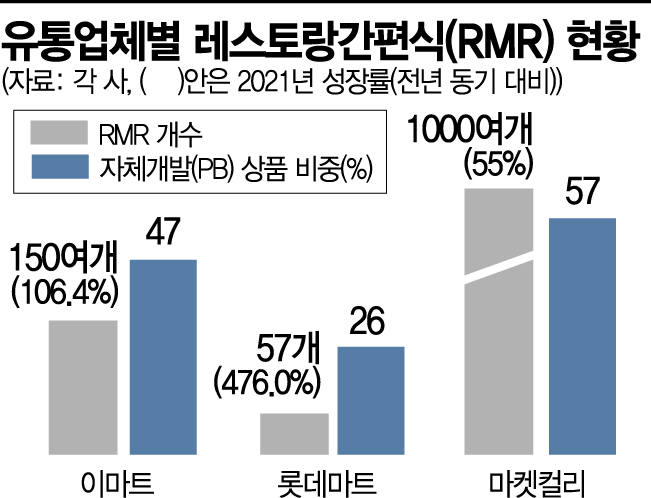
According to the distribution industry on the 12th, private brand (PB) products launched in collaboration with famous restaurants through direct efforts are increasing by channel. As of the end of last year, Emart’s PB products accounted for about 70 out of 150 RMR products, representing 46.7%. Thanks to the rise of RMR centered on PB products, last year’s sales growth rate reached 106.4%. Representative examples include ‘Peacock×Dowroom Carbonara Meal Kit’ in collaboration with Michelin-starred restaurant ‘Dowroom’ and ‘Peacock Odeng Sikdang Budae Jjigae’ made with the popular budae jjigae restaurant ‘Odeng Sikdang’.
Emart stated, "In line with Peacock’s philosophy of ‘a new world of taste,’ we are accelerating the development of meal kit products in partnership with Michelin-selected restaurants," adding, "This year as well, we will recompose Michelin-starred restaurants into meal kits to showcase Peacock meal kits’ differentiated taste and quality."
Lotte Mart also saw rapid growth with a 476.0% increase in RMR sales last year. PB products played a significant role. Among the 57 RMR products currently operated by Lotte Mart, 15 (26.3%) are PB products, with representative items such as ‘Yorihada×Darijip Tteokbokki’ (Busan) and ‘Yorihada×Ogeunnae Dakgalbi’ (Chuncheon, Gangwon). This month, they additionally launched ‘Yorihada×Mibundang Rice Noodles’ in collaboration with the rice noodle specialty restaurant ‘Mibundang.’
Hyundai Department Store also plans to expand its current lineup of about 100 products as its RMR sales growth rate reached 300.7% last year. Through the premium home meal replacement brand ‘One Table,’ Hyundai Department Store is strengthening exclusive products. They are currently selling 10 products, including ‘Jeongseongdang Galbitang,’ a galbitang specialty restaurant in Anyang, Gyeonggi, and ‘Choryuhyang Seafood Nurungji Soup,’ a Chinese cuisine specialty restaurant in Euljiro, Jung-gu, Seoul.
◇Market Kurly Offers Over 1,000 Famous Restaurant Meal Replacements Nationwide
Online, Market Kurly is showing active moves. The number of RMR products sold on Market Kurly last year reached about 1,000. Among these, about 570 products (57.0%) were sold as ‘Kurly Only,’ available exclusively on Market Kurly. Last year, RMR sales volume increased by 55%. Chinese cuisine (442%) and Asian cuisine (225%) showed particularly high performance. The ‘Mokran’ Jajangmyeon operated by Chef Lee Yeon-bok accounted for 77% of the jajangmyeon products sold on Market Kurly last year, gaining popularity.
According to the Korea Agro-Fisheries & Food Trade Corporation (aT), the domestic home meal replacement (HMR) market size is expected to grow from 4 trillion won in 2020 to over 5 trillion won this year. Industry insiders predict that the proportion of RMR within this will increase further. A distribution industry official said, "With the third year of COVID-19 still seeing strong demand for home dining, consumers who previously sought cheap and convenient HMR are now looking for premium products like RMR, and this year, competition among companies to discover famous restaurants nationwide will intensify."
© The Asia Business Daily(www.asiae.co.kr). All rights reserved.
![User Who Sold Erroneously Deposited Bitcoins to Repay Debt and Fund Entertainment... What Did the Supreme Court Decide in 2021? [Legal Issue Check]](https://cwcontent.asiae.co.kr/asiaresize/183/2026020910431234020_1770601391.png)















