Application, Design, Safety Management, and Learning Rights Guarantee Measures
Mandatory Explanation and Prior Consent from School Members
Seoul Requires Prior Consent from More Than Half
Includes Strengthening Safety Performance of Modular Classrooms
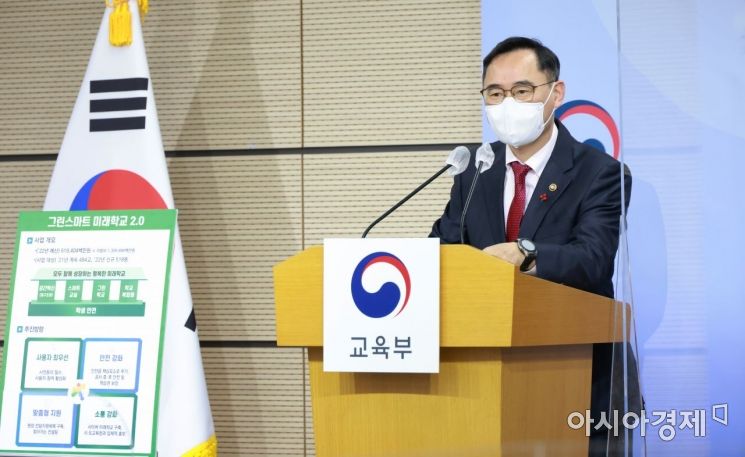 Jeong Jong-cheol, Vice Minister of Education, is announcing the 2022 Green Smart Future School Promotion Plan on the 12th at the 4th Public Briefing Room of the Sejong Government Complex.
[Asia Economy Reporter Han Jinju] The Ministry of Education is breaking ground this year on the ‘Green Smart Future School’ project, which involves expanding and renovating schools that have been in use for over 40 years. To minimize parental opposition and concerns, the ministry has also supplemented prior consent and safety-related standards. When applying for the project and establishing safety management and learning rights protection measures, prior consent from school members must be obtained.
On the 12th, the Ministry of Education announced the ‘2022 Green Smart Future School Promotion Plan’ and revealed that 518 buildings will be selected as project targets this year. A budget of 519.4 billion KRW in national funds and 1.3 trillion KRW in local funds will be invested this year.
Jeong Jong-cheol, Vice Minister of Education, stated, "We will strengthen user participation from the selection of targets to completion and create future schools that properly reflect the demands of school members. We will do our best to ensure that our children can focus on learning in a safe and comfortable environment even during the construction period by enhancing the safety performance of modular classrooms."
The Ministry of Education has made it mandatory to obtain consent from school members during decision-making processes such as future school applications, user-participatory design, safety management during construction, and learning rights protection measures. For members who could not participate in discussions, related information must be posted on the website, and the overall project status, including the project period and purpose, must be continuously shared with school members. Previously, obtaining consent from school members was recommended from the application stage, but after 19 schools in Seoul withdrew from the project, related standards were strengthened.
Vice Minister Jeong explained, "From the target school selection process, prior consent from all school members and parents is mandatory, and the Seoul Metropolitan Office of Education has set a standard that more than half of the school members must agree. While the consent procedure is mandatory, the consent rate for learning rights protection measures is not strictly enforced in advance, but we encourage prior explanation and consent procedures from as many school members as possible."
‘Safety’ is included as a core element to strengthen learning rights protection. During construction, modular classrooms (buildings) will be installed, or idle classrooms or nearby schools will be utilized. Routes for arrival and dismissal and construction vehicle access will be separated, and construction hours will be adjusted or separated by barriers to prevent infringement on learning rights.
A basis for investigating the status of fire facility installation and fire truck access routes will be established, and standards will be revised to allow related measures. Standards for infectious disease prevention will be prepared and reflected in the design. Type-specific supervision standards related to the future school project will be created, applying construction supervision standards higher than legal requirements.
Vice Minister Jeong said, "School facility reconstruction or remodeling has only been done during vacations, but many high schools have had difficulties with smooth construction. We have signed agreements with the Fire Agency and Public Procurement Service to supply modular products that meet six major safety performance criteria and have established measures to distribute them to our school sites. We will strive to continue learning through modular classrooms within the scope of minimizing transfers."
An official from the Ministry of Education said, "We will strictly separate learning spaces during construction and enhance safety to make modular classrooms more comfortable than regular classrooms. If installing modular classrooms is difficult, when utilizing idle facilities (classrooms) inside or outside the school, transfers will be conducted after sufficient consultation and consent with parents."
Last year, the Ministry of Education selected 484 schools as project targets and is promoting design competitions and contracts for schools that have completed pre-planning. From this year, user-participatory design and construction will be promoted. Newly selected schools this year must go through the pre-planning stage and are required to undergo appropriateness reviews of the results. Various workshops involving school members and pre-planners will be conducted, and on- and offline training programs to understand school culture will be operated for the pre-planner talent pool.
10% of the first-year project budget will be invested, with 40% and 50% invested annually over three years. The Ministry of Education is also upgrading the future school portal system to ‘Cyber Future School’ to allow visits to excellent model schools.
© The Asia Business Daily(www.asiae.co.kr). All rights reserved.

















