Candidate Lee Jae-myung Announces Ministry of Economy and Finance Separation and Reorganization Foreseen
Also Declares Establishment of Ministry of Climate and Energy
Experts Point Out "Independence from Politics Is the Priority"
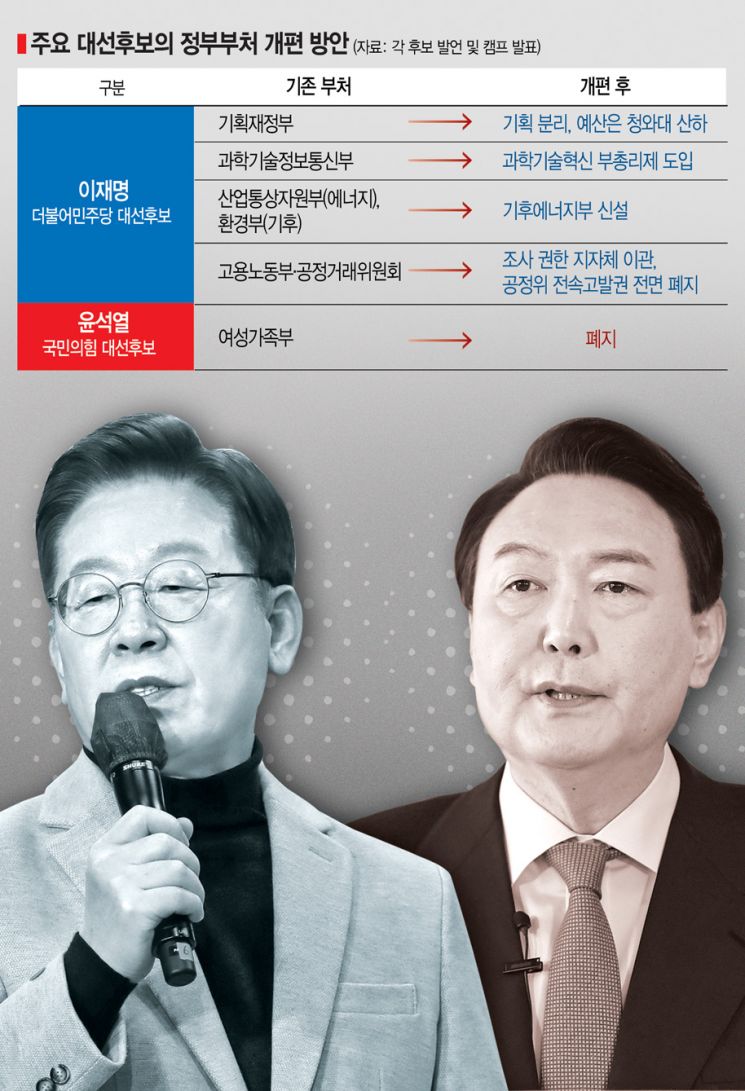
[Asia Economy Reporter Lee Kwang-ho, Sejong=Reporter Kim Hyun-jung] As presidential candidates rush to present government ministry reorganization plans along with some pledges, criticism arises that the ‘ministry reshuffling’ conducted every five years may cause administrative inefficiency. Some argue that while reorganization reflecting economic growth and key issues may be necessary, ‘independence from politics’ is a more urgent matter.
According to the National Assembly and various government ministries on the 12th, the candidate who has presented the most detailed reorganization plan so far is Lee Jae-myung of the Democratic Party of Korea. He has specifically targeted the Ministry of Economy and Finance, which has repeatedly shown disagreements over various issues such as disaster relief payments for COVID-19 response, their scope and targets, supplementary budget formulation, and the effectiveness of issuing local currency.
◆ Ministries with Short Lifespans Due to Repeated Separation and Integration = The Ministry of Economy and Finance is known as a ministry that has undergone repeated separation and integration with each administration. It started in 1948 with the establishment of the government as the Ministry of Finance and the Planning Office. The Planning Office expanded into the Economic Planning Board in 1961, taking charge of budget formulation and economic development planning. The Ministry of Finance handled taxation, treasury, finance, monetary, and foreign exchange policies. Later, in 1994, the Kim Young-sam administration integrated these into the Ministry of Finance and Economy, but in 1998, under the Kim Dae-jung administration, it was downsized and reorganized as the Ministry of Finance and Economy. At that time, the budget was managed by the Presidential Planning and Budget Commission and the Ministry of Finance and Economy, with the Budget Office as an external agency. It was later reorganized under the Prime Minister’s Office as the Planning and Budget Office. The current Ministry of Economy and Finance was finalized in 2008 by the Lee Myung-bak administration by removing finance from the Ministry of Finance and Economy and integrating the budget. In addition, candidate Lee pledged to establish a Ministry of Climate and Energy by merging the energy sector of the Ministry of Trade, Industry and Energy with the Ministry of Environment.
As ministry reorganization plans become a hot topic, the issue of reforming the financial supervisory system, which had been dormant for some time, is also emerging. Earlier, Democratic Party lawmaker Lee Yong-woo introduced a bill titled the “Act on the Establishment of the Financial Services Commission, etc.,” which separates the financial industry policy and financial supervision policy functions of the Financial Services Commission and transfers the industrial policy to the Ministry of Economy and Finance. Currently, the financial supervisory system is structured so that the Financial Services Commission operates financial industry and supervision policies, while the Financial Supervisory Service handles inspections and sanctions. The proposal is to separate the financial industry policy function from the supervisory function. Similarly, People Power Party lawmaker Yoon Chang-hyun introduced a bill to establish the Financial Supervisory Service Act, which includes separating the policy functions of the Financial Services Commission and upgrading it to a ‘Ministry of Finance.’ This was an attempt previously made by former Financial Services Commission Chairman Kim Seok-dong, arguing that as economic crimes increase and digital finance expands, the commission should be elevated from a ‘commission’ level to a full-fledged ‘ministry.’
Within both ruling and opposition parties, negative sentiments are detected regarding the ministry reorganization intentions. Financial Services Commission Chairman Ko Seung-beom and Financial Supervisory Service Governor Jung Eun-bo emphasized cooperation in financial policy coordination, indirectly expressing opposition. Chairman Ko said at last year’s parliamentary audit, "Rather than constantly changing, it is important to maintain the current system and create an organically cooperative system and practices." State Affairs Coordination Office Chief Koo Yoon-chul also explained the day before, "If the Ministry of Economy and Finance is separated, it could become stronger," adding, "Dividing the organization does not mean functions disappear. Issues can be resolved through consideration and discussion within a powerful ministry with coordination authority."
◆ Ministry Reorganization Is Necessary, but Excessive Political Intervention Should Be Avoided = Experts partly agree on the inevitability of ministry reorganization but express concerns about excessive political interference resulting from it. Professor Sung Tae-yoon of Yonsei University’s Department of Economics said, "There is a need to separate functions," but emphasized, "Above all, independence from politics is crucial." Professor Park Jin of the Korea Development Institute (KDI) Graduate School of International Studies pointed out, "There are already criticisms that the president is too imperial, and if budget authority also goes to the Blue House, the burden will fall on the president and the Prime Minister’s Office will be further weakened." He added, "If a Planning and Budget Office is created, it should be placed under the Prime Minister’s Office."
Concerns about government-controlled finance were particularly strong. Professor Sung emphasized, "In the past, independence of financial supervisory bodies from the executive branch was important, but recently, political influence has increased, causing problems." Professor Ko Dong-won of Sungkyunkwan University Law School said, "The financial policy functions of the Financial Services Commission should be transferred to the Ministry of Economy and Finance, and the supervisory functions to the Financial Supervisory Service to create an independent supervisory body," adding, "Most countries have financial supervision carried out by independent agencies, not the government."
Compared to the U.S. cabinet, composed of the president, vice president, the White House, and 15 ministries, South Korea’s executive branch is criticized for undergoing excessively frequent changes. Among the 15 U.S. ministries, the Departments of State, Treasury, and Defense were established in 1789 during the early independence period of the U.S., and although some names have changed, their functions and jurisdictions have remained largely unchanged. Other departments such as the Interior, Agriculture, and Justice were established in the 1800s, and the Departments of Commerce, Labor, and Health and Human Services were founded in the 1900s, maintaining their current forms. The Department of Homeland Security, established in 2002 after the 9/11 attacks in 2001, is considered the most recently created ministry.
© The Asia Business Daily(www.asiae.co.kr). All rights reserved.

















