Institute for Basic Science Korea Virus Basic Research Institute, Confirmed by Animal Experiments

[Asia Economy Reporter Kim Bong-su] Domestic researchers have experimentally proven through animal testing the hypothesis that COVID-19 is more fatal to elderly infected individuals. This is expected to contribute to the development of necessary treatments.
The Korea Basic Science Institute announced on the 12th that the research team led by Center Director Choi Young-gi at the Center for Emerging Virus Research under the Korea Virus Basic Research Institute has experimentally demonstrated that the severity and transmission rate of COVID-19 in elderly infected individuals are higher than those in younger infected individuals.
Currently, elderly infected individuals aged 65 and over show significantly higher severity and mortality rates upon viral infection compared to younger people. This phenomenon has been statistically reported and is well known. However, it had only been a hypothesis and had not been experimentally proven.
In this study, the research team succeeded in verifying this through an actual animal model. They divided ferret animal models infected with the COVID-19 virus into three age groups (under 6 months, between 1 and 2 years, and over 3 years) and compared pathogenicity. The analysis showed that young ferrets had low pathogenicity and proliferation, and thus did not become sources of transmission to other closely contacted animals. In contrast, older ferrets showed high proliferation and a very high transmission rate to other animals. Many virus RNA-positive cells were detected in the lungs, and severe lung lesions appeared, indicating higher severity.
To identify the exact cause, gene expression patterns in infected lung tissues were analyzed using RNA sequencing techniques. In young ferrets, various genes related to tissue regeneration increased after a rapid immune response. However, in older ferrets, expression of inflammatory cytokines (chemokines, type I interferons, etc.) was significantly increased from the early stages of infection, and immune cells (macrophages, natural killer cells, etc.) were overactivated, inducing severe inflammation.
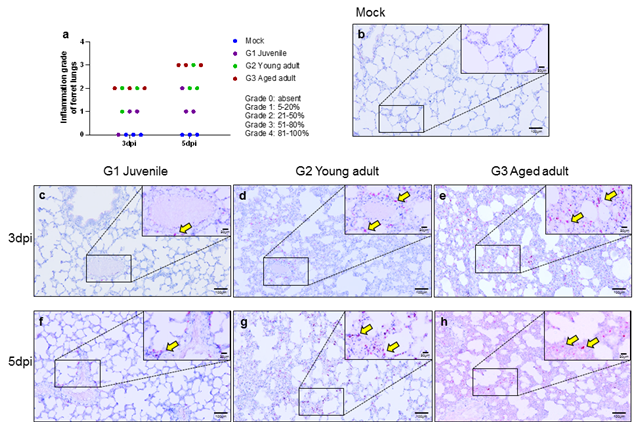 (a) To compare the degree of inflammation in the lung tissues of ferrets infected with the COVID-19 virus, a score from 0 to 4 was assigned based on the extent of inflammatory cell infiltration.
 (b-h) Detection of COVID-19 virus RNA (Spike gene) in infected lung tissues (yellow arrows). Virus RNA-positive cells, which are not detected in the lungs of normal ferrets (b), are increasingly observed in older ferrets (G1: 6 months or younger, G2: 1 year to 2 years, G3: 3 years or older).
This was confirmed through comparative analysis of each experimental result to be very similar to the immunological changes observed in severe or deceased COVID-19 patients. In particular, comparative genomic analysis between severe patients and older ferrets revealed that early overactivation of type I interferons and M1 macrophages is a factor causing severe disease in the elderly. It also proved that the elderly have both higher viral transmission rates and pathogenicity compared to children and adolescents.
Center Director Choi Young-gi stated, “We have experimentally demonstrated for the first time that there are significant differences in COVID-19 virus pathogenicity and transmission rates depending on the host’s age,” and added, “This is expected to accelerate the development of customized COVID-19 treatments for severe and elderly patients.”
This research achievement was published online on the 10th in the international academic journal Nature Communications (IF 14.919).
© The Asia Business Daily(www.asiae.co.kr). All rights reserved.