Rising Food Delivery Fees... 46% of People Say "Up to 1000-2000 Won is Appropriate"
Experts Warn "If Delivery Fees Keep Rising, Consumers May Choose Other Alternatives"
 Food delivery workers are busily moving through the streets of Myeongdong, Jung-gu, Seoul. Photo by Moon Honam munonam@
[Asia Economy Reporter Heo Midam] # Choi (27), an office worker living alone in Mapo-gu, Seoul, recently deleted delivery applications. This is because the amount spent on a single meal, including the minimum order amount and delivery fee, is not insignificant. Choi said, "I used to frequently use delivery apps, ordering delivery food more than four times a week. But recently, with the increase in delivery fees, it quickly costs about 20,000 won every time I eat." He added, "As someone living alone, the rise in delivery fees is burdensome. So these days, I am trying to cook at home and have been grocery shopping."
Since the beginning of the new year, major delivery platform companies and delivery agencies have raised delivery fees, deepening the sighs of self-employed business owners and consumers. Self-employed individuals are inevitably considering raising food prices or delivery tips as the burden of delivery fees increases. With rising prices of ingredients and labor costs, along with delivery fees, it has reached a point where they cannot endure without increasing product prices or delivery tips shared by consumers. However, there are concerns that the burden ultimately borne by consumers will also increase.
According to the delivery industry, some regional delivery agencies raised their basic delivery fees by about 500 to 1,100 won starting from the 1st. This increase became inevitable due to fierce competition to secure delivery drivers. Additionally, when surcharges such as those caused by bad weather are added, delivery fees become even more expensive.
Given this situation, the burden on self-employed business owners and consumers is growing. Delivery fees are shared between business owners and consumers, with the business owners deciding the burden ratio. However, if the basic delivery fee is raised, business owners are likely to increase menu prices or delivery tips, which in turn increases the consumer's burden.
It is not difficult to find self-employed business owners struggling with the increase in delivery fees on online communities. On the 11th, a netizen posted on the community "Because It's Painful, I'm a Boss," where self-employed people gather, saying, "With the rising prices of ingredients and delivery fees, only the self-employed are suffering. Is this fair?" He added, "After much consideration, I raised both delivery fees and food prices. But from the customers' perspective, it seems they have developed a reluctance toward my store."
He continued, "In the end, the self-employed are the ones taking the hit," and said, "Delivery companies have had a good time for the past 1-2 years due to COVID-19, but unfortunately, the overall damage is borne only by the self-employed."
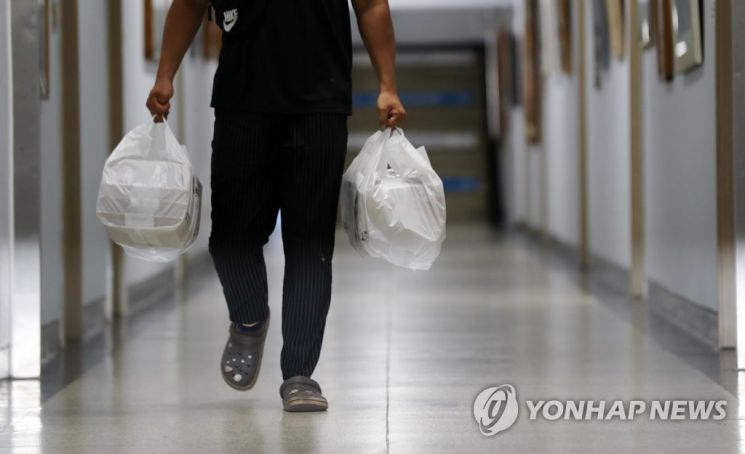 A delivery person is delivering packaged food. The photo is unrelated to specific expressions in the article. Photo by Yonhap News.
Consumers also feel the burden of increased delivery fees. Kim (25), a university student, said, "These days, delivery tips of 3,000 won or more are standard, and many places exceed 5,000 won," adding, "If the delivery fee is over 3,000 won, I tend to look for places with slightly cheaper delivery fees or opt for takeout orders." He added, "With both food prices and delivery fees rising, the burden is too great."
Meanwhile, about half of the population considers a delivery fee of 1,000 to 2,000 won appropriate. According to the "Public Perception Survey on Delivery and Shipping Services" conducted by the Future Administrative Innovation Research Office of the Korea Institute of Public Administration, 71.1% of the public use delivery apps as their preferred food delivery ordering method. The survey was conducted in October last year by polling company R&R Consulting, targeting 2,115 adults nationwide.
When asked about the appropriateness of delivery fees for food delivery, 53.4% of respondents answered "inappropriate." Those who answered "average" accounted for 31.9%, and only 14.7% said "appropriate."
Regarding the maximum delivery fee they are willing to pay, 23.2% chose "1,000 won or more but less than 1,500 won," the highest proportion. This was followed by ▲1,500 won or more but less than 2,000 won (22.3%) ▲2,500 to 3,000 won (13.8%) ▲less than 1,000 won (13.2%) ▲2,000 to 2,500 won (11.6%) ▲no willingness to pay (10.6%). In other words, about 70% of the public considers a delivery fee under 2,000 won appropriate.
However, the delivery workers' union claimed that even with increased delivery fees, delivery workers' incomes have not improved. The Rider Union Gyeonggi Branch, a delivery workers' labor union, held a press conference on the 6th, stating, "Although delivery agencies have recently raised delivery fees, many excessively collect commissions, so delivery workers' incomes have not improved," adding, "For example, even if the basic delivery fee is significantly raised from 3,500 won to 4,300 won, if the commission rises to 800 won, the difference in delivery fees received by workers is negligible."
Experts say that if delivery fees continue to rise, consumers will eventually seek alternatives. Professor Lee Eunhee of Inha University's Department of Consumer Studies said, "Due to the COVID-19 situation, both consumers and self-employed business owners are in difficult circumstances. The self-employed have been the most affected by COVID-19, and consumers are also struggling economically due to rising prices," adding, "In this situation, if delivery fees continue to increase, consumers will have no choice but to select alternatives such as ordering takeout instead of delivery."
© The Asia Business Daily(www.asiae.co.kr). All rights reserved.


















