Exclusion from Small Business Loss Compensation Act
Classified as 'Indirect' Damage Industry
Temporary Disaster Relief Funds, Small Compensation Scale
Industry: "Support Focused on Manufacturing, Not Reflecting Reality
Compensation Law Needed to Improve Fairness Among Industries"
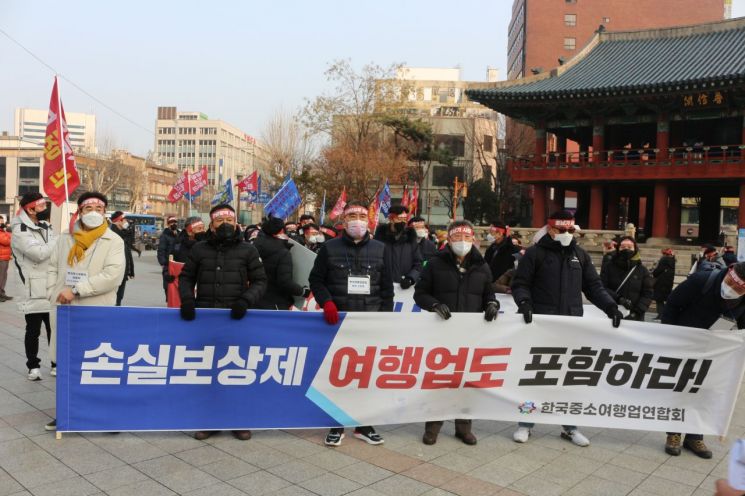 Travel industry workers held a rally on the 9th around Bosingak in Jongno-gu, Seoul, urging for the inclusion of the travel industry in the Loss Compensation Act.
[Asia Economy Reporter Choi Dong-hyun] The travel industry has taken to the streets again. The anticipated phased recovery of daily life (With Corona) has been indefinitely postponed due to the spread of the Omicron variant, pushing those in the industry to the brink of losing their livelihoods. They are calling for improvements to quarantine measures that exclude on-site voices and compensation plans that are unfair across industries.
Kim (52) has been working in the travel industry in Gwangju, Jeollanam-do for 12 years. She started a small travel agency in 2016 during the boom of Chinese tourists (Youke). Her husband also helped as an employee. Kim sent her two children to university through the family business. However, since the outbreak of COVID-19 in 2020, her income dropped to zero, making it impossible to sustain her livelihood. Eventually, Kim took out loans totaling 50 million won twice last year. In the first year, the low interest rate of around 1% helped her manage expenses. But in the second year, the interest rate rose to 2.5%, accelerating the loss of principal.
Since October last year, Kim has been working as a contract employee assisting with quarantine tasks at major tourist sites with the help of the Gwangju Metropolitan City Tourism Association. Her salary is about 1.6 million won. The district where Kim lives employs full-time workers, but in other regions, many work only half a day and usually earn less than 1 million won. This job is also scheduled to end on the 22nd due to local government budget shortages. Feeling desperate, Kim traveled to Seoul on the 9th to attend a rally from Gwanghwamun to the Blue House demanding survival measures and recovery plans for the travel industry. Kim said, "The deadline for my son's university tuition payment is the end of February, and I have no idea how to raise the money," adding, "I urge the government to quickly prepare supplementary budgets so that at least jobs can be maintained."
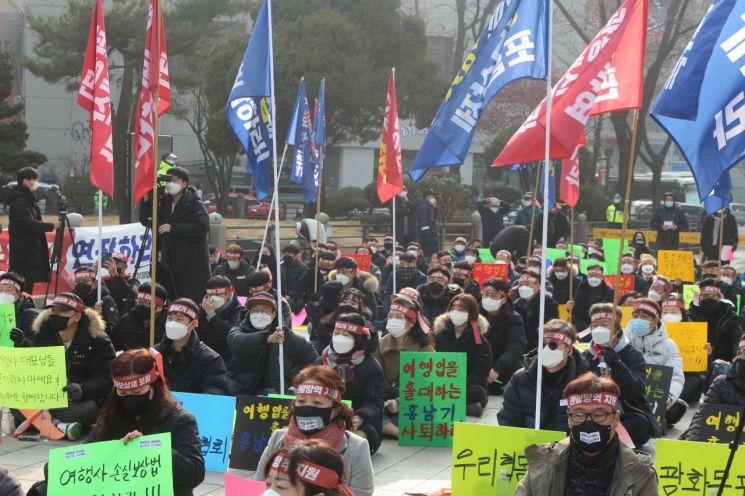 Travel industry workers held a rally and street demonstration on the 9th around Bosingak in Jongno-gu, Seoul, demanding survival measures and recovery plans for the travel industry.
Travel industry workers like Kim all expressed a strong sense of exclusion from the government's COVID-19 compensation measures. A representative example is the ‘Small Business Protection and Support Act Amendment (Loss Compensation Act)’ implemented on July 7 last year. The Loss Compensation Act compensates small business owners for losses caused by direct government quarantine measures such as business suspension or operating hour restrictions. However, travel industry workers do not receive protection under this law despite suffering huge losses due to government quarantine measures like social distancing, because they were not subject to ‘direct’ administrative orders like restaurants or cafes.
The government classifies the travel industry as an ‘indirectly’ affected sector and has been providing compensation in the form of temporary disaster relief funds. However, this type of support is relatively small in scale and comes with strict conditions. The administrative convenience-based payments, detached from the field, have created blind spots. A small travel agency owner said, "In local small travel agencies, many hire spouses or children as employees, but family employees often do not enroll in employment insurance due to complicated requirements and high rates, so they are often left out," adding, "However, employment retention subsidies are only available to those enrolled in employment insurance, so many businesses on leave receive no money at all." Another small travel agency owner pointed out, "The Support Fund Plus groups the travel industry with casinos, airlines, and hotels as tourism businesses and calculates average sales losses to provide support. But sales vary greatly depending on the size and business model even within the travel industry, and this is not considered at all."
The travel industry agrees that a government-wide decision is needed to improve fairness in compensation across industries. Their demand for the resignation of Deputy Prime Minister and Minister of Economy and Finance Hong Nam-ki at the Gwanghwamun protest on the 9th was in the same context.
Oh Chang-hee, president of the Korea Travel Association, said, "When the shipbuilding industry faced difficulties in the past, the government provided significant help by establishing laws and systems," adding, "Currently, the travel industry is facing even greater difficulties but is being left unattended." He continued, "This is the first time a national-level major crisis has hit the service industry, but related laws were designed mainly for the manufacturing sector in the past, so many are not suitable for the current situation," emphasizing, "The government’s top officials need to step up and resolve these difficulties quickly."
© The Asia Business Daily(www.asiae.co.kr). All rights reserved.