Disagreement with Pharmacist Groups
"Speed Decreases When Going Through Pharmacies"
Initially Health Centers... Pharmacies Later
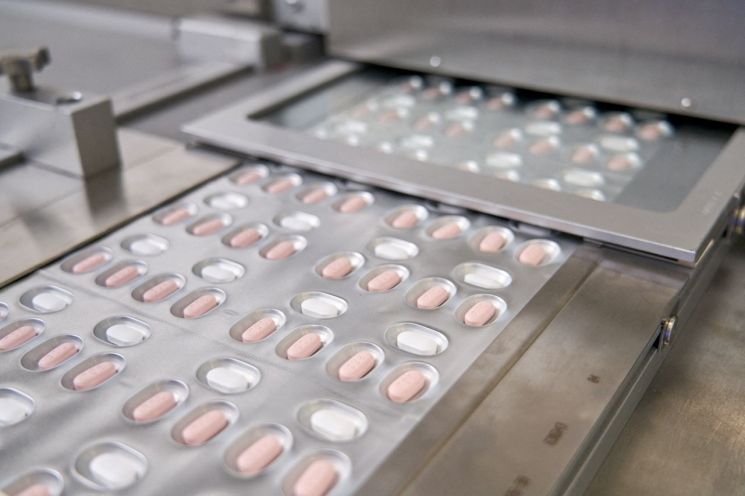
[Asia Economy Reporters Sojeong Seo and Daehyun Kim] With the introduction of Pfizer's oral COVID-19 treatment, Paxlovid, into South Korea on the 13th, the administration of the drug to home-treated patients is entering the final countdown. The government emphasized that Paxlovid must be taken as soon as possible within five days of testing positive and symptom onset to be effective, making the organization of delivery and distribution systems a new challenge.
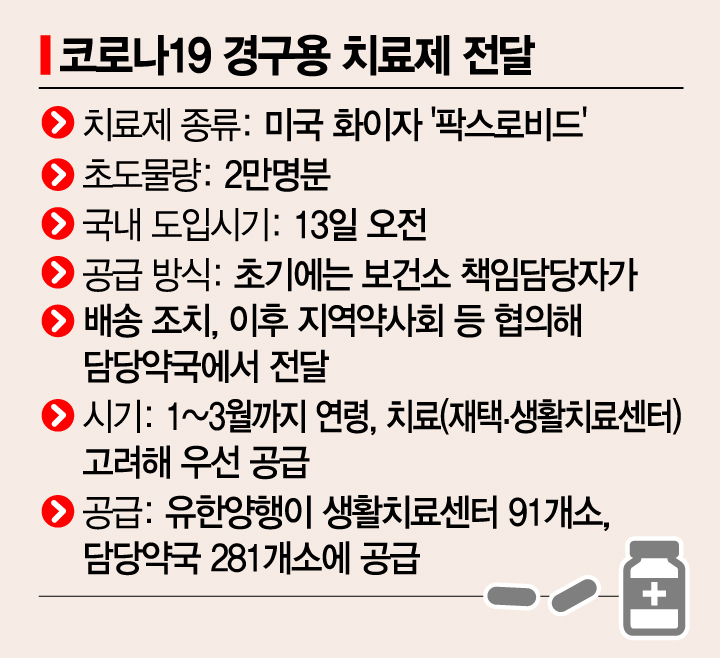
According to health authorities and the pharmaceutical industry on the 11th, with 20,000 doses of Pfizer's Paxlovid arriving in the country on the 13th, final preparations are underway for the rapid prescription to high-risk groups such as the elderly and those with underlying conditions. The day before, the Ministry of Health and Welfare and the Korea Disease Control and Prevention Agency conducted user training for local governments, healthcare organizations, and responsible pharmacies in preparation for the full-scale administration of the oral treatment, with dosing expected to begin as early as the 14th.
◆In the early supply phase, public health centers handle delivery= Although there was a delay in finalizing the delivery method due to differing opinions between the Ministry of Health and Welfare and pharmacist groups, considering the treatment’s characteristic that it must be taken within five days of symptom onset, the existing delivery method used for COVID-19 home treatment prescriptions will be maintained initially. In the early supply phase, the public health center’s responsible staff will manage delivery, and later, in consultation with local pharmaceutical associations, the responsibility will shift to designated pharmacies. Ahead of finalizing the delivery method, the Korean Pharmaceutical Association and others have argued that pharmacies and pharmacists should lead the delivery of oral treatments and that appropriate compensation should be provided accordingly.
Professor Jung-Sik Eom of Gachon University Gil Medical Center’s Infectious Diseases Department stated, "Currently, public health center staff deliver the medication to COVID-19 home-treated patients, and adding an extra step by having pharmacies handle delivery may hinder rapid administration." He added, "However, when new COVID-19 cases surged, the increased workload at public health centers caused delays in medication delivery to home patients, and such a situation could recur." There are also concerns that elderly patients may miss the treatment window because it takes time from testing to diagnosis and symptom recognition, rendering the medication ineffective.
Experts unanimously agree that rapid administration of oral treatments is crucial ahead of their full-scale use. Improving drug delivery methods is important to prepare for a surge in patients due to Omicron dominance. Initially, once Paxlovid is introduced domestically, prescriptions will focus on high-risk groups such as unvaccinated elderly individuals and those with underlying conditions. The pharmaceutical company Yuhan Corporation has been tasked with supplying oral treatments to 91 residential treatment centers and 281 designated pharmacies.
Professor Namjoong Kim of Seoul National University College of Medicine emphasized, "The ultimate goal of the treatment is to identify high-risk groups such as unvaccinated and immunocompromised individuals within five days and deliver the medication." Professor Jaegap Lee of Hallym University Kangnam Sacred Heart Hospital’s Infectious Diseases Department also expressed doubts, saying, "If more than 10,000 cases are confirmed, it is questionable whether it will be possible to screen high-risk groups and complete diagnosis and treatment within five days." He warned, "Without reorganizing the medical system, the medication cannot be effectively administered."
◆Reinfections + Imported Cases, Omicron Dominance= The spread of the Omicron COVID-19 variant is becoming serious. According to the Central Disease Control Headquarters, as of midnight on the day, there were 284 new imported COVID-19 cases. Of the 886 imported cases in the first week of January, 781 cases (88.1%) were confirmed as Omicron variant cases. During this period, domestic Omicron infections increased by 1,033 compared to the fifth week of last month (1,318 cases), reaching a cumulative total of 2,351 cases. The domestic Omicron variant detection rate reached 12.5%, marking the first time it has hit double digits. Lee Sang-won, head of the Epidemiological Investigation and Analysis Team at the Central Disease Control Headquarters, stated the previous day, "The spread of Omicron in the country will accelerate," and predicted, "It is highly likely to become dominant by the end of this month."
© The Asia Business Daily(www.asiae.co.kr). All rights reserved.
![User Who Sold Erroneously Deposited Bitcoins to Repay Debt and Fund Entertainment... What Did the Supreme Court Decide in 2021? [Legal Issue Check]](https://cwcontent.asiae.co.kr/asiaresize/183/2026020910431234020_1770601391.png)
















