Professor Yun Myunghan's Research Team at GIST
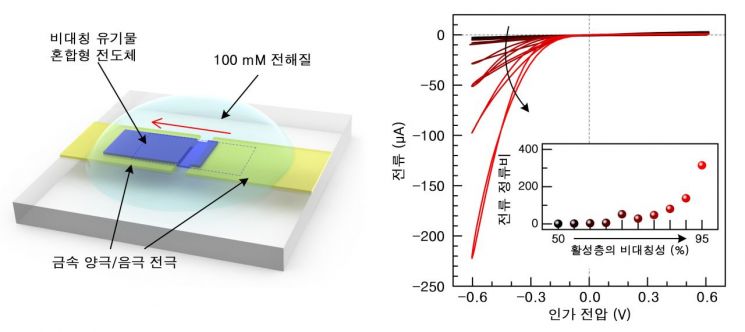 (Left) Schematic diagram of the device proposed by the research team led by Professor Yoon Myung-han at GIST and (Right) Current rectification characteristic graph through asymmetric active layer formation.
[Asia Economy Reporter Kim Bong-su] A conductive polymer-based electrochemical diode device with a new driving principle applicable to various bioelectronic devices and circuits has been developed through an international collaborative research. This aqueous electrolyte polymer diode device, which has the world's highest level of current density, is expected to contribute to the implementation of next-generation implantable devices and circuits.
The research team led by Professor Yoon Myung-han of the Department of New Materials Engineering at Gwangju Institute of Science and Technology (GIST) announced on the 11th that, through joint research with Professor Martin Heeney's team at Imperial College London (ICL), who is also a visiting professor at GIST's Department of New Materials Engineering, they introduced a new rectifying device using an organic mixed conductor.
An organic mixed ionic-electronic conductor (OMIEC) is not a simple electrical conductor like metal but possesses both ionic conductivity and electrical conductivity within an electrolyte. It is used as a semiconductor material for devices that amplify bioelectrical signals in electrolyte environments and for flexible electronic devices. Typical organic-based diodes can be implemented through junctions of p-type and n-type organic semiconductors or metal-organic semiconductor junctions. However, these require precise energy level control and have drawbacks such as low driving stability and low current characteristics. In other words, although higher electrical properties due to higher charge density could be realized compared to conventional organic semiconductor materials, the rectifying function could not be implemented with existing junction-type diode structures due to the nature of operation within electrolytes.
The research team developed a new current rectifying device that utilizes concentrated and dispersed doping and dedoping phenomena in an asymmetrically patterned active layer, which can be implemented with simple patterning, rather than relying on the current rectification driving principle based on energy level bending in conventional junction-type diodes. They also confirmed the feasibility of this approach through computer numerical analysis. Using a real-time optical potential mapping technique during device operation, they experimentally measured the potential distribution within the active layer and compared it with numerical analysis results to elucidate the driving mechanism. Ultimately, the organic electrochemical diode based on the organic mixed ionic-electronic conductor successfully achieved a device with a high current density of approximately 30,000 A/cm² within a low voltage range of about 0.6 volts.
Professor Yoon explained, "This technology can be used in various application devices and circuits that cannot be driven solely by organic electrochemical transistors, and it is expected to significantly contribute to the realization of next-generation implantable bioelectronic devices."
The research results were published online on the 10th in the international academic journal Advanced Materials.
© The Asia Business Daily(www.asiae.co.kr). All rights reserved.
![User Who Sold Erroneously Deposited Bitcoins to Repay Debt and Fund Entertainment... What Did the Supreme Court Decide in 2021? [Legal Issue Check]](https://cwcontent.asiae.co.kr/asiaresize/183/2026020910431234020_1770601391.png)















