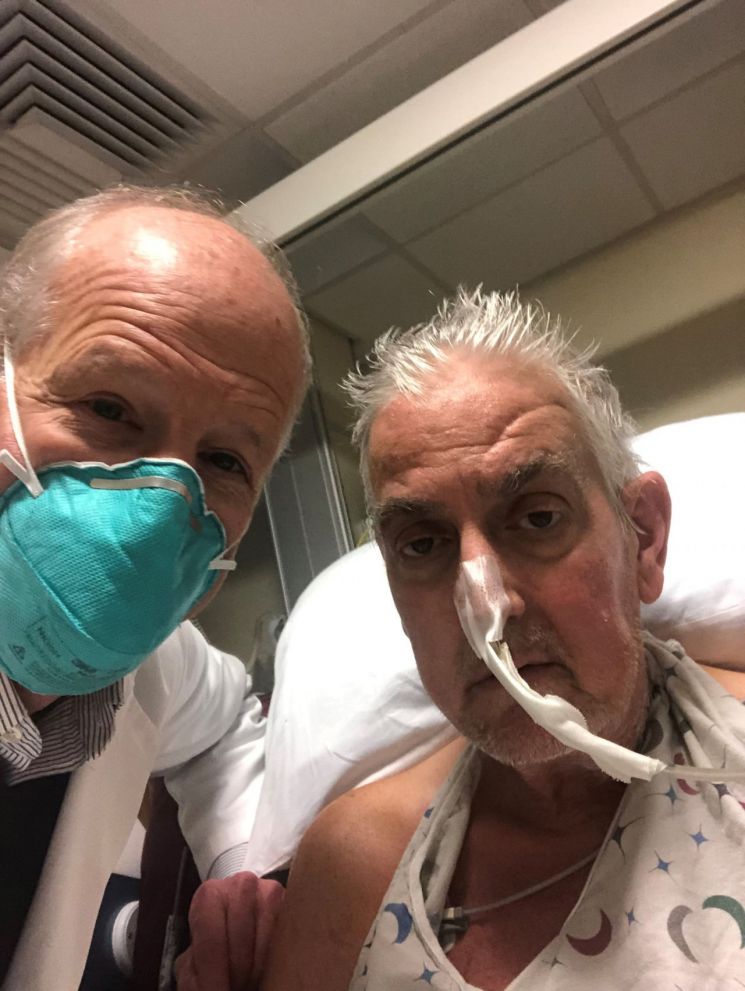
 ▲ David Bennett (right), who received a pig heart transplant, continues to recover on the third day after surgery. [Source=University of Maryland School of Medicine] [Image source=EPA Yonhap News]
[Asia Economy Reporter Kwon Jae-hee] For the first time in the medical field in the United States, a pig's heart was transplanted into a human body. Typically, when animal organs are transplanted into humans, immediate rejection occurs, but in this case, the patient is recovering on the third day after the pig heart transplant, showing a high possibility of success and raising expectations.
According to the Associated Press on the 10th (local time), the University of Maryland Hospital performed the surgery on the 7th with the consent of David Bennett (57), a terminal patient with no other options due to the inability to receive a human organ transplant.
The main issue with animal organ transplants is immediate rejection, but this time, a genetically modified pig heart was used, from which the intracellular sugars that cause such rejection were removed.
Before the surgery, Bennett said, "It's either die or receive a pig heart transplant," adding, "I know this is a chance with no guarantee of success, but it's my last option."
The AP reported, "It is too early to judge whether this surgery will be successful, but it marks a meaningful step in the decades-long journey to use animal organs to save lives someday."
The University of Maryland Hospital also praised the surgery, stating that it demonstrated that a genetically modified animal heart can function in the human body without immediate rejection.
Due to the severe shortage of donated human organs compared to the number of patients waiting for transplants, research into transplanting animal organs as an alternative is ongoing. According to the United Network for Organ Sharing (UNOS), which oversees the U.S. transplant system, more than 3,800 patients were on the waiting list for heart transplants last year in the United States.
Mohammad Mohiuddin, head of the Maryland University Animal-to-Human Transplant Program, said, "If this surgery proves successful, we will be able to supply animal organs to patients in pain."
The U.S. Food and Drug Administration (FDA), which supervises such transplant surgeries, allows animal organ transplants on a limited basis only when the patient's life is in critical danger and no other options are available.
David Klassen, Chief Medical Officer of UNOS, described the University of Maryland Hospital's transplant surgery as "a watershed moment for animal organ transplantation into the human body," adding, "However, it is only the first step in xenotransplantation."
There have been previous attempts to transplant animal organs into humans, but all ended in failure. In 1984, a baboon heart was transplanted into an infant, who survived for 21 days before ultimately passing away.
© The Asia Business Daily(www.asiae.co.kr). All rights reserved.
![User Who Sold Erroneously Deposited Bitcoins to Repay Debt and Fund Entertainment... What Did the Supreme Court Decide in 2021? [Legal Issue Check]](https://cwcontent.asiae.co.kr/asiaresize/183/2026020910431234020_1770601391.png)















