[Seoul District News] In November last year, Wangsimni 2-dong residents identified and reported welfare blind spots among neighbors in need, providing emergency living expenses, meal delivery, hospital accompaniment services, and more to overcome welfare crises... Songpa-gu Garakbon-dong and Songpa-gu Chamber of Commerce join hands to support vulnerable households... 'Yangcheon-style Care SOS Service' launched... Yeongdeungpo-gu Yeongwon Market shows kindness to neighbors in need over the past year... Gangbuk-gu transforms abandoned houses into 'Living Parks'
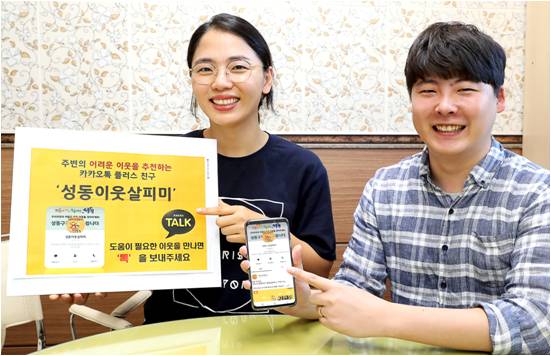
[Asia Economy Reporter Park Jong-il] Seongdong-gu (Mayor Jung Won-oh) has paid a reward for the first time to a resident who reported a household in crisis within the district after implementing the 'Crisis Household Reporting Reward' system.
The recipient of the reward was Mr. S (64), a resident of Wangsimni 2-dong, who reported a person in difficult living conditions to the local community service center and received a reward of 50,000 KRW at the Wangsimni 2-dong Community Service Center on the 7th.
In November last year, Mr. S became aware of the difficulties faced by resident Mr. A (61) living nearby and requested help from the community service center. The officer immediately conducted a home visit to assess Mr. A's situation.
Mr. A had lost teeth and lacked a kitchen in his residence, relying on cup noodles for meals, raising concerns about nutritional deficiency. Economic difficulties had also led to unpaid utility bills. The district office applied for national basic livelihood security benefits on his behalf and immediately designated him as an emergency welfare recipient to provide living expenses support.
Since it takes some time to be selected as a national basic livelihood security recipient, the district office and Wangsimni 2-dong Community Service Center worked together to ensure tailored service support for the individual.
Mr. A was enrolled in the 'Let's Check In Together' service, where the community officer regularly checks on residents if their mobile phones are unused for a certain period. Various items such as winter blankets and food supplies were provided. Through the 'Chakchak Seongdong' home repair visit service, his living environment was improved by replacing the bathroom showerhead, and daily lunchboxes were provided through the Care SOS meal service.
Following a health check by a visiting nurse from the community service center, Mr. A was advised to seek hospital treatment. Accompanied by the district integrated case manager, he visited the hospital and was diagnosed with hypertension and cervical disc issues, starting medication and health management. Last month, he was selected as a national basic livelihood security recipient and can now receive monthly living and medical support.
The crisis household reporting reward system grants a 50,000 KRW Onnuri gift certificate per report to those who discover and report households in welfare crisis situations requiring support. Reports can be made to the local community service center of the reported household or via the KakaoTalk channel 'Seongdong Neighbors Care'. The district established the reward payment regulation through the ordinance on discovering and supporting crisis households in Seongdong-gu, Seoul, enacted last September, encouraging active neighbor reporting and participation to identify welfare blind spots.
Jung Won-oh, Mayor of Seongdong-gu, said, "Please join the crisis household reporting to find residents in difficult living conditions through neighbor reports. We will do our best to provide warmer, tailored services to residents in welfare crisis situations through a safer and more thorough welfare administration network."
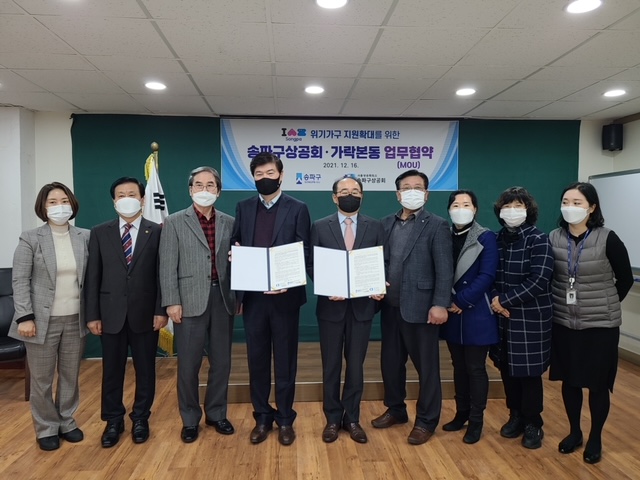
Songpa-gu (Mayor Park Seong-su) announced on the 11th that it will provide additional support funds beyond public assistance for low-income crisis households through a business agreement signed on December 16 last year with Garakbon-dong Community Service Center and Songpa-gu Chamber of Commerce, aiming for practical crisis overcoming.
According to the agreement, the two organizations will focus on substantial and realistic support for vulnerable groups over the next two years, rather than one-time aid. To this end, the Songpa-gu Chamber of Commerce first donated 2 million KRW as crisis household support funds to Garakbon-dong Community Service Center.
The support funds will be executed as additional support linked to the Dong Happiness Fence Solution Project starting this year. Garakbon-dong Community Service Center and Songpa-gu Chamber of Commerce will actively discover crisis households needing additional support through mutual cooperation and discussion and provide customized support according to the crisis situation.
The district expects that this agreement will contribute to promoting stable living for vulnerable groups by expanding various supports beyond public assistance.
Songpa-gu Chamber of Commerce Chairman Bong Yoo-jong, one of the agreement parties, said, "I am very pleased and proud to support vulnerable groups facing difficulties through this agreement. I will gladly participate and help whenever I can in the future."
Park Seong-su, Mayor of Songpa-gu, said, "Due to the difficult economic conditions caused by COVID-19, crisis households such as residents living in boarding houses are increasing, making additional support urgent. I express gratitude to the Songpa-gu Chamber of Commerce for practicing neighborly love, and we will build multifaceted mutual cooperation to create a Songpa-gu where all residents can live happily without exclusion."
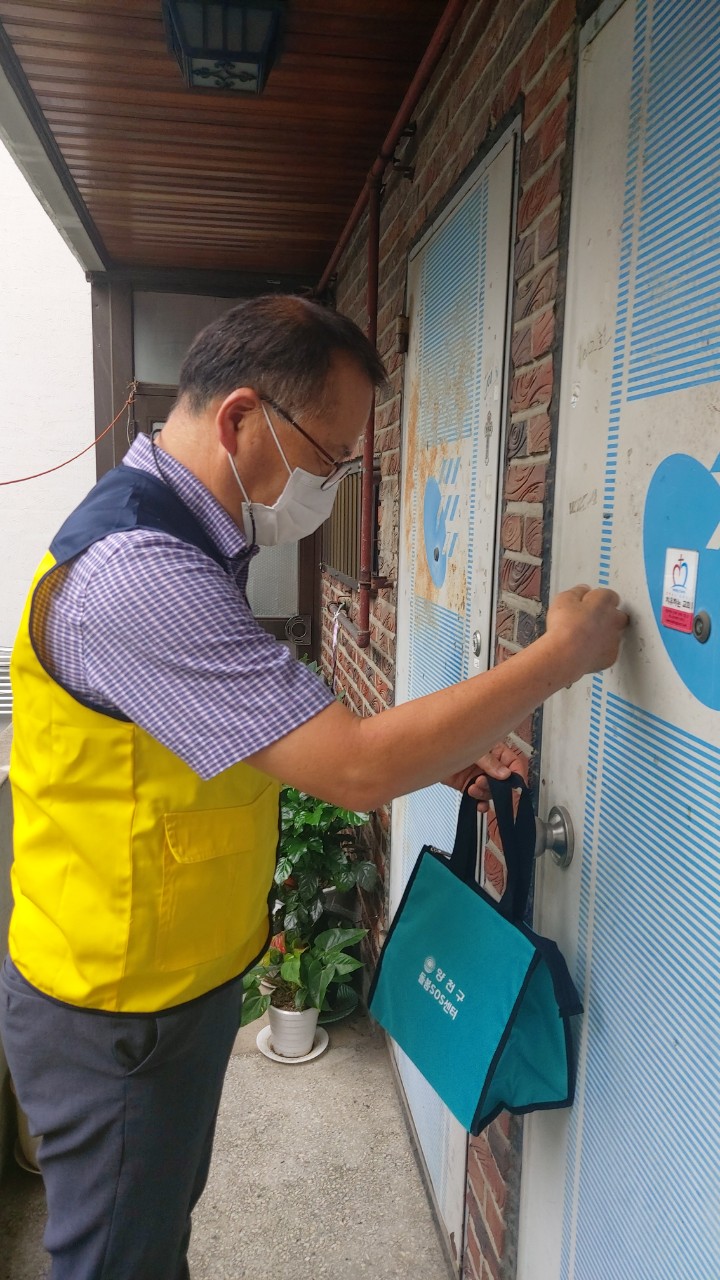
Yangcheon-gu (Mayor Kim Soo-young) will launch the 'Yangcheon-style Care SOS Service' in 2022 to prevent care blind spots caused by COVID-19 and improve overall resident welfare.
The newly enhanced Yangcheon-style Care SOS Service in 2022 includes the following. First, the laundry service, which was piloted since August last year, will enter full operation this year. An agreement was signed with the Yangcheon Regional Self-Sufficiency Center to provide a one-stop service that collects, washes, dries, and delivers large laundry items such as blankets that are difficult to wash at home for care service recipients. The annual material cost has also increased this year to make the laundry service more useful for residents in need.
Second, the annual individual limit for care service usage will increase by 20,000 KRW to 1.6 million KRW in the new year. Third, those with middle-income between 85% and 100% will receive full cost support temporarily until the highest crisis alert level is maintained.
Recipients of national basic livelihood security, near-poverty groups, and those with middle income at or below 85% (income standard for a single-person household is 1,654,000 KRW) will receive full cost support. Other residents can use the care service by paying the full cost themselves if needed.
The 'Care SOS Center' is a project that provides customized services matching care needs from the public sector to residents requiring urgent care. Since August last year, the service system has been improved to provide five major care services (▲temporary home care ▲short-term facility ▲accompaniment support ▲housing convenience ▲meal support) and five mid- to long-term care linkage services (▲check-in ▲health support ▲care system ▲case management ▲emergency support).
Eligibility includes Yangcheon-gu residents aged 65 or older, persons with disabilities, and middle-aged persons aged 50 or older. However, cost support and self-payment depend on income standards. Additionally, applicants must temporarily meet all three conditions at the time of application: ▲difficulty performing independent daily activities ▲no family to care for them ▲not currently using other public systems.
The application process is as follows: the applicant applies to the care manager at the local community service center, who conducts an on-site visit to identify difficulties and necessary support and establishes a customized care plan. Then, the plan is referred and linked to contracted institutions to promptly provide services to the applicant.
The Care SOS Center service will operate continuously in the new year despite the COVID-19 situation. For urgent care needs, residents can visit or call their local community service center. For more details about the Care SOS Center services, contact the Welfare Policy Division.
Kim Soo-young, Mayor of Yangcheon-gu, said, "In 2022, we will actively discover residents needing urgent care through the solid operation of the Care SOS Center and services and strive to provide timely necessary support."
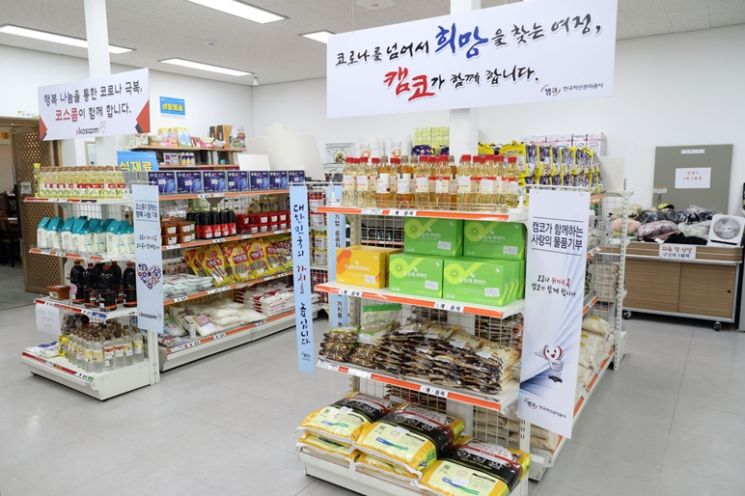
Yeongdeungpo-gu (Mayor Chae Hyun-il) Yeongwon Market, where residents facing economic difficulties can freely take goods worth about 30,000 KRW, has marked its first anniversary and is playing a strong support role for vulnerable households.
Unlike food banks targeting emergency support, basic livelihood security dropouts, and near-poverty groups, Yeongwon Market is a free daily necessities store that anyone in the district facing livelihood threats can use freely.
Since its opening on January 18 last year, it has provided free food items such as rice and ramen, and daily necessities like toilet paper and shampoo within a certain amount, continuously attracting vulnerable households in need.
The district reported that over the past year, about 3,900 people visited Yeongwon Market and received goods approximately 6,200 times, with about 2,300 residents visiting the market more than twice.
According to the market's operating guidelines, visitors who come more than twice are linked to welfare counseling at the local community service center to help ensure appropriate welfare benefits according to their situation.
As of January 10, a total of 1,177 welfare counseling sessions have been conducted for Yeongwon Market users, with 55 people applying for public welfare services and 259 receiving other services such as additional goods support or job counseling.
Additionally, to ensure no residents suffer from extreme weather, a large stock of cooling and heating devices, electric blankets, hot packs, and seasonal clothing is maintained. Hygiene products such as masks and hand sanitizers for COVID-19 prevention, as well as food, clothing, and fashion accessories, are provided without shortage.
Going forward, the district plans to expand the existing four support item categories to five, promoting Yeongwon Market usage and diversifying support goods to attract more vulnerable households.
Yeongwon Market is located at ▲80 Seonyu-dong 1-ro (Dangsan 1-dong, 1st branch) ▲9-17 Dosin-ro 54-gil (Singil 1-dong, 2nd branch) ▲7 Singil-ro 8-gil (Singil 6-dong, 3rd branch), and anyone facing economic difficulties can take goods worth about 30,000 KRW free of charge.
For inquiries about using Yeongwon Market or for those wishing to donate goods or sponsor, contact the Yeongdeungpo-gu Social Welfare Council.
Chae Hyun-il, Mayor of Yeongdeungpo-gu, said, "I sincerely thank everyone who has supported and promoted Yeongwon Market over the past year. I hope Yeongwon Market will continue to be a strong support that delivers warmth and hope to neighbors struggling with livelihood difficulties."
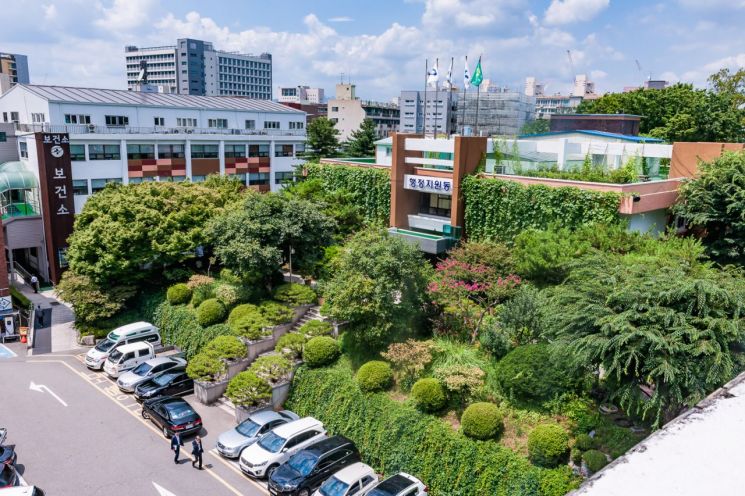
Gwangjin-gu (Mayor Kim Seon-gap) will support three special care services to address care blind spots.
These services, launched for the first time this year, aim to assist households experiencing care gaps due to sudden illness or accidents and are provided to ▲young carer families ▲single-person households discharged from hospital ▲hospitalized children.
First, the 'Young Carer Family Care Support' service is for young family members aged 39 or younger who are solely caring for patients with severe illnesses. This service was established to alleviate the burden on so-called 'Young Carers,' a recent social issue, by providing regular services such as dispatching care workers and meal support to young carers facing difficulties in studies and social activities due to family caregiving. Support is provided to households with income within 130% of the median income.
Next, the 'Short-term Care for Single-person Discharged Households' service supports single-person households residing in Gwangjin-gu who are discharged after surgery, severe illness, or fracture treatment. They receive home services such as housekeeping, meal support, and visiting nursing for up to three months. If the household income is within 130% of the median income, the service fee is fully supported; if between 130% and 150%, 50% is supported. This service is expected to be a great help to single-person households living apart from family.
Lastly, the 'Hospitalized Child Care Support' service, the first of its kind among Seoul's autonomous districts, is provided to children aged 12 or younger hospitalized in hospitals. Dispatched child care specialists guide hospitalized children in meals and medication and provide play support, offering child-tailored care and emotional support. Households with income within 150% of the median income receive full support for service fees, while others pay out-of-pocket. Applications for this service will be accepted starting March.
All three special care services can be applied for by phone or visit to the Care SOS Center at the local community service center. Selected households will have a care manager visit to establish a customized care plan, and specialized institutions will provide the services accordingly. For details, contact the local community service center.
Kim Seon-gap, Mayor of Gwangjin-gu, said, "Family care is a problem that society as a whole must actively address, not just individuals. I hope the three special care services launched this year will greatly help our residents with family care, and we will continue efforts to eliminate care blind spots."
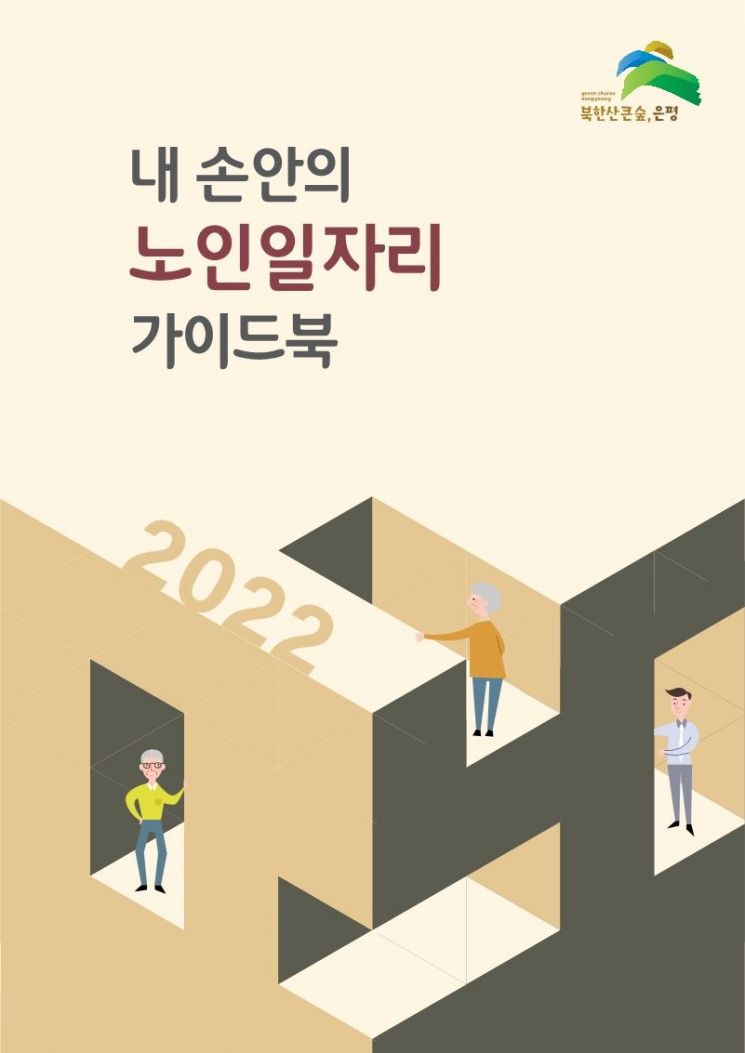
Eunpyeong-gu (Mayor Kim Mi-kyung) announced that it has published the 'Elderly Job Guidebook in My Hands,' containing various information such as elderly job guidance and interview skills for seniors seeking employment this year.
The district proactively responded to the increasing demand for senior jobs by producing and distributing the guidebook through the Eunpyeong Job Support Center.
The guidebook is designed to make it easy to understand various elderly job opportunities operating in the region at a glance. It is expected to help provide diverse social participation opportunities for seniors.
The guidebook contains 58 pages with six themes, including ▲Eunpyeong-gu elderly job guidance and application ▲job map at a glance ▲government-supported jobs ▲reemployment guide ▲job information sites, providing highly useful information related to senior jobs.
Kim Mi-kyung, Mayor of Eunpyeong-gu, said, "The 'Elderly Job Guidebook in My Hands' will be a useful guide for seniors in Eunpyeong-gu who are motivated to work. We will actively promote various activities to create a better working environment for seniors."
Seongbuk-gu (Mayor Lee Seung-ro)'s Love Thermometer is rising day by day thanks to residents' donations.
Especially, the Jangwi 3-dong Community Leaders Association (Chairman Park Jeong-hee) led the donations by delivering 500,000 KRW on the 4th to help neighbors have a warm winter.
The Jangwi 3-dong Community Leaders Association discovers neighbors in welfare blind spots and resolves residents' inconveniences. It also serves as a communication channel between the community service center and residents, steadily donating small amounts annually to help neighbors in need.
Chairman Park Jeong-hee said, "While volunteering as a local volunteer, I felt continuous interest and help are needed for those in difficulty. Although a small amount, I hope it helps neighbors in need, and I want to continue volunteering for our community."
The donated funds will be entrusted to the Community Chest of Korea to be used for helping neighbors in need.
A district official said, "Despite the difficult situation due to COVID-19 social distancing, we thank donors for their continuous donations every year. We will ensure the funds are properly delivered to help neighbors in need," and presented a certificate of appreciation.
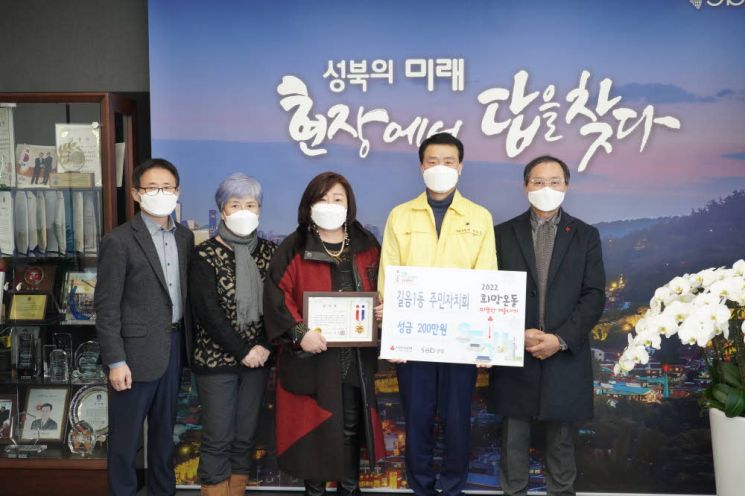
Two days later, on the 6th, the Gireum 1-dong Residents' Autonomy Committee (Chairman Lee Young-ri) delivered 2 million KRW to the Gireum 1-dong Community Service Center to help vulnerable groups. Besides the donation, they also contributed sponsorship funds and spring kimchi for kimchi-making.
Moreover, the 2022 Warm Winter Donation Campaign continues in Gireum 1-dong. Many organizations such as local churches and apartment residents' representative meetings have donated money and goods (white rice, ramen, kimchi, etc.), and local students have donated white rice with warm letters asking to deliver it to neighbors struggling due to COVID-19.
Lee Seung-ro, Mayor of Seongbuk-gu, said, "I express deep respect and gratitude to donors and sponsors practicing warm and devoted sharing. We will use the donated funds appropriately to help neighbors in need."
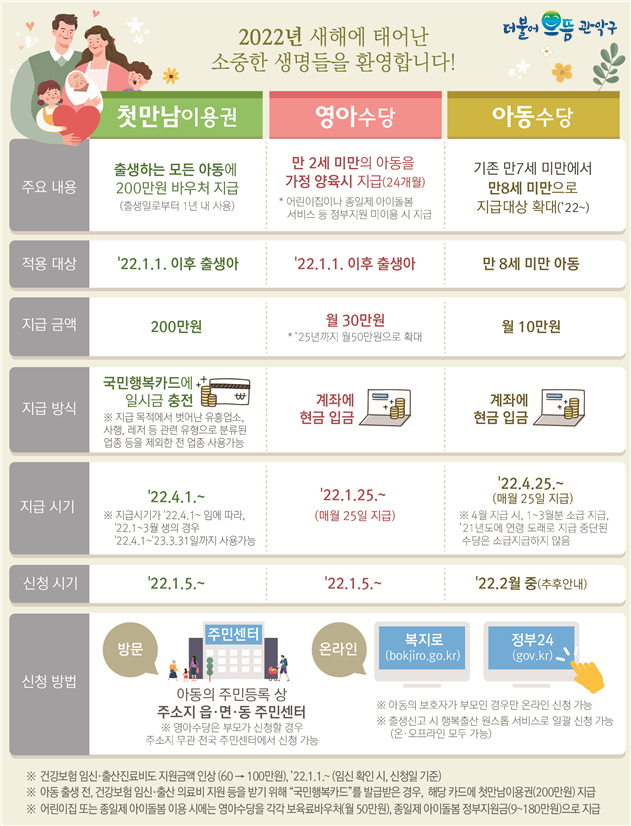
Gwanak-gu (Mayor Park Jun-hee) will significantly introduce and expand infant-related support funds such as the First Meeting Voucher and infant/child allowances for all newborns starting in 2022.
In response to the serious social problem caused by low birth rates, the district announced that it will actively respond by introducing and expanding child-related support funds to reduce the economic burden of early child-rearing and strengthen national and social responsibility.
First, the First Meeting Voucher is a system that provides 2 million KRW per newborn, regardless of birth order within the family, as points on the National Happiness Card to all newborns who have received a resident registration number after birth registration, to alleviate the economic burden on families with newborns.
Applications can be made by visiting the local community service center or online via the Bokjiro or Government24 websites. The usage period is one year from the child's birth date, and it can be widely used in most industries except gambling, leisure, and entertainment businesses, including online. Unused points automatically expire after the usage period.
The infant allowance is a support fund for children under two years old raised at home, providing 300,000 KRW monthly from January 2022 births, with plans to expand to 500,000 KRW by 2025.
The child allowance, previously paid 100,000 KRW monthly up to age seven, will be expanded to age eight this year, benefiting about 2,000 additional children in the district.
All applications can be made simultaneously with birth registration through the 'Happy Birth One-Stop Service.' The First Meeting Voucher and child allowance will be implemented from April due to system upgrades, with retroactive payments for applications from January to March made in April.
A district official said, "We expect that the First Meeting Voucher, infant allowance introduction, and child allowance expansion will reduce the economic burden on families with newborns. We will continue to actively promote various childbirth policies to create a Gwanak-gu where it is good to give birth and raise children."
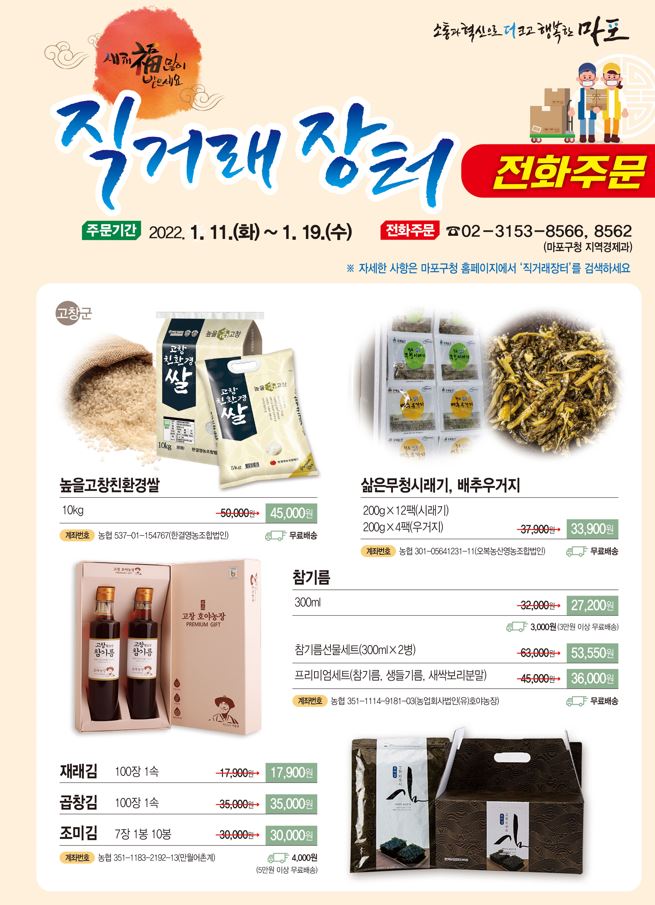
Mapo-gu (Mayor Yoo Dong-gyun) announced that it will operate an online direct transaction market from the 11th to the 19th ahead of the biggest traditional holiday, Seollal (Lunar New Year).
By eliminating intermediate distribution stages, the market offers residents high-quality local specialties at prices lower than the market and helps farmers struggling to secure sales channels due to COVID-19.
The district has held direct transaction markets at the Mapo-gu Office plaza with sister cities and excellent farms during Seollal and Chuseok holidays annually. However, since the spread of COVID-19, the market has been conducted non-face-to-face since 2020 to ensure residents' safety.
This Seollal direct transaction market includes participation from 18 local governments, including sister cities such as Gochang-gun in Jeollabuk-do, Yecheon-gun in Gyeongsangbuk-do, Sinan-gun in Jeollanam-do, and Namhae-gun in Gyeongsangnam-do.
Products for sale include about 40 local specialties and agricultural products such as eco-friendly rice, Korean beef, apples, dried persimmons, and wild vegetables, sold at prices 10% to 40% cheaper than market prices.
Residents wishing to purchase can check detailed information such as product list, prices, and account numbers through the Mapo-gu Office website or promotional materials at 16 community service centers, then place orders by phone with the Mapo-gu Office Regional Economy Division.
After receiving payment via bank transfer, the producing farms will confirm and sequentially ship the goods to buyers' homes.
Yoo Dong-gyun, Mayor of Mapo-gu, said, "I ask for many residents' participation in the online direct transaction market, which helps farms struggling due to COVID-19 resurgence and allows purchasing high-quality local specialties at affordable prices."
◆Mapo-gu Personnel
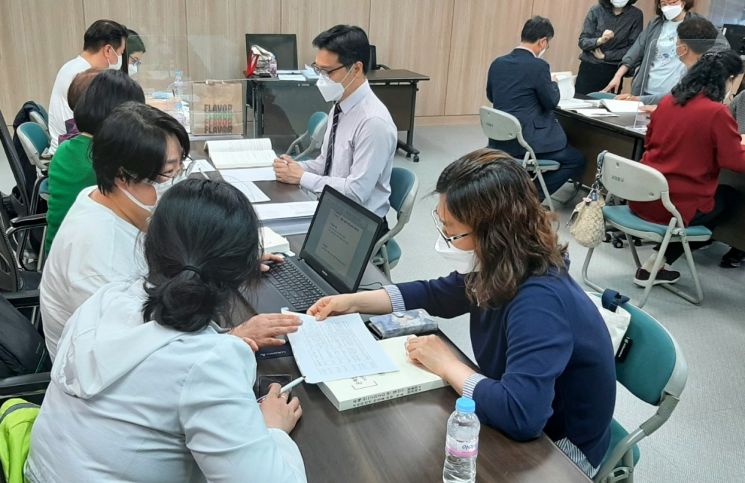
Seodaemun-gu (Mayor Moon Seok-jin) is recruiting support members to consult residents on 'participatory budget project proposal writing' until the 28th of this month.
Eligibility criteria include ▲at least 3 years of experience as a Seodaemun-gu Resident Participatory Budget Committee member ▲at least 2 years as a Seoul Citizen Participatory Budget Committee member ▲at least 1 year of full-time experience in participatory budgeting or budget fields at other organizations, institutions, or companies.
Anyone meeting at least one of these criteria can apply.
The district will select up to 10 members through document and interview screening next month and appoint them as Seodaemun-gu Participatory Budget Support Members after training.
Since last year, the district has operated a participatory budget support group. Members help residents write participatory budget project proposals more effectively to improve completeness and project adoption rates.
The support group activities will run from March to August this year, and members will receive a fixed allowance during consulting.
For detailed information on recruitment, refer to the 'Notices' section on the Seodaemun-gu website or contact the Participatory Budget Team at the Seodaemun-gu Office Public-Private Cooperation Division.
Mayor Moon Seok-jin said, "Seodaemun local government was selected as an 'Excellent Local Government' in the Ministry of the Interior and Safety's participatory budget evaluation last year. We are striving to activate related systems and expand fiscal democracy. We expect the support group activities to further promote residents' interest and participation in the participatory budget system."
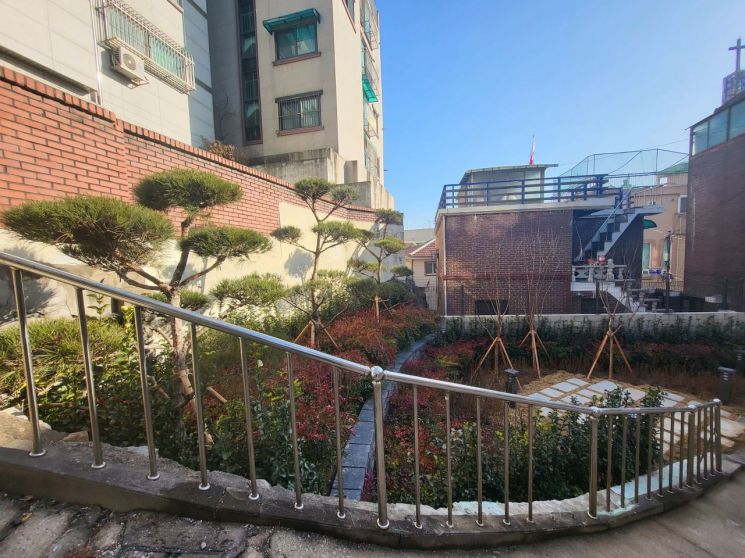
Gangbuk-gu (Mayor Park Gyeom-su) has created a living garden for local residents by utilizing abandoned unauthorized buildings and nearby land.
Since June last year, Gangbuk-gu demolished vacant houses on two plots at 791-1388 and 791-4333 Mia-dong and created a living garden on the site in December last year. The two plots are owned by Seoul Housing and Communities Corporation (SH), and the project was carried out through an agreement among Gangbuk-gu, Seoul City, and SH Corporation on land and vacant house use.
The living garden covers 82 square meters and includes landscape blocks, seating walls, stepping stones, and access paths, providing a resting place for local residents. Various trees and flowers such as sculptural pine, evergreen shrubs, Korean boxwood, and hydrangea were planted to improve urban aesthetics.
Abandoned vacant houses not only spoil the local scenery but also serve as spaces for youth delinquency and attract homeless people in winter, raising concerns about fire and safety accidents, causing headaches for residents. Gangbuk-gu transformed these vacant houses into living gardens for residents to rest, solving local problems.
Park Gyeom-su, Mayor of Gangbuk-gu, said, "We will secure more gardens in the region to create green spaces where residents can rest. We will strive to improve the residential environment and make Gangbuk-gu a better place to live."
© The Asia Business Daily(www.asiae.co.kr). All rights reserved.
![User Who Sold Erroneously Deposited Bitcoins to Repay Debt and Fund Entertainment... What Did the Supreme Court Decide in 2021? [Legal Issue Check]](https://cwcontent.asiae.co.kr/asiaresize/183/2026020910431234020_1770601391.png)

















