Increase Rate of First Dose Vaccination from 7th to 10th: 0.6%p
Half the Increase Rate Compared to a Week Ago (1.1%p)
Second Dose Vaccination Rate Increase Higher Than First Dose
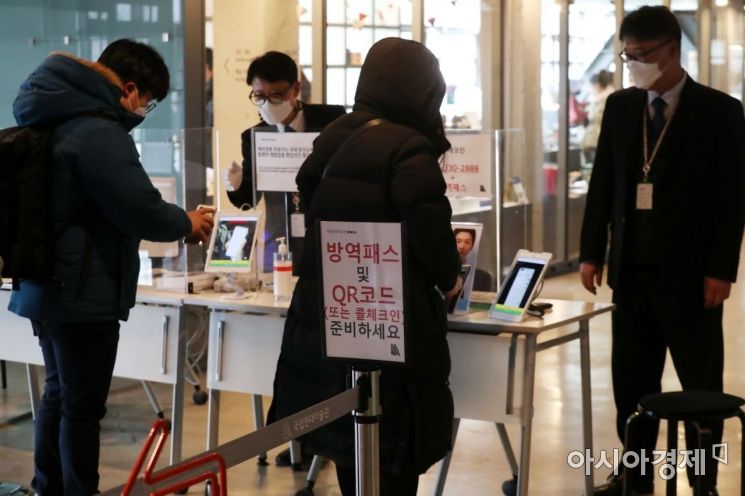 On the first day the quarantine pass validity period applies, the 3rd, citizens are checking the validity status of their quarantine passes at the National Museum of Modern and Contemporary Art in Jongno-gu, Seoul. From today, once the validity period expires, it will be difficult to use multi-use facilities such as museums, karaoke rooms, and movie theaters. In this case, unless a negative PCR test certificate is submitted, a third vaccination must be received for the quarantine pass to be valid. Photo by Moon Honam munonam@
[Asia Economy Reporter Han Jinju] The increase in the first-dose vaccination rate among adolescents has slowed down following the court's decision to suspend the enforcement of the youth vaccine pass.
According to the Ministry of Education on the 10th, as of midnight on the 10th, the first-dose vaccination completion rate for adolescents aged 13 to 18 was 77.1%, an increase of 0.6 percentage points from 76.5% on Friday the 7th.
One week earlier, on December 31 and January 3, the rate increased by 1.1 percentage points from 74.0% to 75.1%, so the recent increase is at a lower level compared to that.
Since the court's decision to suspend the enforcement of the youth vaccine pass on January 4, the increase in vaccination rate has remained around 0.3 percentage points. On the 4th, the Seoul Administrative Court accepted the request for suspension. From the 5th to the 7th, the daily first-dose vaccination rate among adolescents increased by 0.3 percentage points each day.
Regarding the slowdown in the first-dose vaccination rate, a Ministry of Education official responded, "It is difficult to predict changes in the current situation."
However, the increase rate for the second dose is higher compared to the first dose. As of midnight on the 10th, the second-dose vaccination completion rate for adolescents aged 13 to 18 was 58.6%, up 3.1 percentage points from the 7th. From the 4th to the 7th, the daily increases were 0.6, 1.3, and 1.5 percentage points, respectively.
Regarding concerns that the Omicron variant wave may coincide with the new school semester, a Ministry of Education official said, "Normal school attendance requires a comprehensive consideration of vaccination rates, reinforcement of quarantine principles, support for quarantine supplies and personnel, and other various factors. We will monitor the situation and establish academic operation plans related to normal attendance."
Meanwhile, from January 6 to 9, the average daily number of confirmed COVID-19 cases among students nationwide in kindergartens, elementary, middle, and high schools was 340.5. The average daily student confirmed cases over the past four weeks were ▲ December 16?22: 959.3 ▲ December 23?29: 775.4 ▲ December 30?January 5: 544.0 ▲ January 6?9: 340.5.
© The Asia Business Daily(www.asiae.co.kr). All rights reserved.

















