Landlords Hesitant to Contract with LH Due to Vague Reluctance
Finding Listings Is Like Catching Stars... Also Difficult to Find Burdensome Semi-Jeonse
LH "Bearing Costs for Wallpaper and Flooring to Increase Contract Rate"
Landlords Hesitant to Contract with LH Due to Vague Reluctance
Finding Listings Is Like Catching Stars... Also Difficult to Find Burdensome Semi-Jeonse
LH "Bearing Costs for Wallpaper and Flooring to Increase Contract Rate"
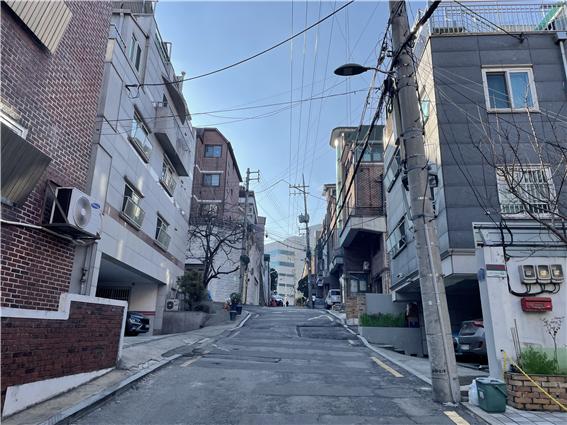 A panoramic view of the one-room apartment area in Sinchon-dong, Seodaemun-gu, Seoul. Despite being a densely populated one-room apartment area, there were no places available for contract under the Youth Jeonse Lease program by Korea Land and Housing Corporation (LH). Photo by Myeonghwan Lee, Junior Reporter lifehwan@
[Asia Economy Reporters Seoyul Hwang (Intern), Myunghwan Lee (Intern)] “There were almost no options. First, I had to give up on the room size, then the distance to the subway station, and finally the amenities.”
Ji-eun Lee (25), a job seeker who moved to Seoul from Changwon, Gyeongnam, recently visited a total of seven real estate agencies to sign a contract under the Korea Land and Housing Corporation (LH) Youth Jeonse Lease program, but five of them said there were no available properties. She was looking for a Jeonse (key money deposit) property to reduce monthly rent burden but ended up renting a 5-pyeong (approximately 16.5 square meters) half-Jeonse studio with a deposit of 120 million KRW and a monthly rent of about 400,000 KRW. She said, “Although I was selected for the Youth Jeonse Lease, the harder part was actually finding a house that met the conditions.”
It has been revealed that the LH Youth Jeonse Lease program, a housing policy for youth, is not being effectively utilized. Most landlords are reluctant to contract with LH due to concerns about asset exposure and the complicated procedures. It is understood that about half of the eligible applicants have not been able to find a suitable residence, raising the need for improvements to the system.
"No Houses Available" One in Two LH Youth Lease Applicants Fail to Find a Home
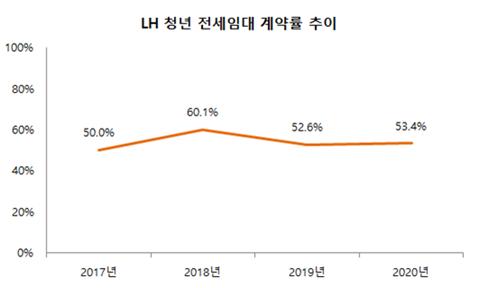
According to data obtained by Asia Economy on the 6th from the office of Assemblyman Chun Junho of the Democratic Party, the actual contract rate for Youth Jeonse Lease applicants was only 53.4% as of 2020. This is a 0.8 percentage point increase from 52.6% in the previous year but a 6.7 percentage point decrease compared to 60.1% in 2018. Although the maximum Jeonse deposit support in the metropolitan area increased from 80 million KRW to 120 million KRW since 2018, the contract rate has not improved.
This was also confirmed during on-site reporting. On the morning of the 4th, the reporter visited real estate agencies in Dongseon-dong, Seongbuk-gu, and Sinchon-dong, Seodaemun-gu, Seoul, to check the availability of properties eligible for contracts under the Youth Jeonse Lease program. The real estate agents unanimously said that there were almost no properties available for contract under the LH Youth Jeonse Lease program. These two areas are university-dense neighborhoods with a relatively high proportion of single-person households in Seoul.
The representative of real estate agency A in Sinchon-dong said, “There are not many Jeonse studio properties to begin with,” and firmly stated, “You won’t be able to find an LH (Youth) Jeonse here.” The only available property for Youth Jeonse Lease was a rooftop room in Dongseon-dong with a deposit of 100 million KRW and a monthly rent of 300,000 KRW, a half-Jeonse lease. For tenants, this means paying monthly rent in addition to the Jeonse deposit interest paid to LH, which inevitably increases the financial burden.
"Why deal with a public institution..." Landlords Reluctant to Contract
The reason the Youth Jeonse Lease program is not gaining traction in the field is that landlords are reluctant to enter into contracts, according to the real estate industry. Landlords feel burdened by the exposure of their asset information during LH’s rights analysis process to verify the property’s status. Real estate agent B in Dongseon-dong explained, “Landlords feel their assets are exposed during the LH document submission process,” and added, “Since there are no significant benefits, they have no reason to offer their properties for Youth Jeonse Lease.”
The contract process being more complicated than regular leases is also a hurdle. The Youth Jeonse Lease contract requires LH regional headquarters to conduct a rights analysis on the property selected by the tenant. According to the real estate industry, coordinating schedules with LH’s legal officers responsible for contract work usually takes 4 to 6 weeks to complete the contract. Although LH’s approval for the rights analysis takes about 10 days, the actual contract negotiation process takes a considerable amount of time afterward. Real estate agent Seok-i Seo (60) said, “From the landlord’s perspective, the property is effectively tied up during the rights analysis period, so they do not prefer it.”
Contracts sometimes fail due to defects in the property itself. Real estate agent Jisoo Jang (35) explained, “Contracts can be canceled if the property is not registered as a residential building in the building register or if there are loans or prior-ranking deposits.” During the on-site reporting, some agents even advised, “Check with LH first to see if the property meets the criteria” when providing property information.
Experts: "Increase Benefits for Landlords"
LH explained, “Due to landlords’ preference for monthly rent and the sharp rise in Jeonse prices, it is difficult to find Youth Jeonse Lease properties,” and added, “We are providing benefits such as fire insurance subscription and support for wallpaper and flooring costs to encourage landlords to sign Jeonse contracts.” They also said, “To reduce landlords’ concerns about asset exposure, we simplified the prior-ranking tenant deposit confirmation form into a property confirmation explanation form starting this year.”
Experts agree that practical incentives are needed to encourage landlords to actively participate in the Youth Jeonse Lease program. Seinhyung Seo, president of the Korea Real Estate Society and professor of real estate at Gyeongin Women’s University, advised, “Landlords are reluctant to disclose asset information when signing LH Youth Jeonse Lease contracts,” and recommended, “Substantial benefits such as property tax reductions are necessary to attract landlords.”
☞ What is LH Youth Jeonse Lease? = LH signs a Jeonse contract with landlords and then subleases the property to youth at a low monthly rent to reduce housing cost burdens. After applying and being selected as a beneficiary, the youth must find a suitable property themselves. Then, LH conducts a rights analysis on the property to review the possibility of Jeonse before signing the lease contract. The maximum Jeonse deposit support is up to 120 million KRW in the metropolitan area, and tenants can live for up to six years through two contract renewals. Priority for support is determined based on the average monthly income and assets of the applicant or the applicant and their parents.
© The Asia Business Daily(www.asiae.co.kr). All rights reserved.













