Naver Implements One Device One Certificate Policy
Danggeun Market Blocks 'Certificate Trading Posts' with AI Filtering
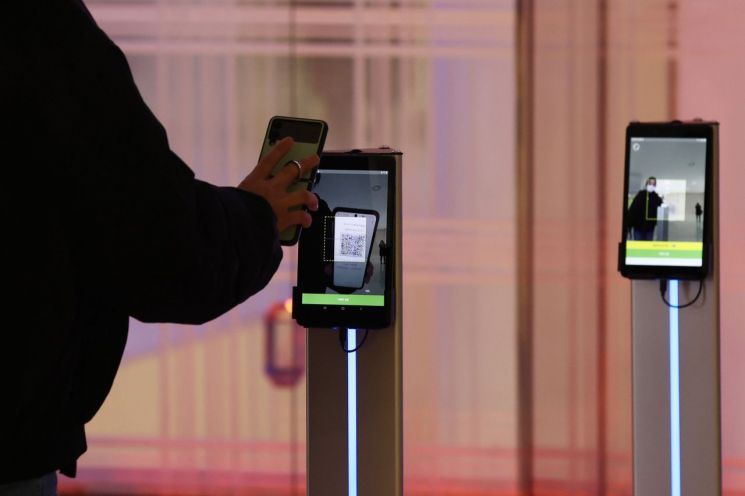 A COVID-19 vaccination QR verification device at the entrance of a large shopping mall in Seoul. / Photo by Yonhap News
[Asia Economy Reporter Kang Juhee] As attempts to bypass the QR code authentication of vaccination certificates have become frequent following the government's implementation of the 'Quarantine Pass (Vaccination Proof and Negative Test Confirmation System),' Naver and Danggeun Market have strengthened technical measures to prevent this.
Naver has enhanced its authentication process to block QR code authentication using someone else's ID, while Danggeun Market is using artificial intelligence (AI) filtering technology to prevent the sale of vaccine authentication IDs.
According to a News1 report on the 8th, Naver recently reinforced technical measures to prevent QR check-ins using stolen identities. This move came after concerns were raised that QR codes could be generated using accounts of others who had verified vaccination status following the government's quarantine pass implementation.
Originally, the Naver app allowed users who completed their COVID-19 vaccination to log in on other devices using their ID and use the QR check-in feature without additional authentication.
After cases of abuse emerged, Naver recently strengthened the authentication process. When logging in on a new device, vaccination information is not immediately issued; instead, identity verification through the Naver certificate is required. The certificate is issued only after procedures such as SMS verification or bank account confirmation, and certificates issued on previous devices cannot be used. By applying a one-device-one-certificate policy, it has become more difficult to easily generate vaccine authentication QR codes.
Danggeun Market, which faced controversy over posts trading vaccine vaccination IDs, has also introduced filtering technology using AI machine learning to counter QR code bypass authentication. When a post titled "Renting a Naver ID of a fully vaccinated person for 50,000 won" was uploaded on the 16th of last month, it was removed within one minute for violating operational policies.
With an environment where illegal trade posts are not easily exposed, attempts to trade vaccine vaccination IDs on Danggeun Market have reportedly decreased. Naver is also deleting posts related to vaccine vaccination ID trading through keyword monitoring and other measures.
The quarantine authorities are also responding to deceptive authentication through technical guidelines for QR check-in services. The Korea Disease Control and Prevention Agency (KDCA) Central Quarantine Countermeasures Headquarters improved the electronic entry log app system on the 31st of last month ahead of implementing the 'Quarantine Pass Validity Period System,' which ends the quarantine pass effect if a third vaccination is not received within six months (180 days) after the second vaccination.
The COOV app operated by KDCA, along with Naver, KakaoTalk, Toss, and the three major telecom PASS apps, now feature a flowing blue border around the QR code display. This prevents users from capturing the QR code screen and makes it easier to verify valid vaccination proof.
In the case of KakaoTalk, due to the nature of the service, logging in with someone else's account on another device is difficult. When logging in on a different device, the chat history on the previous device is reset, and vaccination proof is not linked. However, on iPhones, QR code capture is still possible.
The fact that vaccination certificates can be issued through multiple apps remains a loophole. The quarantine authorities stated that this is to consider user convenience, allowing QR check-in through other apps if one service experiences a malfunction.
The quarantine authorities also announced that they will continuously monitor forgery and tampering of the quarantine pass. They warned that anyone who steals vaccination certificates may face criminal penalties of up to 10 years imprisonment.
© The Asia Business Daily(www.asiae.co.kr). All rights reserved.
![User Who Sold Erroneously Deposited Bitcoins to Repay Debt and Fund Entertainment... What Did the Supreme Court Decide in 2021? [Legal Issue Check]](https://cwcontent.asiae.co.kr/asiaresize/183/2026020910431234020_1770601391.png)















