Damage to Corporate and Institutional Decision-Making Authority
Overlap with Financial Sector Stewardship Code
Expansion of Management Decision-Making Risk
Collapse of Tripartite Grand Bargaining Decision-Making System
Management's Opinions Ignored, Including Easing of Serious Accident Punishment Act
Time-Off System Guarantees Public Officials' Interests with Taxpayer Money
Next Political Target: Expansion of Labor Standards Act
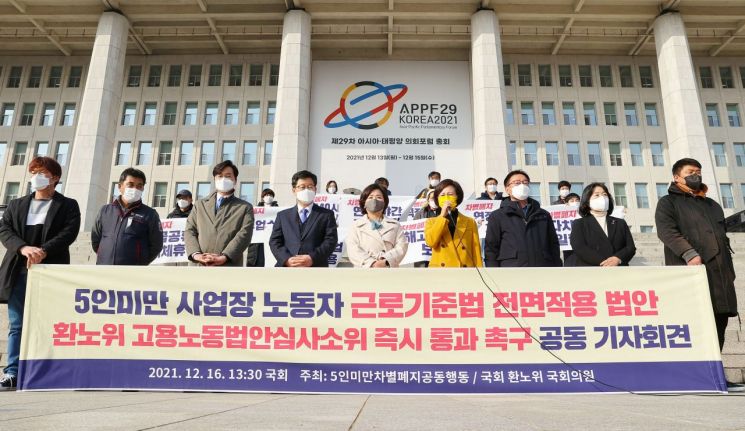 Politicians processed the labor director system for public institutions and the time-off system for public officials and teachers (paid work hour exemption for full-time union officials) in just one day. Their next goal is to expand the Labor Standards Act to workplaces with fewer than five employees. (Image source=Yonhap News)
[Sejong=Asia Economy Reporter Moon Chaeseok] The public institution labor director system and the time-off system for public officials and teachers (paid leave for full-time union officials) have passed the National Assembly. Looking at past legislative processes such as the implementation of the Serious Accident Punishment Act, the increase in the minimum wage, and the amendment of the Labor Union Act that expands the right to strike for non-working union members (unemployed, dismissed, etc.) since the Moon Jae-in administration, there is a flood of concerns from the business community that the spread to the private sector is only a matter of time. In the case of the time-off system, it is expected that public backlash will not be small as it is a system that allows full-time union activities to be conducted using taxpayers' money. From the results perspective, there are concerns that management risks will increase, as well as a bad precedent that the tripartite dialogue system did not function during the decision-making process.
The ruling and opposition parties handled the public institution labor director system and the time-off system for public officials and teachers on the 4th. In the case of the labor director system, Deputy Prime Minister and Minister of Economy and Finance Hong Nam-ki and Minister of Employment and Labor Ahn Kyung-duk stated that the introduction to the private sector should not be decided hastily and that sufficient social consensus is necessary, but many reactions find it hard to believe these words as they are.
From the corporate perspective, there were many concerns that external management participation such as activist funds would increase due to the stewardship code in the financial sector during the Moon Jae-in administration. On top of this, with the introduction of the labor director system guaranteeing workers' representatives' participation in management, there are concerns that the union side's authority over key personnel appointments and various decision-making powers will intensify during shareholder meeting seasons. It was also announced that as soon as the Act on the Management of Public Institutions passes on the 11th, about 130 public institutions will be able to implement the system. This could also affect the stock prices and investor sentiment of publicly listed public enterprises such as Korea Electric Power Corporation and Korea Gas Corporation. It is also uncertain how shareholders will react at the general meetings.
The time-off system is likely to face criticism as a waste of taxpayers' money. This is because the law guarantees even public officials to engage in full-time union activities. Not only the time-off system but also the abolition of the 'non-legal union notification' system for organizations like the Korean Teachers and Education Workers Union (Jeon-gyo-jo) last year, and the strengthening of strike rights for non-working union members due to the amendment of the Labor Union Act cannot be excluded. In the worst case, various strike activities or boycotts that hinder management activities using public funds could pour in. This poses a significant risk to corporate and public institution management.
As these major decisions rapidly spread skewed toward the political and labor sides, the opinions of the industrial sector, which is a negotiation partner, are being thoroughly ignored, raising concerns. The business community's demand to ease the Serious Accident Punishment Act among labor issues is not progressing at all. Rather, Minister Ahn firmly stated at a press conference on the 6th that "there will be no additional supplementary measures" regarding the Serious Accident Punishment Act. There is also strong internal and external pressure to promptly extend the Labor Standards Act to workplaces with fewer than five employees. In this process, there are even criticisms that the tripartite grand compromise and decision-making system at social dialogue bodies such as the Presidential Commission on Economic, Social and Labor Affairs are not functioning at all.
© The Asia Business Daily(www.asiae.co.kr). All rights reserved.
![User Who Sold Erroneously Deposited Bitcoins to Repay Debt and Fund Entertainment... What Did the Supreme Court Decide in 2021? [Legal Issue Check]](https://cwcontent.asiae.co.kr/asiaresize/183/2026020910431234020_1770601391.png)















