Joint Research by Professors Yoon Myung-han (GIST) and Kim Beom-jun (KAIST)
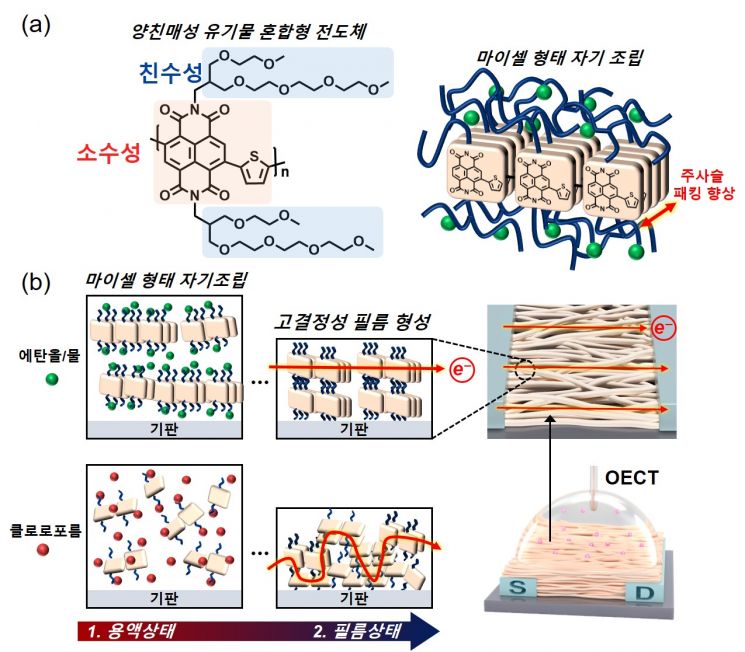 Figure (a). Schematic diagram of the molecule proposed in this study
 Figure (b). Schematic diagram of the micelle-type self-assembly process of the polymer through solvent change and the structure of the formed film
[Asia Economy Reporter Kim Bong-su] As BCI technology connecting the human brain and computers is actively being researched, an eco-friendly, high-performance implantable electronic device has been developed.
The research team led by Professor Yoon Myung-han of the Department of New Materials Engineering at Gwangju Institute of Science and Technology (GIST) announced on the 7th that, in collaboration with Professor Kim Beom-jun's team from the Department of Bio and Chemical Engineering at KAIST, they developed a high-performance n-type organic mixed ionic-electronic conductor (OMIEC) compatible with eco-friendly aqueous solvent processes and elucidated the effects of aqueous solvents on polymer microstructure and electrical and electrochemical performance.
Organic mixed ionic-electronic conductors are not simple electrical conductors like metals but possess both ionic conductivity and electrical conductivity within electrolytes. They are used as semiconductor materials for devices that amplify bioelectrical signals in electrolyte environments and for flexible electronic devices. Electrochemical transistors made based on OMIEC can amplify signals and switch by ion injection within electrolytes. They are being intensively developed for next-generation bio-healthcare devices as they can detect various bioelectrical signals from the brain, heart, muscles, etc., through implantation or attachment inside or outside the body.
However, most existing electrochemical transistor devices are based on p-type organic semiconductors. Research on n-type organic semiconductors, which have charge mobility over a hundred times lower, is rare.
To address the low electron mobility issue of such n-type organic mixed ionic-electronic conductors, the research team developed an amphiphilic conductor material and fabricated electrochemical transistor devices. By applying a large amount of oligo ethylene glycol (OEG) side chains to the polymer monomer side groups, they dissolved the material in an aqueous solvent composed of ethanol and water. They then compared and analyzed the electrical and electrochemical properties with the same material dissolved in chloroform, a halogenated organic solvent commonly used in existing solution processes.
In the ethanol-water solvent, the hydrophilic oligo ethylene glycol side chains dissolve, but the hydrophobic main chains do not, resulting in the material existing as aggregated micelles in solution. In contrast, when chloroform is used, both side chains and main chains dissolve well. The main chains in micelle form minimize interaction with ethanol-water molecules, inducing strong pi-pi stacking between main chains in solution, and high crystallinity was observed in thin films tens of nanometers thick produced by solution coating processes. Furthermore, when applied to the active layer of accumulation mode electrochemical transistor devices, the electron mobility and electrochemical transistor performance evaluation indices increased more than threefold compared to devices fabricated using chloroform.
Professor Yoon said, "By simultaneously improving eco-friendliness and electron mobility characteristics of n-type electrochemical transistors, this is expected to greatly contribute to the realization of next-generation complex circuit-type bioelectronic devices," adding, "this research is significant in presenting an organic polymer synthesis strategy suitable for fabricating high-performance implantable electrochemical devices using eco-friendly processes."
This research result was published online on the 5th in the international journal Advanced Functional Materials.
© The Asia Business Daily(www.asiae.co.kr). All rights reserved.

















